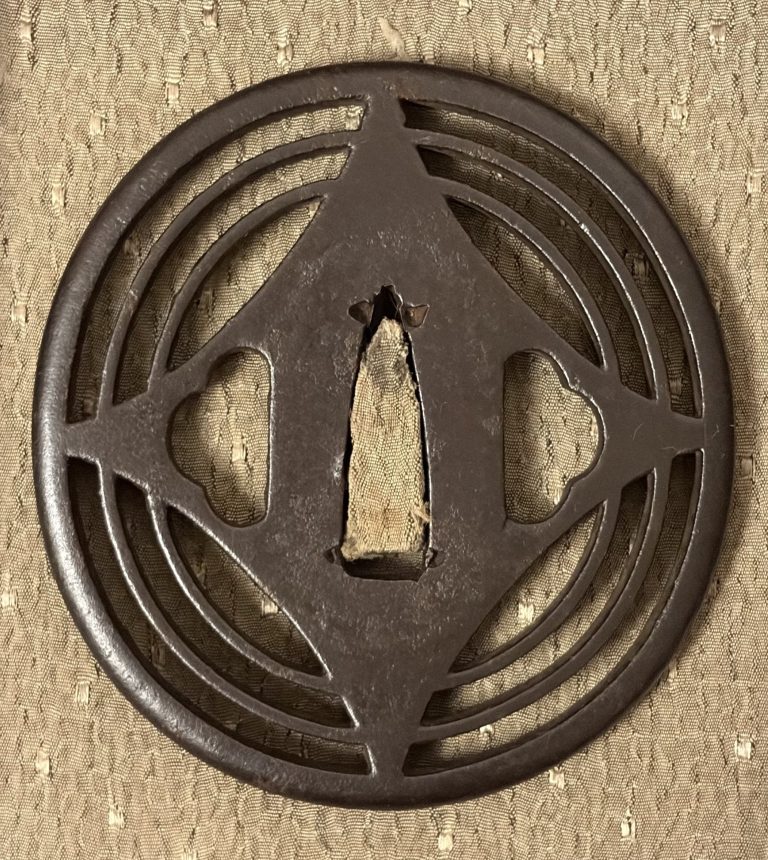
Vier Ringe
Interlocking Rings, Owari
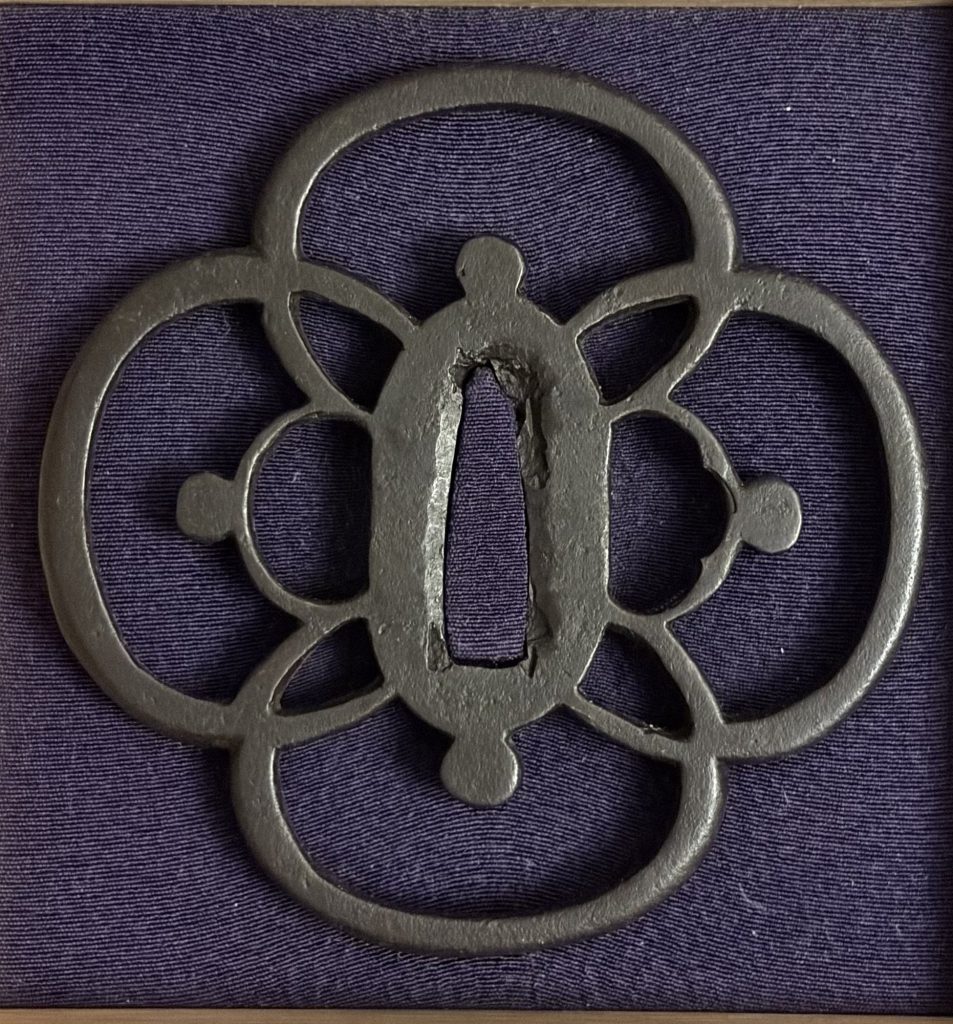
An Owari tsuba of iron, made of almost nothing but rings. Four of them overlap round the centre, each passing through its neighbours, and their outer curves make the four-lobed outline of the guard. In the middle an oval band frames the seppa-dai. Small round knobs sit at its four points, where it meets the rings.
The NBTHK names the design wachigai-sukashi, interlocking rings in openwork, and the shape mokko-gata. It describes the guard as iron, pierced from the ground, with a round rim, and attributes it to Owari in the Edo period.
The Ashmolean Museum describes Owari openwork as close to Heianjo work, but thicker and less fine. Here the rings are broad and plain, and the iron does the work alone.
The guard lies in a wooden box. Inside the lid an inscription in brush names it as an openwork iron tsuba in mokko-gata, mumei, Owari, and dates it to the summer of Showa 39, 1964. It is signed Kanzan, with two seals. Kanzan is the name of Satō Kan’ichi, 1907 to 1978 (National Diet Library), and the box carries his reading of the guard.
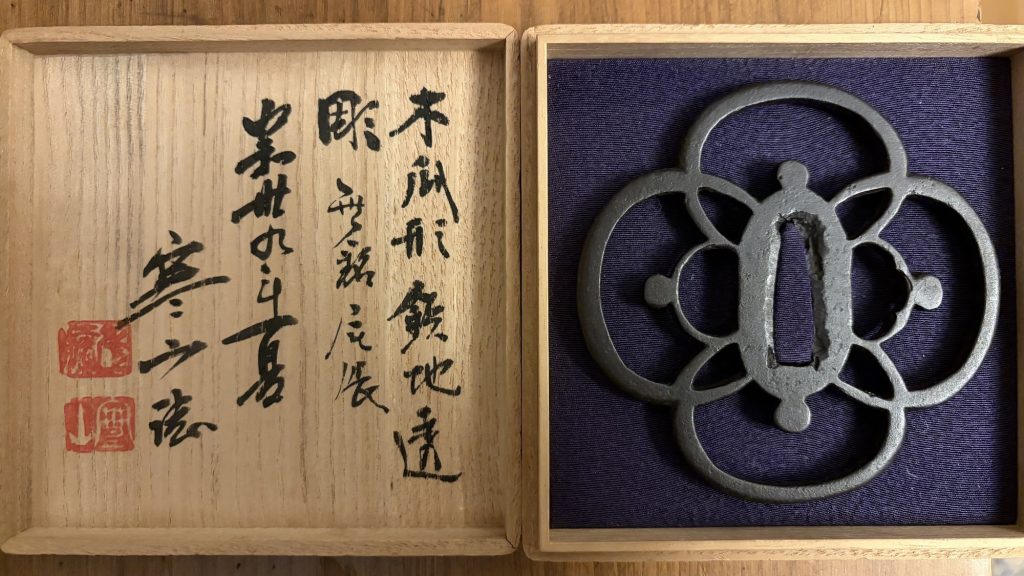
Tsuba. Mumei, Owari. Tetsu, ji-sukashi, maru-mimi. Mokko-gata. Wachigai-sukashi. Edo-Zeit. NBTHK Hozon. Hakogaki von Satō Kanzan. Privatsammlung, erworben in Japan.
In the collection
- Type
- Tosogu › Tsuba
- School
- Owari
- Period
- Edo-Zeit
- Material
- Tetsu
- Motif
- Mon und Muster