Faden um die Spule
A Thread Spool in Openwork, Higo
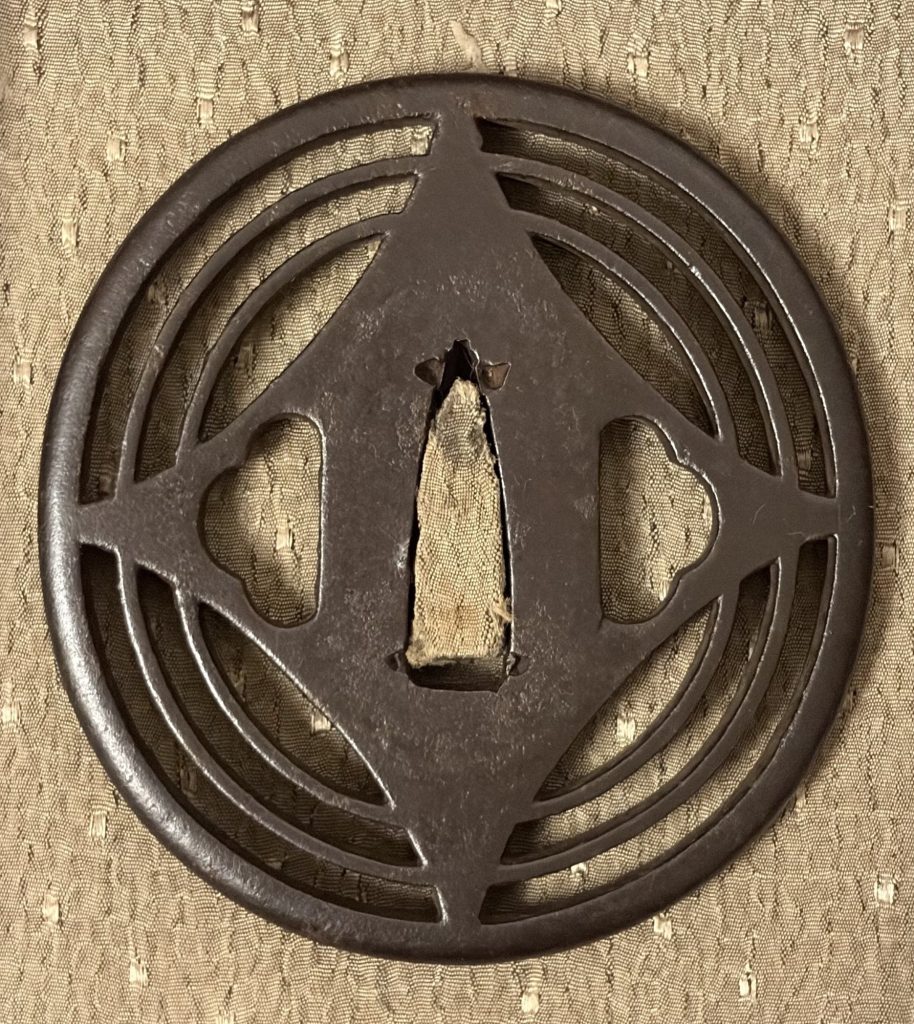
A Higo tsuba of iron, slightly taller than wide, cut away until little more than its lines remain. Four thin rings run round the edge, one inside the other, like thread wound on a reel. Across them lies the spool itself, a long diamond that reaches from the top of the guard to the bottom and out to both sides. Its centre widens into the seppa-dai, with the nakago-ana and two hitsu-ana, each with a lobed outer edge.
The NBTHK names the design itomaki-sukashi, an openwork thread spool. It describes the shape as tate-maru-gata, an upright round, the iron as polished, the openwork as cut from the ground, and the rim as round. It attributes the guard to Higo and names no maker.
Nothing is inlaid. The rings keep an even width all the way round, and the design is carried by the spaces between them. The NBTHK names the province and no workshop. Museum catalogues divide Higo work into several lines; the Museum of Fine Arts, Boston, for instance, files guards under Kamiyoshi and Nishigaki. A. J. Koop, cataloguing the A. H. Church collection for the Ashmolean Museum, names the Hayashi or Kasuga group, the Kamiyoshi, the Shimidzu-Jingo and the Suwa among the Higo workers. The paper does not go that far, and neither does this page.
Tsuba. Mumei, Higo. Tetsu, migaki-ji, ji-sukashi, maru-mimi. Tate-maru-gata. Itomaki-sukashi. Mittlere Edo-Zeit. NBTHK Hozon. Privatsammlung, erworben in Japan.
In the collection
- Type
- Tosogu › Tsuba
- School
- Higo
- Period
- Edo-Zeit › Mittlere Edo-Zeit
- Material
- Tetsu
- Motif
- Mon und Muster