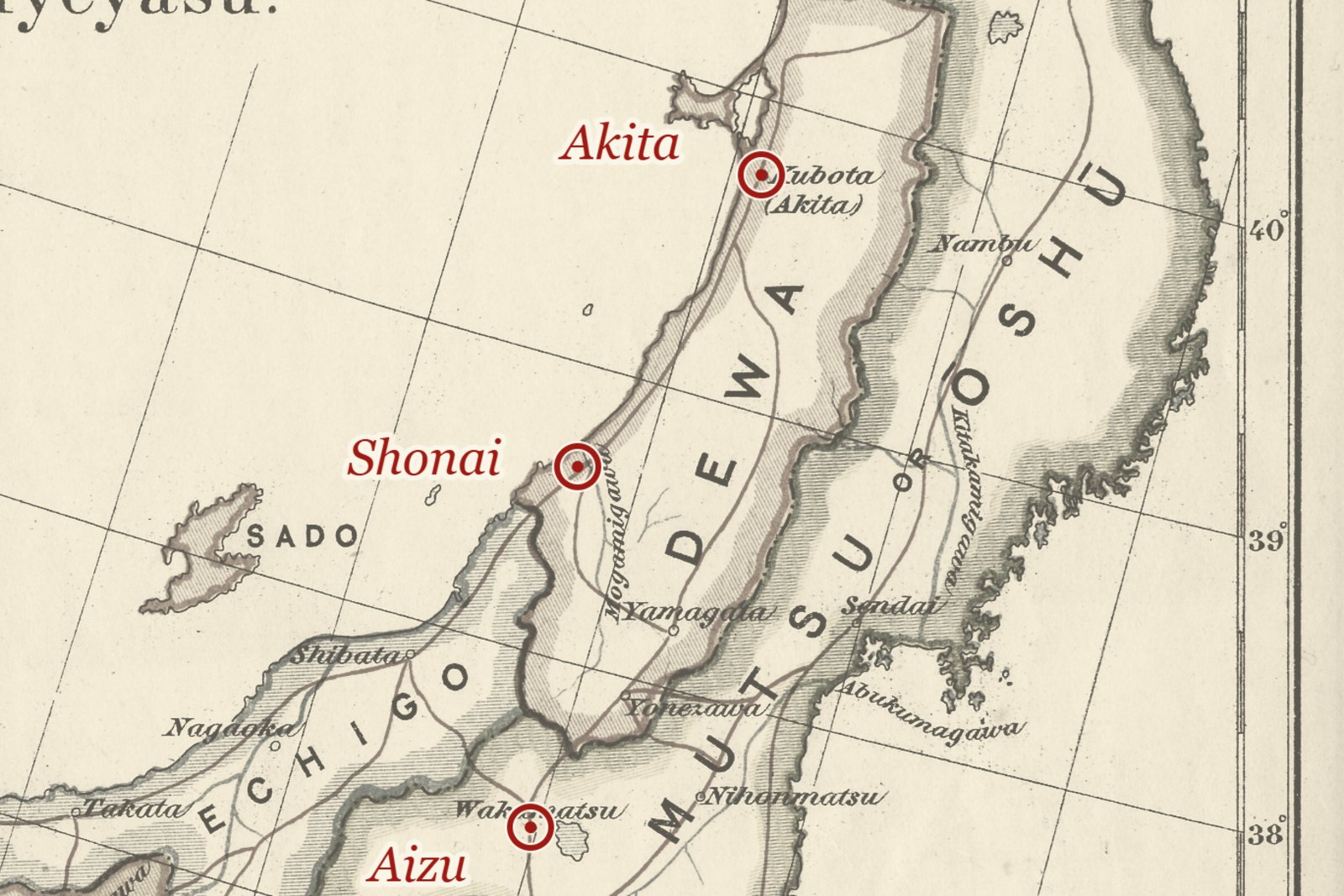
In the eighteenth and nineteenth centuries the Shoami name left Kyoto. A. J. Koop, cataloguing the Church collection around 1929, lists the provincial centres where it settled: Aizu in Mutsu, Shonai and Akita in Dewa, Tsuyama in Mimasaka, and above all Matsuyama and other towns in Iyo, on the island of Shikoku. In Edo, he adds, Shoami work was less popular than the more refined work of other schools. The last of the Shoami, Katsuyoshi, died in 1909.
That is a span of three centuries and most of the country. It is also a list of castle towns.
Castle towns
The Edo period divided Japan into domains, each with a lord and a castle town. Craftsmen followed. A lord who wanted guards for his retainers, gifts for his peers or fittings for his own swords kept metalworkers in his town, and a family with an old name from the capital may have been an easy choice. That is how the pattern reads. For most branches the documents are missing.
The Akita branch shows how this could work. A Japanese mokume-gane workshop, writing on the history of its craft, traces it to Shoami Denbei, who lived from 1651 to 1728, trained in Edo and then served the Satake, the lords of Akita. The Satake had been moved north from Hitachi in 1602, after the Tokugawa came to power. The branch became known for guri-bori, scroll patterns cut into layered metals in the manner of carved lacquer, and for grounds of mokume.
For Aizu, Shonai, Tsuyama and Iyo this collection has no comparable history to offer. The branches are known above all from their work and from the signatures of later masters.
Sorted by place
Collections still sort the Shoami this way. Koop placed the Shoami guards of the Church collection under Kyoto, Iyo, Awa, Shonai, Bushu, Aizu and Akita, and put about half of them under a last heading, unclassified. The Museum of Fine Arts in Boston files its Shoami guards in the same manner. It has a group for the Shoami school as a whole, with more than one hundred and fifty guards, and separate groups for the Aizu, Iyo and Awa Shoami. The Iyo guards there are signed by masters such as Moriyoshi, dated 1776, and Moritomi, dated 1819.
Sorting by place is not only convenient. A branch name says that a guard shows the habits of one provincial workshop: its favoured subjects, its way with iron and inlay, its rims. Koop saw this too. In his view the style of the Shoami varies with the period and the surroundings of each master, and yet keeps an underlying character of its own.
What a branch name can say
The papers of the NBTHK follow the same order. Where the work shows the habits of a branch, the paper names it: Aizu Shoami, Akita Shoami, Iyo Shoami. Where it shows the habits of the school but not of a place, the paper says Shoami alone. Older work, from before the provinces, is called Ko-Shoami, old Shoami.
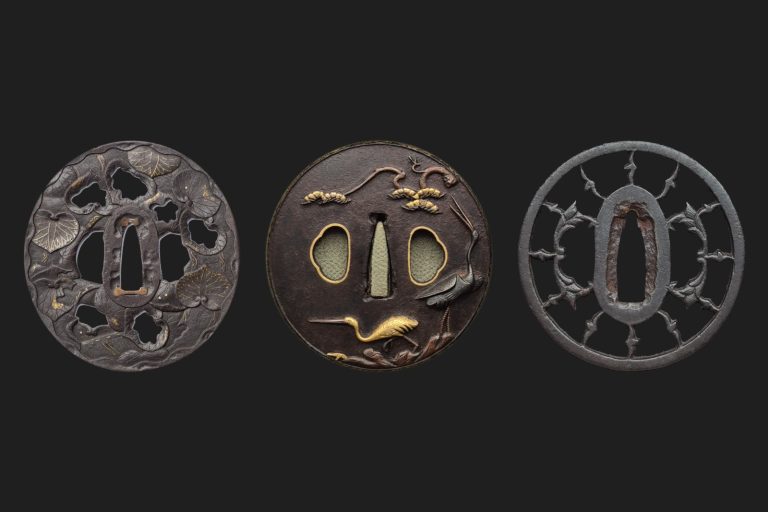
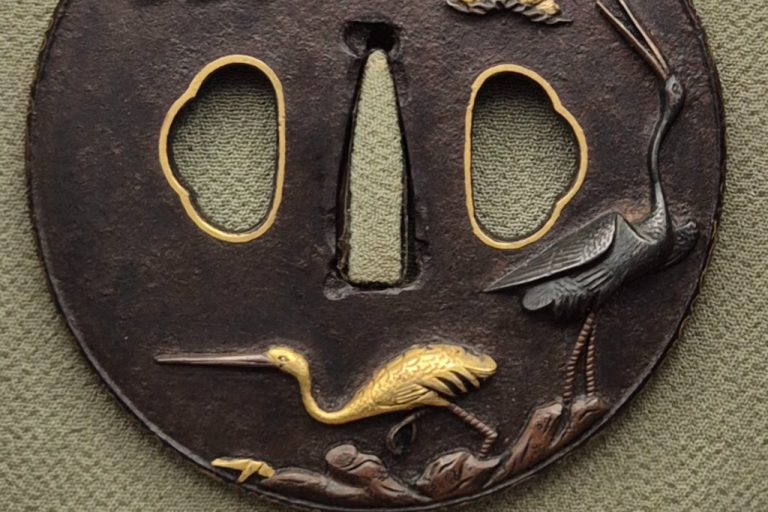
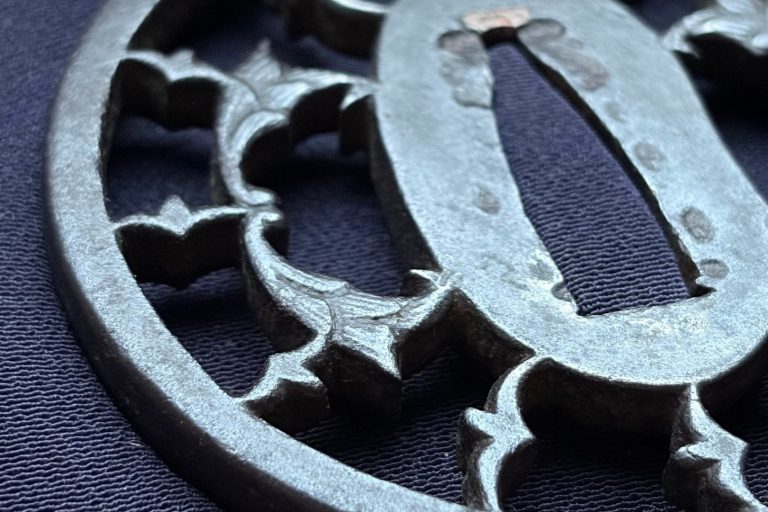
Two of the three papers in this collection name a branch, and both branches are in the north. The aoi guard is given to Akita, the crane guard to Aizu. Both are iron, both are inlaid with gold, and both leave much of the plate open. The third guard, the one without a branch, carries no inlay at all. Whether that is a northern trait or a coincidence of two guards, the collection is too small to say.
A map of a name
The maps that go with this series mark the places that Koop names. They are different maps from those of the five traditions of the sword. Those five are provinces of forging, laid over the old blades long after they were made. The Shoami places are towns where a name was carried, by families, to lords who wanted it. One map was drawn by appraisers. The other was drawn by the families who moved.
The Shoami: all parts
The three guards and their papers, side by side: The Shoami: Three Papers, One Name
Sources
- A. J. Koop, The A. H. Church Collection of Japanese Sword-Guards (Tsuba), chapter “Shōami school (early 17th to 19th century)”, Ashmolean Museum, Eastern Art Online.
- Museum of Fine Arts, Boston, collection database: groups “Shoami School”, “Aizu Shoami School”, “Iyo Shoami School”, “Awa Shoami School”.
- Akita: after a Japanese mokume-gane workshop on the history of its craft, and Akita International University on the Satake, as cited on the collection page of the Akita guard.
- Collection pages: Akita Shoami tsuba with aoi and rafts; Aizu Shoami tsuba with pine and cranes.