Der geteilte Rand
Taikobo Fishing, by Tsuneshige
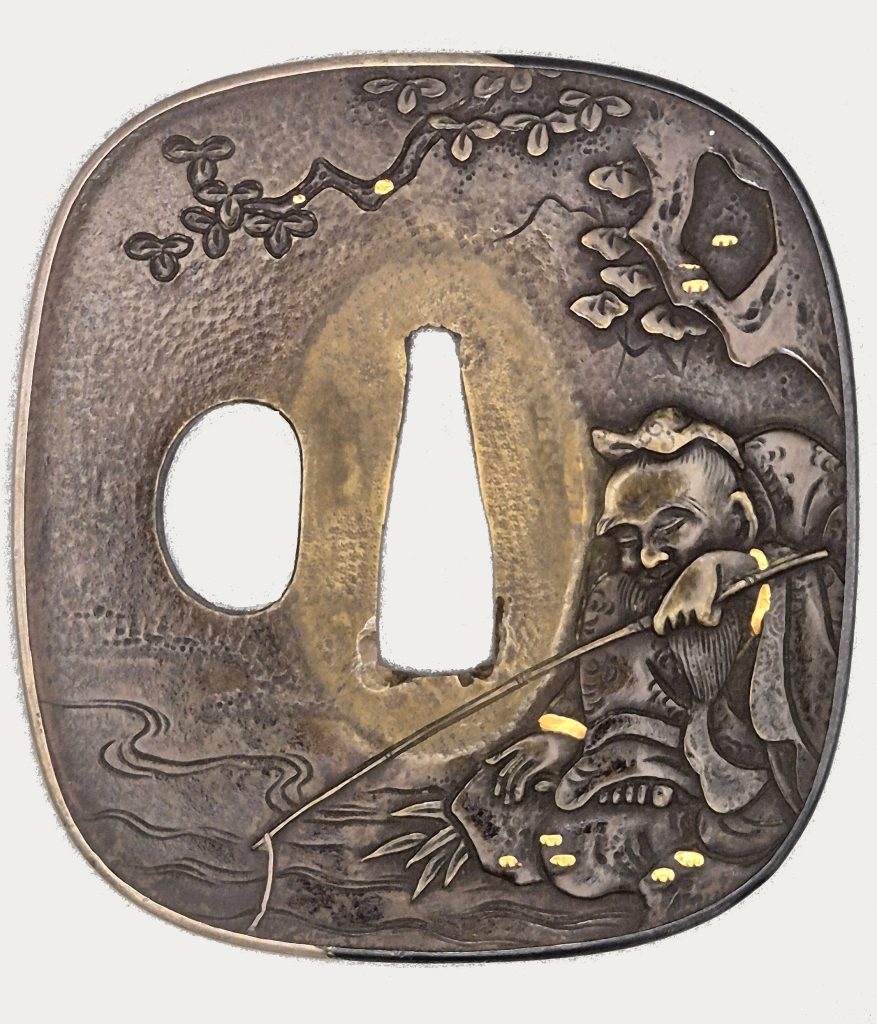
On this tsuba by Tsuneshige, an old man sits on the rocks at the right edge of the plate. He holds a long rod, and the line runs out over a stream that winds across the lower field. Branches with small leaves hang from the top. Touches of gold lie on his robe and on the rocks. The ground is brass with a fine, stone-like texture.
Das Objekt
The NBTHK describes a rounded square of brass with an ishime ground. The figure is carved in high relief from the plate and touched with color.
Then the rim. It is a fitted fukurin of two metals, shakudo on one side and silver on the other. The paper calls it kezuri-tsugi fukurin, a rim joined from separate pieces. Dark and pale meet along a single line, and the join holds without a gap. Two metals of different color and hardness close one circle.
Nothing in the scene asks for it. A sage waits by the water, and around him the rim is split between dark and light. The maker leaves the reason unspoken.
Die Szene
The paper names the figure Taikobo, the Chinese sage Jiang Ziya. The Walters Art Museum tells his story on another guard. Taikobo fished without bait, because he did not want to catch anything. A ruler out hunting found him at the river, was impressed, and asked him to serve as his counselor. Museum texts differ on which ruler it was, so this page leaves the name open.
Read that way, the rod here is not for fish. The old man is waiting, and the guard shows the moment before he is found.
Die signierte Seite
The back shows a tree trunk along the left edge, clusters of small leaves and a few touches of gold. Beside the central opening the guard is signed 常重, Tsuneshige.
The Metropolitan Museum of Art lists Kawamura Tsuneshige of the Nara school, active in the late eighteenth century. The Museum of Fine Arts, Boston, files guards under a Tsuneshige sub-school of the Nara line. The paper confirms the signature.
Eine Korrektur
An earlier version of this page gave the plate as shibuichi. The paper names brass.
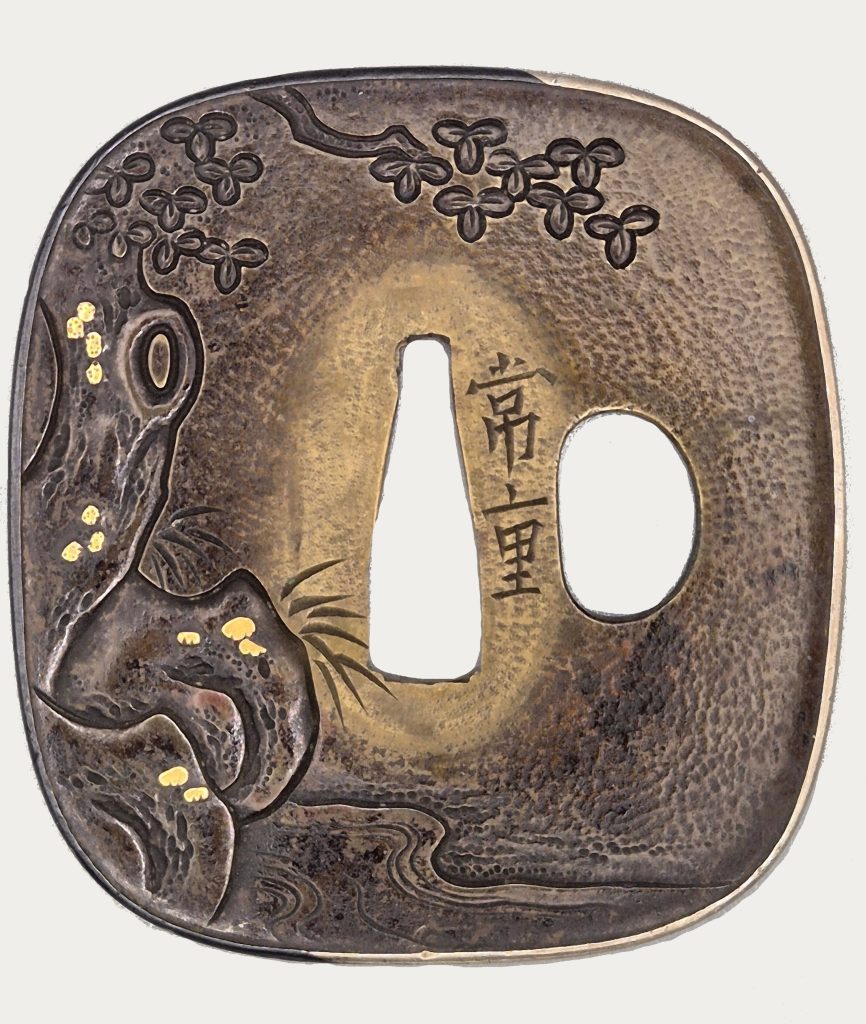
Tsuneshige’s Taikobo Tsuba
Tsuba. Signiert Tsuneshige. Shinchu, ishime-ji, sukidashi-takabori, iroe. Nade-kaku-gata, kezuri-tsugi fukurin in Shakudo und Silber. Taikobo-zu. Edo-Zeit. NBTHK Hozon. Privatsammlung, erworben in Europa.
In the collection
- Type
- Tosogu › Tsuba
- School
- Nara › Tsuneshige
- Period
- Edo-Zeit
- Material
- Shinchu
- Motif
- Mensch und Legende