On a Manchester collector, an aesthetic argument, and the man who wrote it all down.
Walter Lionel Behrens did not simply collect Japanese sword fittings. He held a position on them. And the position was, for his time and milieu, deliberately unfashionable.
A major Commitment to Japanese Arts
Behrens was a major collector of Asian objects around the turn of the twentieth century, his holdings numbering thousands of items across multiple categories — netsuke, inro, lacquer, Chinese antiquities, Buddhist objects. But it is his collection of Tosogu that interests us here, and more precisely the sensibility that shaped it. Henri L. Joly, the French-born cataloguer who documented more British private collections of Japanese sword fittings than any other individual of his era, recorded that sensibility with characteristic precision in the preface to Part III of the Behrens catalogue, published in 1912.
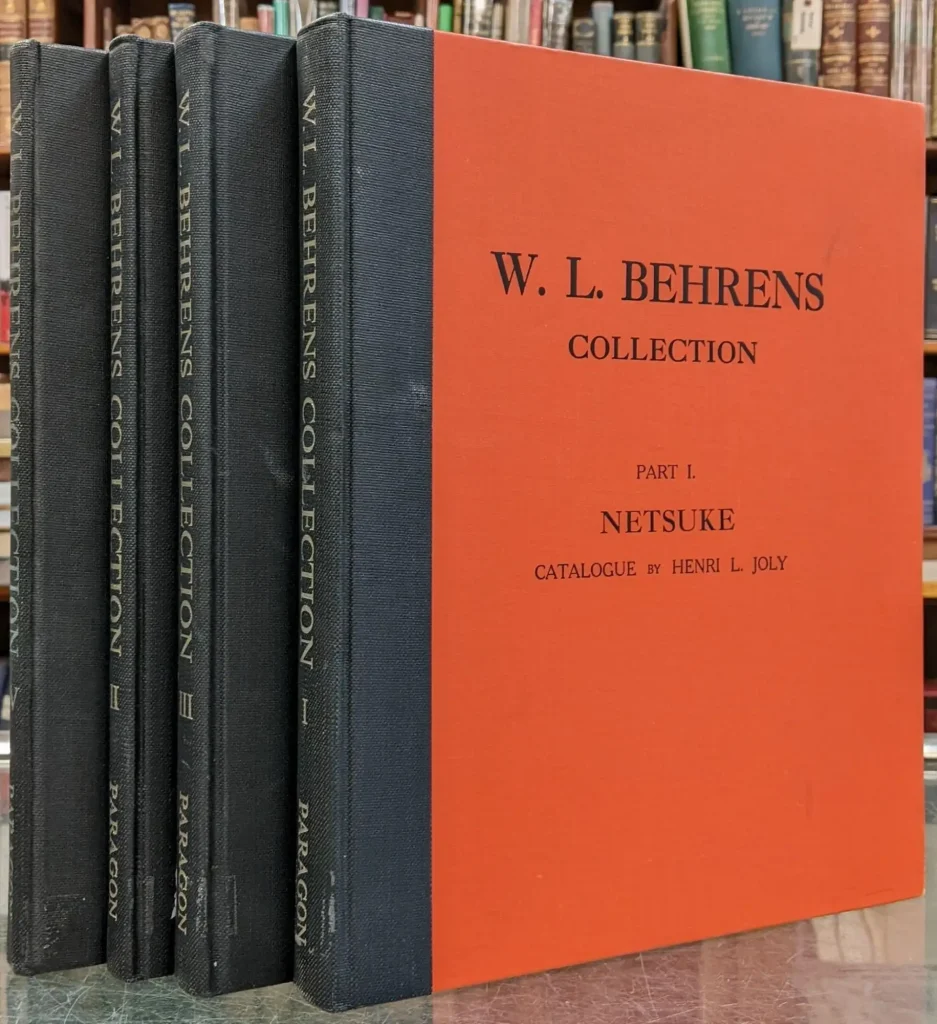
Behrens’ aim, Joly writes, was carried out “to a certain point only, because this intention became thwarted some years ago by a proclivity to reject the elaborate work of the XVIIIth Century, and to interest himself only in the archaic, the so-called primitive tsuba, which commended themselves to French collectors, or to acquire specimens curious for their strange shapes or peculiar designs, in which symbolical meanings might be found or fancied.”
This is, dressed in Joly’s diplomatically compressed prose, an account of a collector who changed direction mid-career — and whose change of direction was both an aesthetic statement and an implicit critique. The elaborate metalwork of the eighteenth century, with its inlaid gold and silver, its pictorial complexity, its appeal to the European eye trained on the decorative arts of the Meiji period, held no further interest for Behrens. He turned instead toward the archaic: early iron guards, simple forms, objects in which what mattered was not ornament but structure, not display but the quality of the iron itself.
This was a minority position in Britain in the 1890s and 1900s. The dominant taste, shaped in part by the great exhibitions and by the availability of late Edo and Meiji-period pieces in the London market, ran toward the elaborate. Behrens pushed against that current. In doing so he aligned himself with a strand of French collecting that the British market had largely ignored — a preference for early, formally austere pieces over the more accessible appeal of heavily decorated later work.
An Exquisite Taste
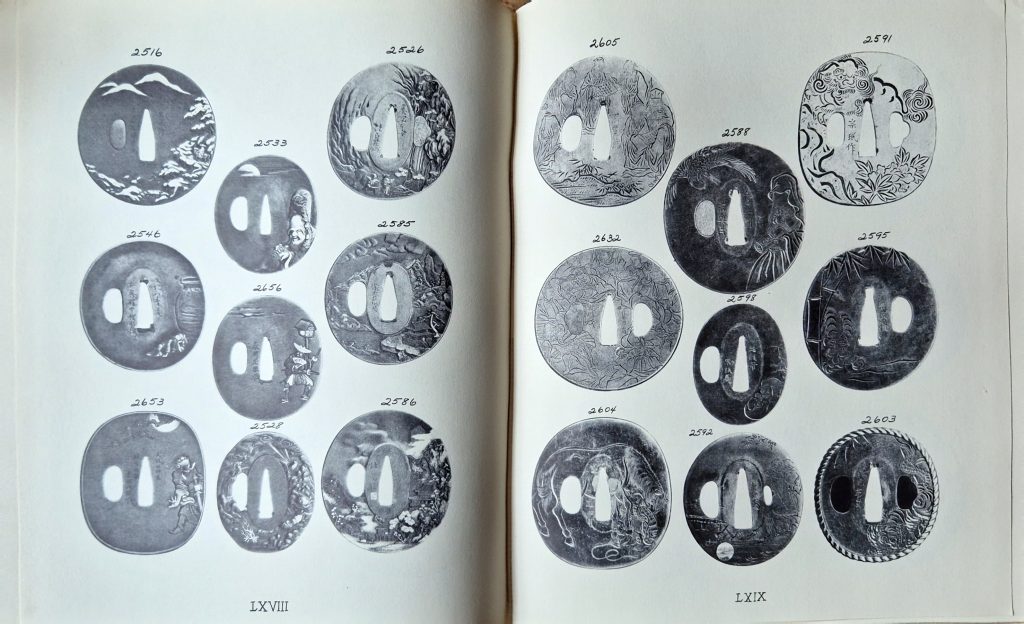
The consequences for the collection were significant. Joly notes that Behrens had assembled an important series of Tanaka School tsuba from the early nineteenth century, and that the Higo guards — including Nara and Hamano work — were represented in notable numbers. The Yoshiro and Namban schools were present. So were the followers of Sōten. But the collection as a whole reflects an edited vision rather than a comprehensive survey: Behrens was buying what corresponded to a developed aesthetic position, not what was simply available.
The collection was sold at several auctions in the early 1900s and was catalogued into multiple volumes. Part III, covering sword fittings, tsuba, and metal, appeared in 1912 — the same year Joly produced his catalogue of the Naunton collection, and two years after his work on Hawkshaw. Joly was, by this point, the indispensable figure in British Tosogu documentation: the man without whom most of these collections would exist only in scattered sale records, their contents unattributed and their character lost.
That Behrens, Hawkshaw, Church, Naunton, and Gilbertson were all active in roughly the same period, all within the same London-centred collecting world, all relying on Joly to mediate between their holdings and the scholarship of the field — this is not coincidental. It reflects the particular character of British collecting in this domain: private, networked, published in limited editions, structured around personal relationships with a small number of intermediaries who possessed both the linguistic access and the connoisseurial training to make the objects legible.
What Behrens contributes to that picture is the dimension of taste as argument. His pivot toward the archaic was not merely personal preference — it was a claim about where value resided in the field, and a rejection of the criteria by which most of his contemporaries were buying. He was wrong about some things, as Joly gently notes: the elaborate work of the eighteenth century that Behrens dismissed contains some of the finest technical achievement in the entire tradition. But being wrong in an interesting direction is often more productive than being conventionally right. Behrens asked a question that the field was not yet ready to fully answer: what does it mean to prefer the simple?
The catalogue that records his collection is, like all the Joly catalogues, a document of its moment — precise, dry, occasionally exasperated, and quietly essential. It was reprinted in New York in 1966, fifty years after first publication, which is itself a measure of its continued utility. The objects are long since scattered. The argument Behrens made with them remains.
Sources
- Joly, Henri L. Catalogue of the W. L. Behrens Collection. Part III: Japanese Sword Fittings, Tsuba and Metal. London, 1912. Reprinted New York, 1966.
- Joly, Henri L. Legend in Japanese Art. London: John Lane, 1908. — Illustrates pieces from the Behrens collection and provides the scholarly framework.
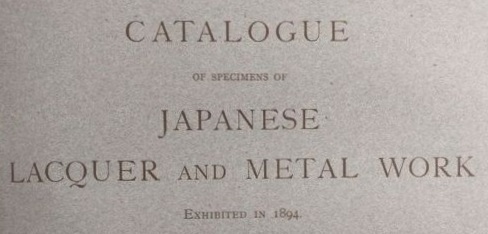
- Burlington Fine Arts Club. Catalogue of a Collection of Japanese lacquer and metalwork exhibited in 1894. London, 1894. — Contextualises the British collecting world within which Behrens operated.