
On an unknown collector, 500 signatures, and the moment British Tosogu scholarship began.
Now I know that his first name was Edward. Beyond that, “E. Gilbertson” remains one of the more elusive figures in the early history of European Tosogu collecting. A man known almost entirely through the weight of what he assembled, and through the single quantitative detail that the 1894 Burlington Fine Arts Club catalogue preserves about him: that his private collection contained over 500 different artist signatures.
The 500 Mei
Five hundred signatures. In a field where attribution was still largely guesswork, where Japanese expertise was rarely accessible to European collectors, where the distinction between schools was understood by almost no one outside Japa. This figure was not merely impressive. It was a statement about the depth and seriousness of a collection that most of his contemporaries could not have matched.
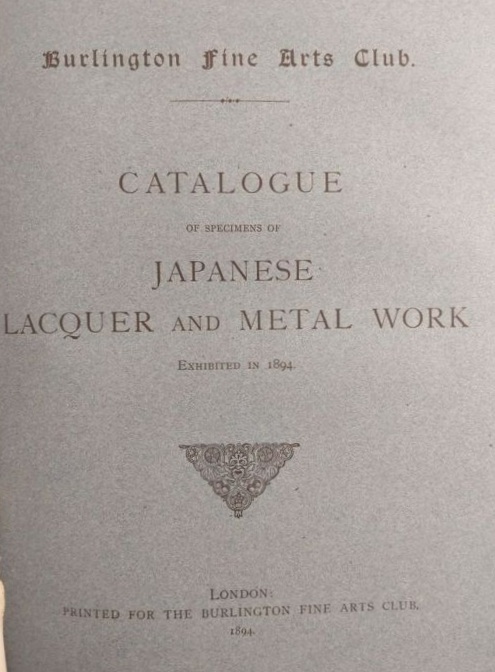
The 1894 exhibition of Japanese lacquer and metalwork, organised by the Burlington Fine Arts Club in London, gathered the significant British private holdings of the period for the first time. It was the moment at which the British collecting world took stock of what it had accumulated, and Gilbertson’s collection dominated the picture. The catalogue notes that in addition to the thousand or more Tosogu artists represented by signed specimens in the private collections of England, there were probably at least as many workers whose productions were anonymous. A measure of how much remained unknown even to the best-informed collectors. Gilbertson’s 500 signatures were, in that context, a remarkable mapping of a largely uncharted territory.
The exhibition catalogue directed visitors specifically to Gilbertson’s privately printed catalogue of his own collection as essential reference — alongside Bing’s Artistic Japan, Brinckmann’s work, and Gonse — as one of the few serious published resources then available in any language. This is a significant indication of its standing. By 1894, Gilbertson’s catalogue was already considered indispensable.
A broad Approach
What the 1894 exhibition also reveals is how Gilbertson collected: with systematic breadth rather than aesthetic selectivity. Among the specimens he contributed was a tortoise-shell tsuba ornamented with gold lacquer; an object unusual enough to merit specific mention in the catalogue text. This was not a collector who confined himself to the conventionally desirable. He ranged across materials, periods, and schools, accumulating signatures the way a scholar accumulates evidence: each one another data point in a field that badly needed more of them.
This is the contribution that distinguishes Gilbertson from the collectors who came after him. Behrens had aesthetic positions. Church had scientific discipline. Hawkshaw had Joly to write his catalogue with elegant precision. What Gilbertson had, before any of them, was the raw ambition to map the field — to collect not what was beautiful or fashionable but what was representative, what was signed, what could be traced. In a discipline that was still struggling to establish its own vocabulary, he was building an index.
The collection was sold in multiple auction sessions, the third portion appearing at Glendining & Co. in 1917, suggesting the holdings were substantial enough to require multiple sales. Where the objects went is largely untraced. The catalogue survives; the collection does not, as a collection.
What Gilbertson leaves behind is less a legacy of specific objects than a legacy of method. He demonstrated, at the earliest moment of serious British engagement with the field, that Tosogu collecting could be more than the acquisition of beautiful things — that it could be a form of scholarship, conducted through objects, patient and systematic. The collectors who followed him — Hawkshaw, Behrens, Church, Naunton — all operated in a landscape he had helped to define. Henri Joly, who catalogued so many of the great British collections, built on a foundation of knowledge that Gilbertson’s work had helped to establish.
His name appears in footnotes. His first initial remains uncertain. His collection is dispersed. And yet every serious student of European Tosogu history passes through the moment he created: the 1894 Burlington exhibition, the privately printed catalogue, the 500 signatures that told the field how large the territory actually was.
Sources
- Burlington Fine Arts Club. Catalogue of a Collection of Japanese lacquer and metalwork exhibited in 1894. London, 1894. — The primary exhibition catalogue documenting Gilbertson’s holdings.
- Joly, Henri L. Legend in Japanese Art. London: John Lane, 1908.
- Joly, Henri L., and J. C. Hawkshaw. Japanese Sword-Mounts: a Descriptive Catalogue of the Collection of J.C. Hawkshaw. London, 1910. — Documents the tradition of private cataloguing within which Gilbertson’s work operated.
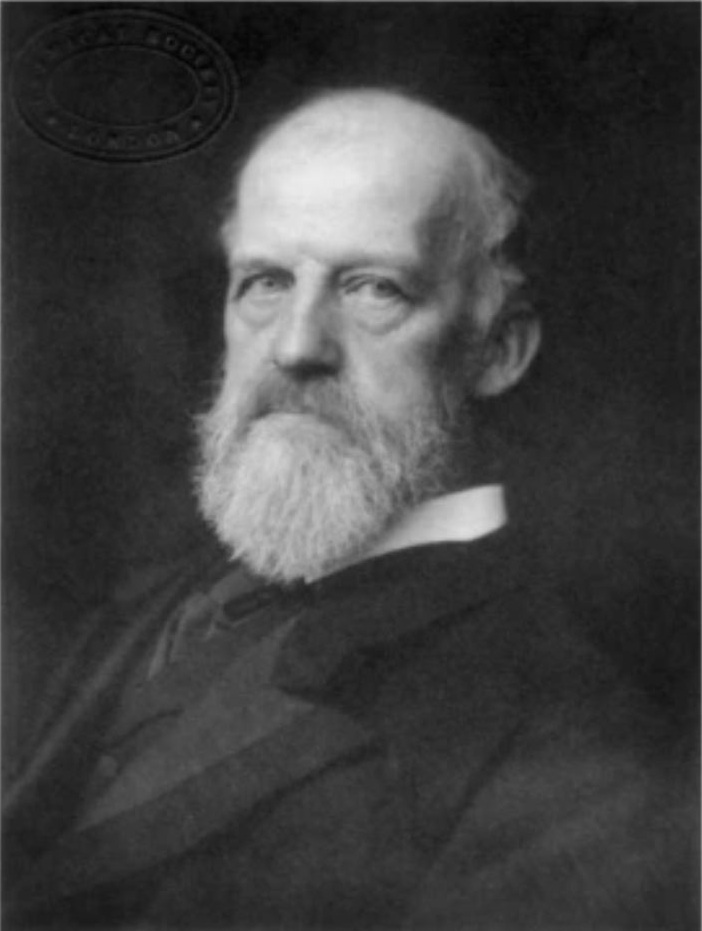
His name was edward gilbertson
much of the collection ended up in new zealand some is still there
thank you very much, Tim. I appreciate your comment – will change the article to the correct name. Do you know where in NZ? Is it in a museum or in private collections? Best, Alex