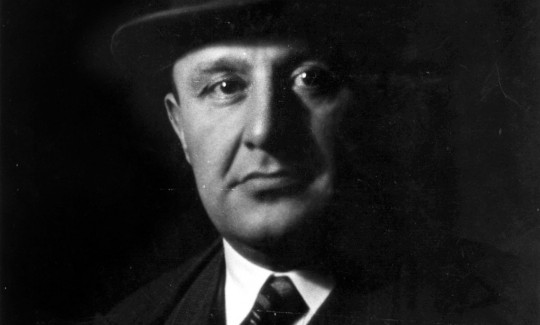
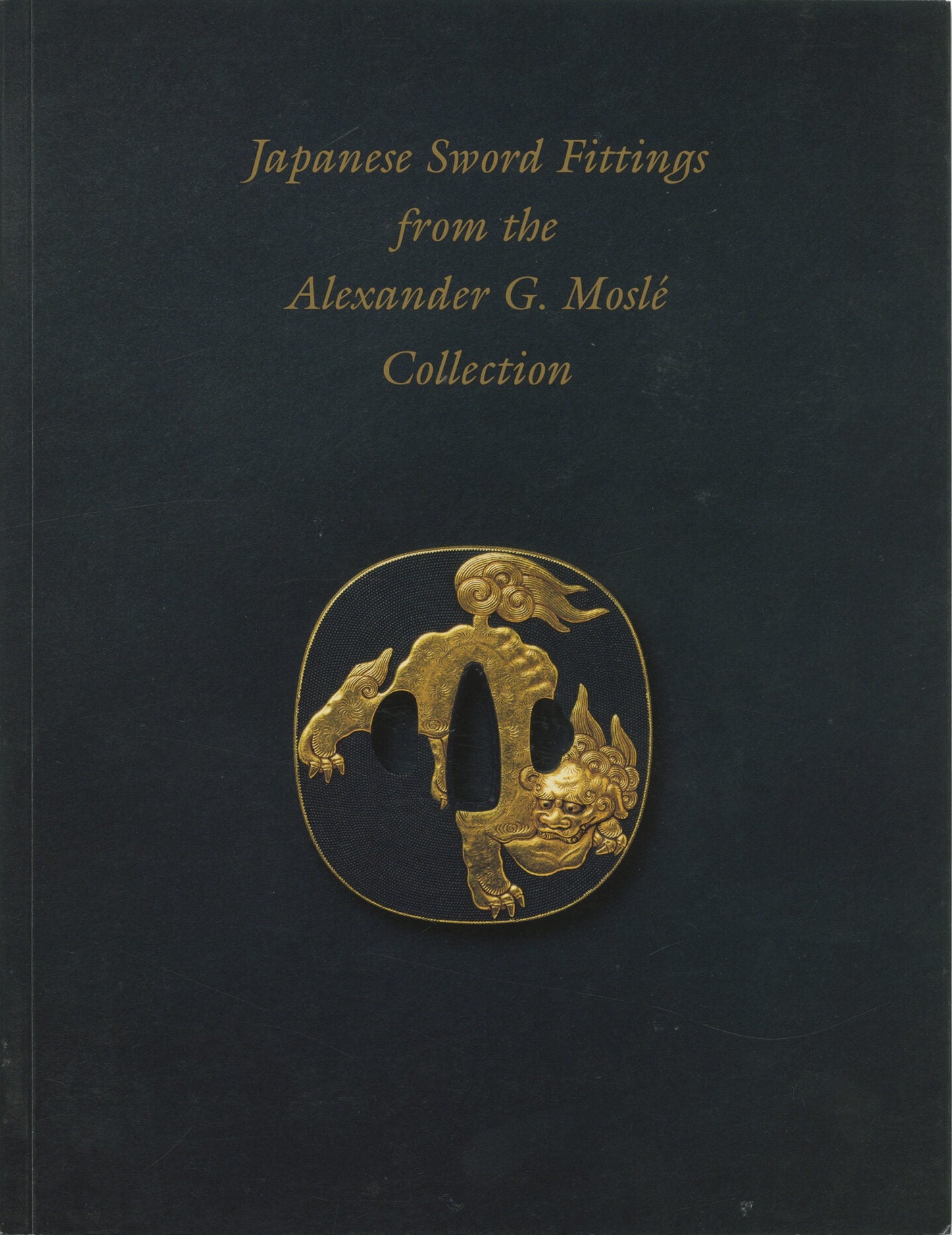
On a German businessman, twenty-three years in Japan, and the long misfortune of too much.
He arrived in Japan in 1884 representing Grusonwerk, later a subsidiary of Krupp. He was there to sell armaments.
This is the detail that explains everything else. The other European collectors in this series came to Japan as tourists, diplomats, physicians, or wealthy men of leisure. Moslé came as the commercial representative of one of the most powerful industrial enterprises in the world, negotiating contracts with a Japanese military that was in the process of building itself into a modern imperial force. His clients and interlocutors were not shopkeepers and dealers. They were generals and aristocrats, the men who were simultaneously dismantling the old samurai world and deciding what to do with what it had left behind.
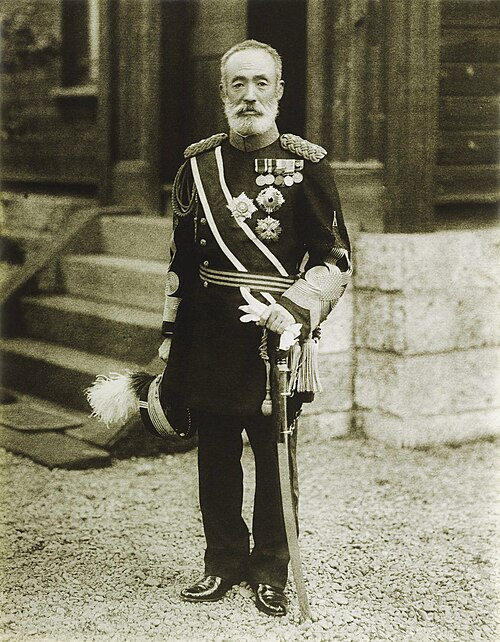
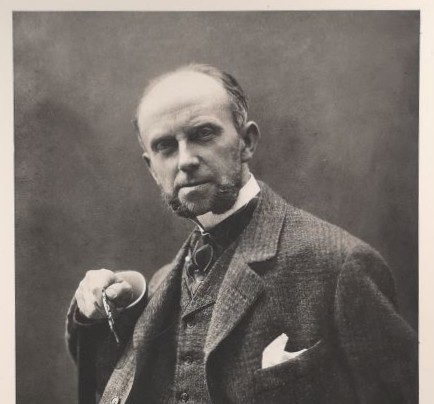
Photo from Wikipedia
He moved in circles that included: Tokugawa Iesato, the last head of the Tokugawa house, the family that had ruled Japan for two and a half centuries. General Nogi Maresuke, the Meiji military hero whose death by ritual suicide upon the Emperor Meiji’s passing in 1912 would become one of the most discussed acts of the era. Through his position and through the access that came with it, Moslé moved in circles that no European collector — not Oeder, not Jacoby, not Brinckmann working through Hara — could have reached from Hamburg or Berlin.
Moslé was born in the city of Bremen, Germany in 1862 and spent twenty-three years in Japan, returning to Europe around 1907. Whether he had intended to stay so long, or whether the Gruson Werke business simply kept him there, the public record does not say. What it says is that he continued buying until 1920, more than a decade after his return — that the collection did not stop with Japan but was maintained and refined from Europe through the connections and correspondences he had built during those two decades in Tokyo.
The core of the collection was assembled through a specific dealer: Ogura Soemon, whose business traded under the name Amiya. The relationship was not merely commercial. The Izzard catalogue of 2004, which remains the most detailed account of Moslé and his collection, describes the acquisition process as one conducted with “the advice and teachings of Akiyama Kyusaku” — a Japanese scholar of tosogu whose guidance shaped not only what Moslé bought but how he understood what he was buying. Akiyama is listed in the 1914 descriptive catalogue among Moslé’s named mentors, alongside Ogura Soemon himself, Wada Tsunahiro (who had assembled the Furukawa collection), and Paul Vautier. The last name is the one that most catches the eye. Paul Vautier is the same man who authored the catalogue of Georg Oeder’s collection — the Berlin exhibition of 1909 in which Moslé’s own collection also appeared. The two great German tosogu collections of the Meiji era were shaped, in part, by the same hand.
This mentor network is unusual enough to deserve attention on its own terms. Most European collectors of the period — even those who reached genuine depth — worked without formal instruction. Brinckmann in Hamburg relied on Hara to correct his evolutionary frameworks but had no sustained teaching relationship with a Japanese specialist. Halberstadt collected from European auctions without any Japanese guidance at all. Moslé had, in Japan, the closest thing available to a formal education in the field: a specialist dealer in Amiya, a scholar in Akiyama, access through his social connections to collections and objects that most foreigners would never see, and the particular advantage of having arrived during the dispersal itself, when the objects were still moving through networks that retained their original context and provenance.
What this produced, at its best, was the Goto group
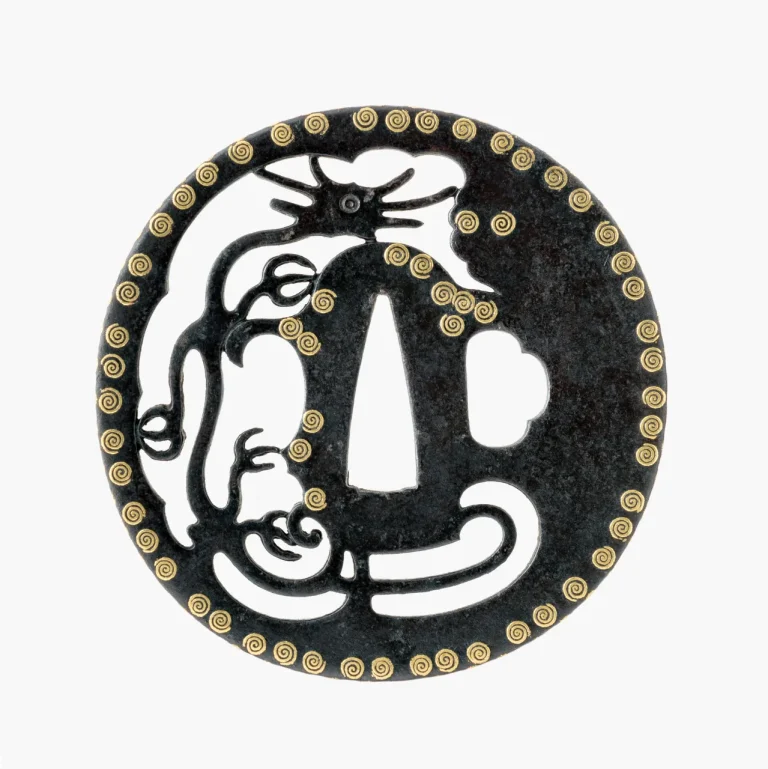
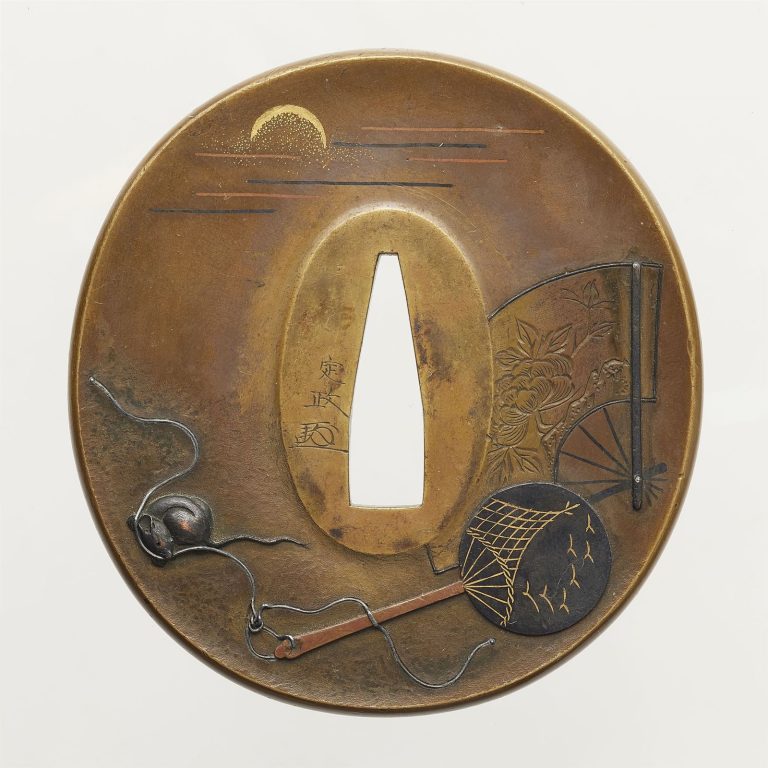
Among the collection’s 1,600 sword fittings, some 300 pieces were works by the Goto school — the lineage of metalworkers that had served the Ashikaga and Tokugawa shogunates from the fifteenth century onward, whose soft-metal work in shakudo and gold represented the highest expression of a tradition that the sword-prohibition of 1876 had effectively ended as a living craft. Within this group was a subset of particular scholarly significance: pieces accompanied by origami — authenticating documents issued by Goto masters for works attributed to their own ancestors, from the period before the school had adopted the practice of signing their works directly. These documents represent the Goto house’s own attestation of lineage, issued internally, before the Western collecting market had created the incentive to produce such things for commercial purposes. To have assembled 300 Goto pieces with a meaningful subset carrying this form of primary authentication, in Japan, during the dispersal, with the guidance of Akiyama and the access of Amiya — this was not luck. It was the product of exactly the kind of sustained, expert, deeply embedded engagement that the scale of Moslé’s Japan residence made possible.
Also as acting Consul of Belgium to Japan — a diplomatic role that compounded his already exceptional access — Moslé occupied a position unlike any other European collector in this series. He was not a visitor to Japan. He was, for twenty-three years, an institutional presence within it: representing a major German industrial firm, holding a diplomatic appointment, maintaining personal friendships with the Tokugawa heir and Meiji military figures, conducting business across the full social range of a society in rapid transformation. If there was a European who was positioned to collect Japanese sword fittings from the inside rather than the outside, it was him.
He returned to Germany around 1907. The collection came with him, and in 1909 it was exhibited at the Kunstgewerbemuseum in Berlin. The catalogue produced for that exhibition, Japanische Kunstwerke: Sammlung Moslé, documented the holding with the systematic rigour that had become standard in German-language scholarship. Two volumes of descriptive catalogue followed in Leipzig: 1914 for the first, 1932 for the second — the latter appearing a quarter century after his return from Japan, when the network of relationships he had built in Tokyo was still sufficiently intact to sustain scholarly documentation at that level.
Then the silence
Between 1907 and the late 1920s, the trail in the public record runs thin. What the Izzard account establishes is what happened next: in the late 1920s Moslé brought the collection to the United States, primarily to interest public institutions in acquiring it. He wanted it to go somewhere permanent. He had spent two decades in Japan building something of genuine scholarly significance, and he understood — with the methodical instincts of a man who had spent those two decades also negotiating Krupp contracts — that the collection needed an institutional home.
In this he was only partially successful. Institutions took some pieces; private collectors took others. The core, and in particular the metalwork that was the collection’s greatest strength, remained intact. Then the war came and stranded him. He was in America when Europe closed. The period that followed was one of decline: a man in his seventies and then his early eighties, far from both Germany and Japan, with a collection he could no longer manage and affairs that passed, eventually, into the hands of a trustee. He died in 1946, in America, four years before the collection was finally dispersed at Parke-Bernet Galleries in New York in two sales: April 22 and May 12, 1948; conducted not by Moslé but by his trustee Donald McCormack of the Riggs National Bank. The dispersal had effectively happened before he died; the sale confirmed it.
For half a century after 1948, the pieces were simply gone — absorbed into private hands, unlabelled in the auction literature of the period, as anonymous as any other Japanese metalwork of the period moving through the New York market. Then, in September 2004, Sebastian Izzard Asian Art LLC exhibited 170 pieces from the collection that had been in private hands since 1948. The exhibition catalogue gave the field its first proper sustained look at what Moslé’s collection, at its best, had contained: the Goto pieces, the Ishiguro school, the Kano Natsuo daisho, the full depth of a holding assembled over thirty-five years with Japanese expert guidance that no other European collector of the period had enjoyed in comparable measure.
The comparison with Brinckmann is instructive and unavoidable. Brinckmann, working in Hamburg, needed Hara in the room to correct his evolutionary theories about tosogu. Moslé spent twenty-three years in the room — guided by Akiyama, supplied by Amiya, socially positioned through the Krupp connection and the Belgian consulate to access objects and knowledge that no Hamburg museum director could reach. The collection that resulted was not simply larger than what a European collecting from the auction circuit could have assembled. It was different in kind: shaped by Japanese scholarship, authenticated through Japanese institutional channels, built within the collecting world of Meiji Japan rather than at a remove from it.
The armaments representative who counted the Tokugawa heir among his personal friends, who spent two decades learning how to look at Japanese metalwork from the people who had made it or inherited it or studied it for a lifetime — this is not the usual story of the European collector encountering Japanese art from the outside. It is the story of someone who had, for a specific period under specific historical conditions, something approaching the inside position.
The collection he assembled from that position was, by any measure, extraordinary. That it ended up dispersed in a two-day New York auction while its builder was dying in America far from the country that had produced it is the kind of irony that the twentieth century specialised in.
Sources:
- Sebastian Izzard Asian Art LLC. “September 2004 Exhibition: Japanese Sword Fittings from the Collection of Alexander G. Moslé.” [izzardasianart.com] — The most detailed available account of Moslé’s biography, the collection’s character, and the events of 1948 and their context.
- Moslé, Alexander G. Japanische Kunstwerke: Sammlung Moslé. Berlin: Kunstgewerbemuseum, 1909. Available digitised via Internet Archive.
- Haynes, Robert, and Robert Burawoy. 100 Selected Tsuba from European Public Collections. — Confirms the Goto group of c.300 pieces, the origami documentation, the Gruson Werke role, and the death year of 1946.
- Moslé, Alexander G. The Moslé Collection: Descriptive Catalogue. 2 vols. Leipzig: Poeschel & Trepte, 1914 / 1932. — Lists Paul Vautier, Wada Tsunahiro, Akiyama Kyusaku, and Ogura Soemon (Amiya) as mentors.
- Parke-Bernet Galleries. Japanese Art: Part One of the Collection of Alexander G. Moslé. New York, April 22, 1948.
- Metropolitan Museum of Art provenance records, indexed under “Alexander G. Moslé” — confirms specific pieces and their 1948 dispersal route.