On a Kidderminster carpet maker, a Japanese museum in a Worcestershire garden, and the moment before Joly.
There is a photograph taken somewhere around the turn of the century that shows the interior of a room at Franche Hall, Kidderminster: objects covering every available surface, prints on the walls, lacquerwork on shelves, the accumulated evidence of twenty years of sustained and serious attention. It is the kind of room that appears throughout the history of British Japonisme — the Victorian collector’s interior, ordered by private logic, unmistakable in its density — but Franche Hall was not in London, or Edinburgh, or one of the university towns where such rooms generally appeared. It was in Worcestershire, in the middle of a carpet-manufacturing town, and it belonged to a man who had made his fortune by changing the way carpets were woven.
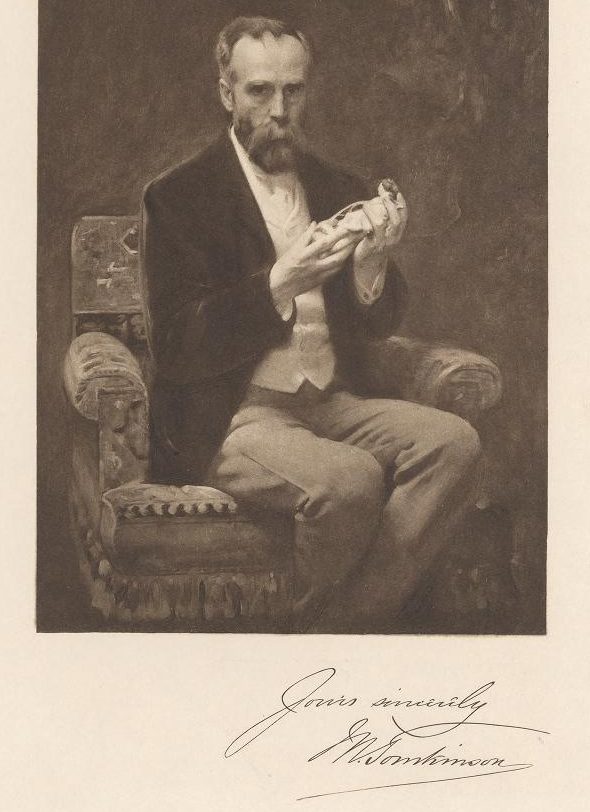
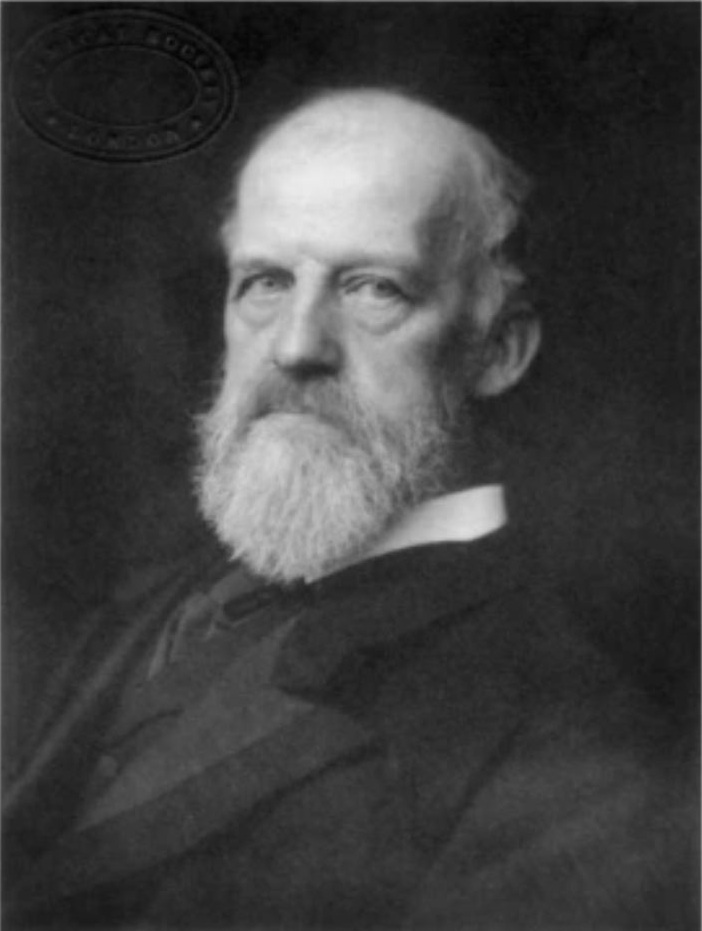
Michael Tomkinson was born in 1841 and died in 1921. He was Mayor of Kidderminster in 1887 and Sheriff of Nottingham in 1892. He had begun collecting Japanese art in 1878, a decade before he made the journey to Japan itself. When he finally went — in 1888, travelling overland and by sea from Kidderminster to Yokohama — he went not as a scholar or diplomat but as a man who had already decided what he was looking for, and who collected thereafter through an art dealer with whom he had built a relationship of trust over years. The collection that resulted was, by any measure of the period, extraordinary: several thousand objects comprising netsuke, inro, lacquer, ivory okimono, ceramics, woodblock prints, textiles, swords, bronzes, and the sword fittings that link him to this series. It was housed eventually in a purpose-built Japanese museum in the grounds of Franche Hall: a dedicated space, not a room pressed into service, not a cabinet in a library, but a structure conceived specifically for the objects it would contain.
This is the detail that separates Tomkinson from most of his British contemporaries. Behrens had a large collection. Church had a systematic one. Gilbertson had an extraordinary breadth of signatures. But Tomkinson built a building. In Kidderminster, in 1887 or thereabouts — in the grounds of a house that his carpet business had made possible — he created what the Museum of Carpet now describes simply as “a Japanese museum.” The gesture is significant: it is not the gesture of a man who collects for private pleasure, but of one who has concluded that what he has assembled requires its own architecture.
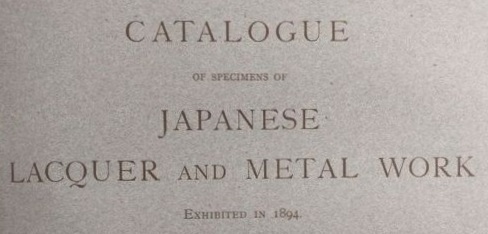
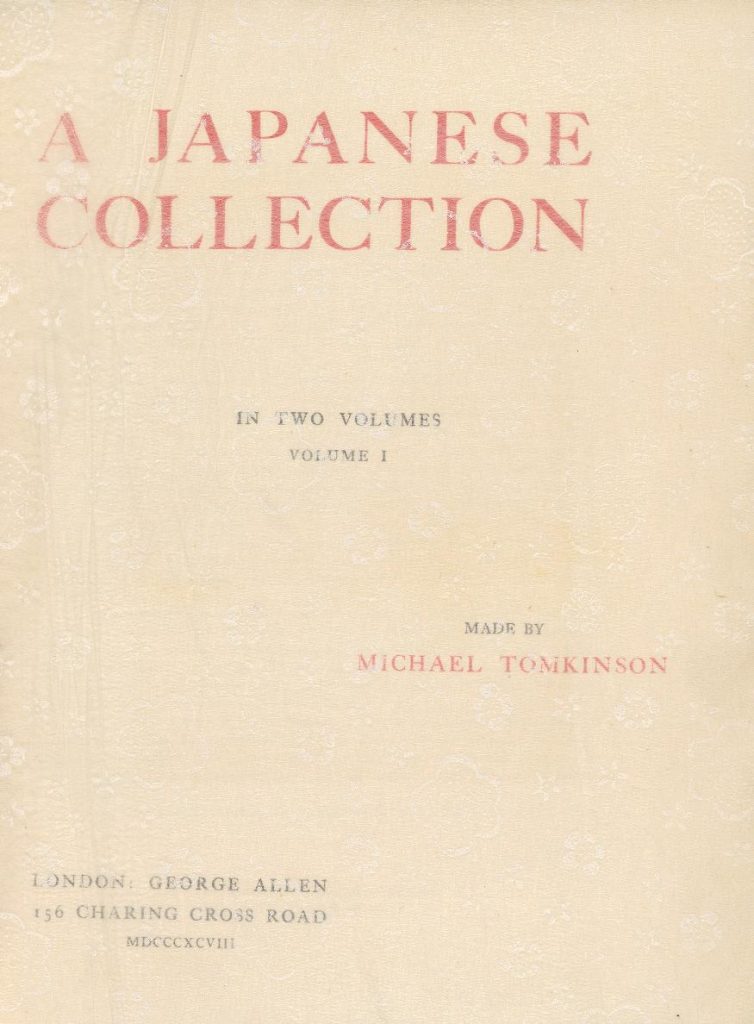
The 1898 catalogue was the natural extension of this conviction. A Japanese Collection, published by George Allen in London in a limited edition of 200 copies — 25 on India paper, 175 standard — is one of the most unusual documents in the history of British Japonisme. Not because of what Tomkinson wrote in it (his own contribution is modest and careful), but because of what it is: a collector who has assembled a team of the field’s leading experts to write about his objects, section by section, each bringing to the catalogue the particular knowledge that Tomkinson himself did not claim to possess.
Gilbertson wrote on swords and metal fittings. Church wrote on stone and pottery. Gleeson White wrote on woodblock prints. W. Gowland — a geologist and archaeologist who had spent years in Japan — wrote on the bronzes. Charles Holme contributed on lacquer. W. Anderson, author of The Pictorial Arts of Japan, handled paintings. Edward F. Strange covered the textiles. The result is less a conventional collection catalogue than a symposium in book form: seven different specialists, each authoritative in their domain, brought together by a man in Worcestershire who had decided that his collection deserved serious documentation and had the resources and the connections to make it happen.
This approach is unlike anything the Joly catalogues would later produce. Joly worked alone — one intelligence, systematically imposed across an entire holding. Tomkinson’s method was to distribute the interpretive labour, to invite expertise rather than deploy it. Each section carries the particular voice and preoccupation of its author. Gilbertson’s section on swords and fittings has the same careful breadth of attribution that characterises his own collecting — the same concern with classification, with the mapping of a territory rather than the appreciation of individual peaks. Church’s section on pottery reflects the same chemist’s eye that shaped his own tsuba collection: attention to material, to surface, to the evidence that the object carries of its own making. The catalogue is, in this sense, also a portrait of the British Japonisme network at a specific moment — the late 1890s, just before Joly would begin the systematic documentary work that would define the following decade.
What the catalogue reveals about the sword fittings holding is significant. Gilbertson — the man who had himself assembled more than 500 artist signatures, whose privately printed catalogue was already a standard reference — wrote the section on weapons and metal. That he was willing to do so is itself a statement about the quality of what Tomkinson had assembled. Gilbertson did not lend his authority lightly. The fittings in Tomkinson’s collection covered the major schools; the presence of pieces subsequently acquired by the Victoria and Albert Museum, the British Museum, and the Ashmolean — all reportedly among the institutional recipients when the collection was sold at auction in London in 1921 — suggests that at least some of what Tomkinson held was of museum quality.
The Japan Society was another dimension of Tomkinson’s engagement. He and his wife Annie — who kept a diary of their life at Franche Hall from 1884 to 1920, a document that now rests in the archive — were active members. Michael served on the council. In this he was part of the same London-centred learned world that sustained Joly’s Japan Society presentations and Behrens’s circle; but he inhabited it from a distance, visiting rather than residing, maintaining his Kidderminster base while participating in the metropolitan conversation.
The relationship between the factory and the collection is worth pausing on. Tomkinson had bought the UK patent rights for the Axminster spool loom — the technological development that transformed the manufacture of a particular kind of carpet from a cottage craft into an industrial process. By 1876, Tomkinson and Adam employed 800 people and produced 4,000 rugs a week. The firm’s design studio employed 24 people. A railway rug for a first-class carriage was a Tomkinson and Adam speciality. This was a man who thought about pattern, surface, material, and the relationship between design and production at industrial scale, every working day of his life.
It would be too neat to say that this background shaped his eye for Japanese decorative art. But it would also be obtuse to ignore it. The design vocabulary of Japonisme had, by the 1880s, worked its way thoroughly into British decorative arts, including carpet design. The Kidderminster carpet industry was not immune to these currents; Tomkinson’s own collection, as the Museum of Carpet’s later exhibition documented, had a tangible impact on local carpet design. A man who collected katagami stencils — hand-cut mulberry paper stencils of the kind used in Japanese textile production — was not making an arbitrary choice. He was looking, across a very large cultural distance, at an industrial process related to his own, and at the aesthetic tradition that that process served.
Franche Hall was demolished in 1924, three years after Tomkinson’s death. The collection had already been dispersed at auction in London. The building that had housed the Japanese museum in the grounds is gone. What remains is the catalogue: 200 copies, of which an inscribed copy — number seven — appeared at Mallams in Cheltenham in 2023, offered by a direct descendant, with an estimate that placed it in the range where serious reference works sit. And the objects themselves, scattered: some in the V&A, the British Museum, the Ashmolean; some at the Museum of Carpet in Kidderminster; some in private hands, passing through the auction rooms with the faded label of a Worcestershire collection attached.
The catalogue, though, endures in a way that the collection itself cannot. A Japanese Collection is something more than a record of what Tomkinson owned. It is the last major British document of the Japonisme collecting world before Joly institutionalised it — before the private printing of 300 numbered copies, the collotype plates, the systematic indices of signatures in Japanese characters, became the standard form. Tomkinson’s catalogue is messier, more various, more personal, written by many hands rather than one. It captures a moment when the field in Britain was still constituted by amateurs in the true sense: people who approached Japanese art from the outside, bringing to it the specific expertise of their other lives — the chemist’s knowledge of pigment, the geologist’s familiarity with stone, the manufacturer’s eye for pattern and surface — and who found in it something that their other lives had not quite provided.
After 1908, Joly would set the template. Before 1908, there was Tomkinson, and Gilbertson, and Church, and a catalogue produced in Worcestershire by a man who had built a Japanese museum in his garden and decided that it deserved to be written up properly, by the best people available, in a book limited to 200 copies.
That is, in its way, a precise definition of what serious collecting looks like before the professionals arrive.
Sources
- Tomkinson, Michael, et al. A Japanese Collection. 2 vols. London: George Allen, 1898. Limited edition of 200 copies. Essays by Tomkinson, Gilbertson, A.H. Church, Gleeson White, W. Gowland, Charles Holme, W. Anderson, and Edward F. Strange. Digitised: archive.org/details/japanesecollecti02tomk
- Bordignon, Laura. “Empire of the Sun.” Published by the British Antique Dealers’ Association (BADA). [bada.org] — The most detailed secondary account of Tomkinson’s biography, the Japan voyage, and the collection’s institutional dispersal.
- Museum of Carpet, Kidderminster. “Journey to Japan” exhibition notes. [museumofcarpet.org.uk] — Documents the 1888 voyage, the Japanese museum at Franche Hall, and the collection’s impact on Kidderminster carpet design.
- Mallams Auctioneers, Cheltenham. Japanese Art Sale, May 2023. — Includes inscribed copy No. 7 of A Japanese Collection, sold by a direct descendant; lot notes provide additional biographical detail.
- Joly, Henri L. Legend in Japanese Art. London: John Lane, 1908. — References Tomkinson collection pieces, establishing his standing in the field before Joly’s systematising work.