Ein Licht im Regen
Aridoshi by Tsuneshige
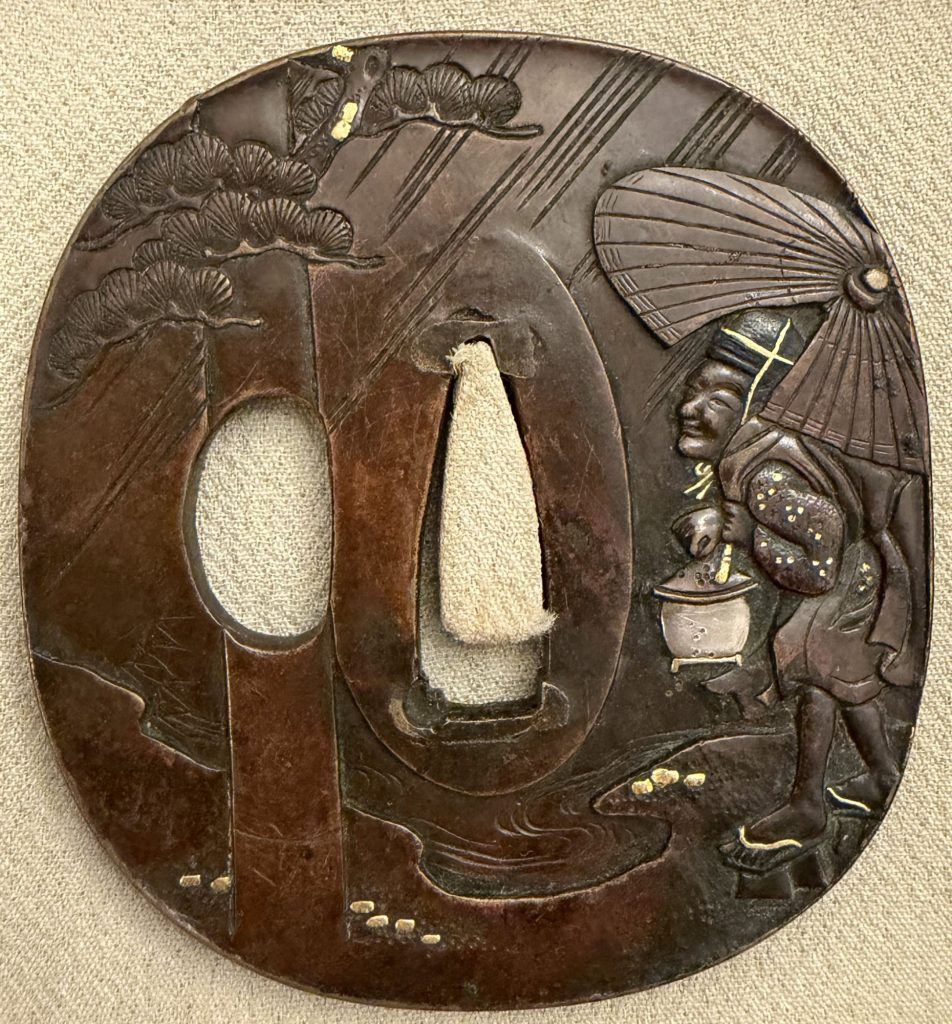
On this Aridoshi tsuba, an old man walks through the rain. He wears a black cap, holds a large paper umbrella over his shoulder and carries a lantern low in one hand. His robe is dotted with gold, and wooden clogs keep his feet out of the wet. Rain falls in slanting strokes from the upper right. At the left a single upright post rises past a pine, and a stream winds across the foot of the plate. There is no rider, no horse and no poet. Only the old man and the light he carries.
Das Objekt
The plate is sentoku, a brass alloy, under a deep reddish patina. The figure is carved in relief, his cap in a dark alloy, the lantern in silver. The rain is cut as bundles of fine parallel lines, kebori. Small dots of gold are inlaid along the stream, on the robe and on the pine.
The left hitsu-ana sits inside the upright post, and the post widens around it. The opening belongs to the design rather than cutting into it. Read together with the legend, the post is one leg of a torii, the gate of a shrine.
Die Legende
JAANUS, the dictionary of Japanese art terms, tells the story. Aridoshi is a shrine in Izumi province, near present-day Osaka. One rainy night the poet Ki no Tsurayuki rode past it, and his horse fell ill. He learned that the god of the shrine was angry, because he had passed on horseback. Tsurayuki calmed the god with a poem. It turns on the words ari to hoshi, there are stars, which can also be heard as Aridoshi. Zeami later made the story into a Noh play in which the god himself takes the leading role.
In pictures the god appears in disguise, as an old shrine priest with an umbrella and a lantern. JAANUS adds that umbrella and lantern are sometimes shown on their own. This guard takes that course. The poet and his fallen horse are left out. The god remains, and the rain.
Die signierte Seite
The other face keeps the rain and loses the figure. An old pine rises along the left edge, its trunk opened by a large knot hole and touched with gold. A wooden fence of posts and rails stands below, and water runs along the bottom. Beside the central opening, between it and the right hitsu-ana, the guard is signed 常重, Tsuneshige.
The Metropolitan Museum of Art lists Kawamura Tsuneshige of the Nara school, active in the late eighteenth century. The Museum of Fine Arts, Boston, files guards under a Tsuneshige sub-school of the Nara line.
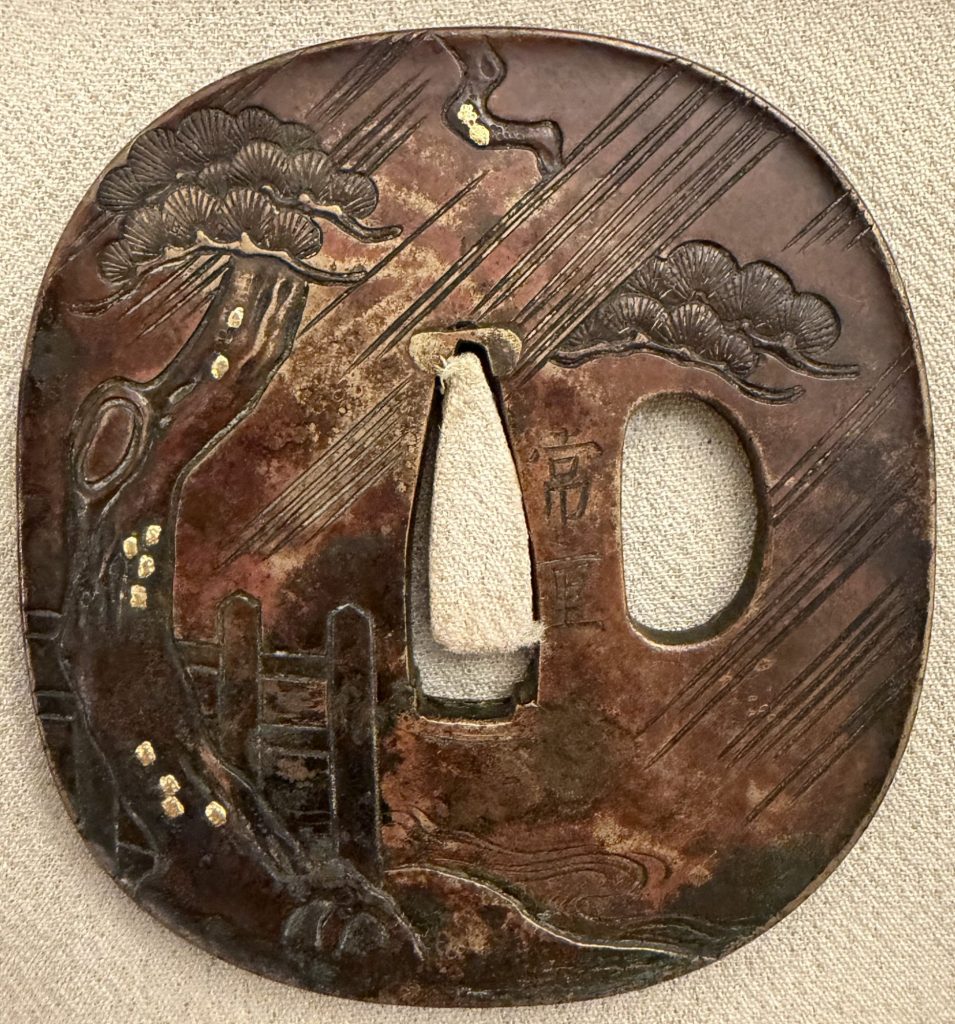
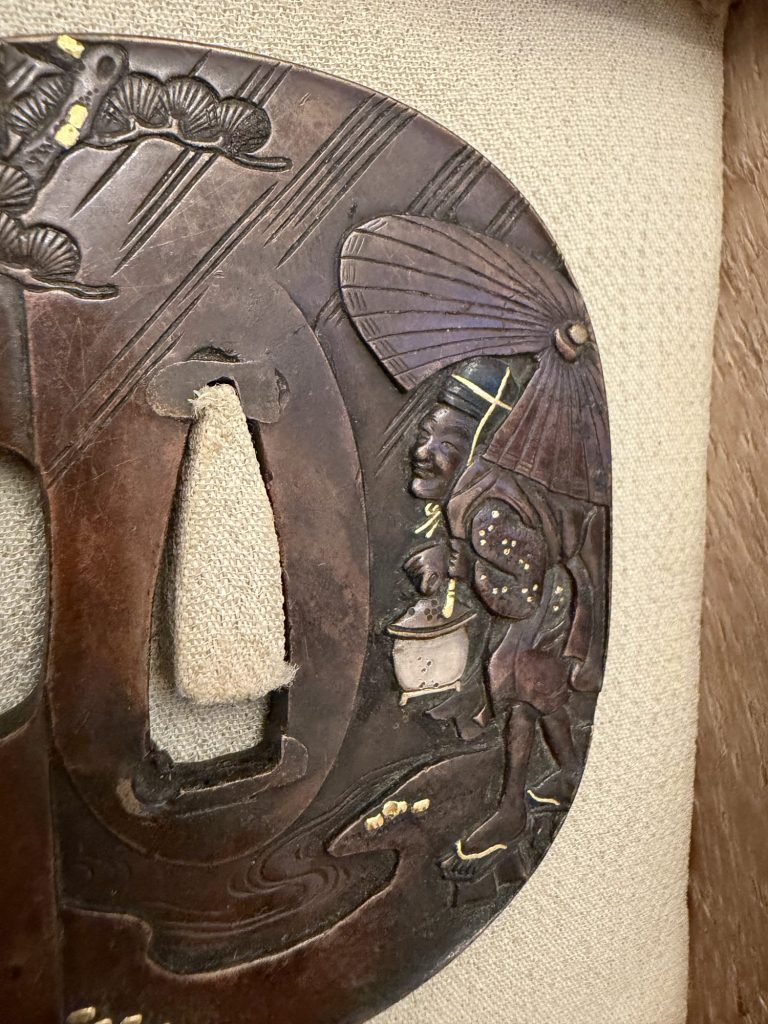
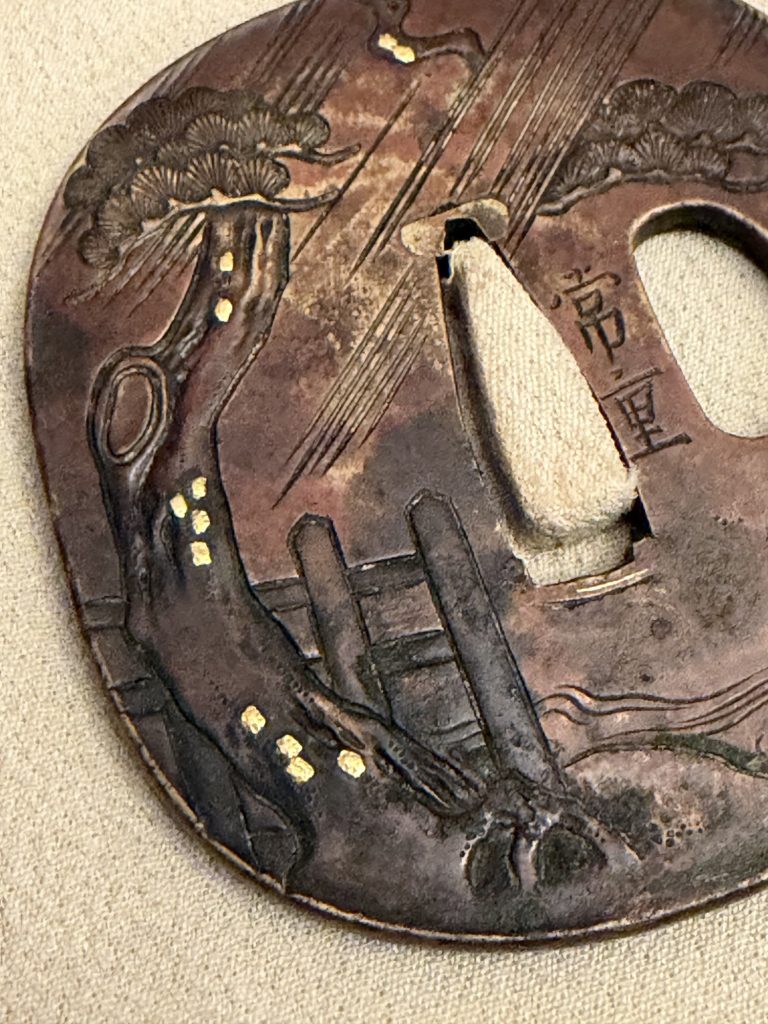
Tsuneshige’s Aridoshi Tsuba
Tsuba. Signiert Tsuneshige. Sentoku mit rötlicher Patina, Relief, kebori, kin-zogan, Einlagen in Silber und dunkler Legierung. Aridoshi: der Gott als alter Schreinpriester mit Schirm und Laterne im Regen, daneben ein Torii-Pfosten. Rückseite Kiefer, Zaun und Regen. Edo-Zeit. Privatsammlung, erworben in Japan.
In the collection
- Type
- Tosogu › Tsuba
- School
- Nara › Tsuneshige
- Period
- Edo-Zeit
- Material
- Sentoku
- Motif
- Mensch und LegendeGötter und Glücksbringer