All three guards are unsigned. None of them carries a name that a paper could confirm or reject. What the NBTHK gives for each is an attribution: a judgement from the work, made by appraisers who have seen many guards of the same kind. The three judgements reach different depths.
Akita
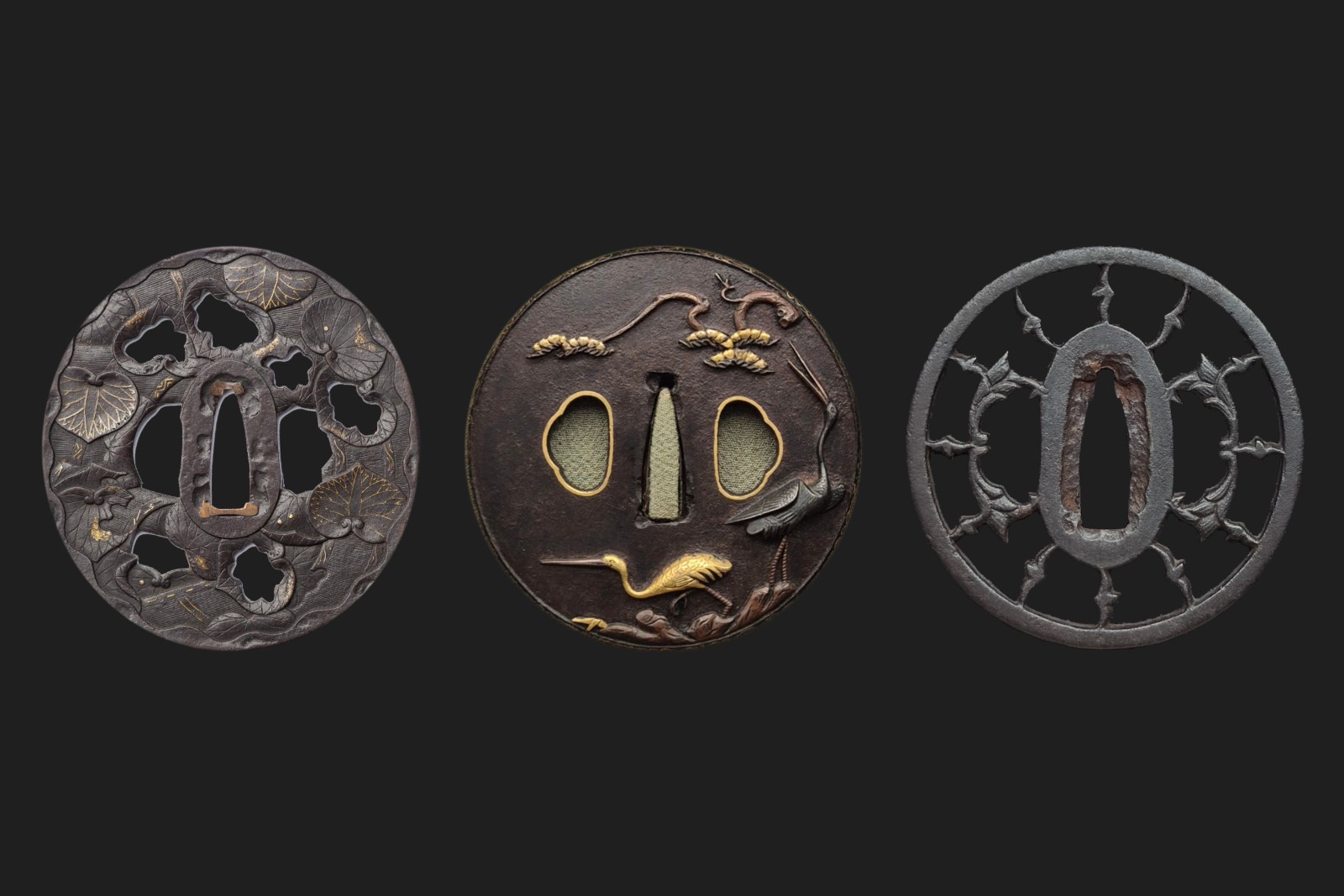
The first guard is round and iron. Leaves of aoi drift across it, between and over rafts cut with parallel lines, the joints of the rafts marked with small chevrons of gold. Openings with soft outlines let light through the plate. The paper, Tokubetsu Hozon, gives it to the Akita Shoami.
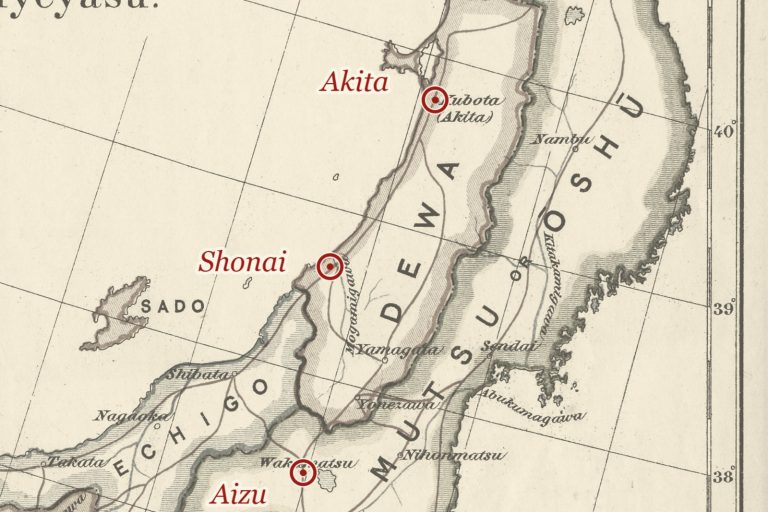
It was not always so. When this guard was first published on this site, it stood as work of the Ito school of Edo. The shinsa placed it in Akita, at the other end of the country, and the page now says so.
A. J. Koop, cataloguing the Church collection in Oxford, had several guards with aoi among his Shoami. One, with aoi leaves floating on water, he placed in Kyoto. The others he left among the unclassified guards. The same motif, sorted three ways: Kyoto, no place, and now Akita. A motif does not fix a branch. The work around it does.
Aizu
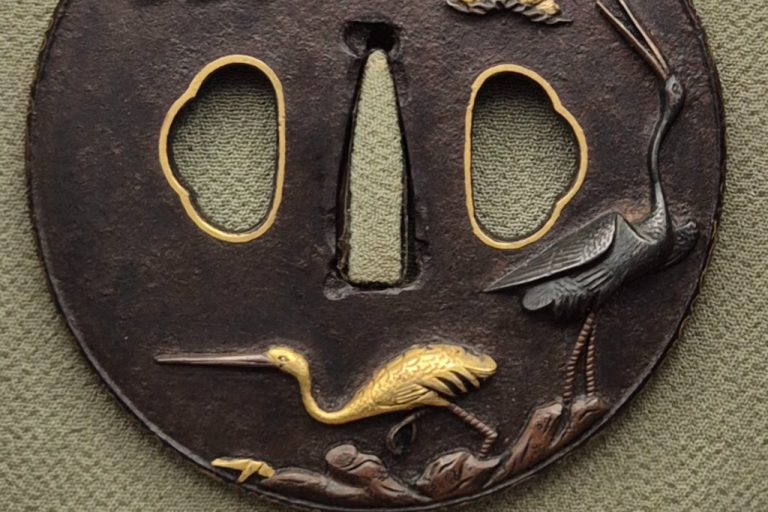
The second guard is round and iron too, and most of its field is left open. A pine branch with gold needles reaches across the top. A dark crane in shakudo stands at the right, a gold crane moves low over the rocks. The rim is left standing from the plate and inlaid with gold, and both side openings, the hitsu-ana for the small knife and the hairpin, are lined with gold. The paper, Hozon, names the subject, a pine with a pair of cranes, and gives the guard to the Aizu Shoami.
Koop had eight guards from Aizu, with subjects as different as a crab under bamboo, a demon queller and chessmen. A branch had no fixed repertoire of motifs. What it had was the hand of a workshop.
No branch
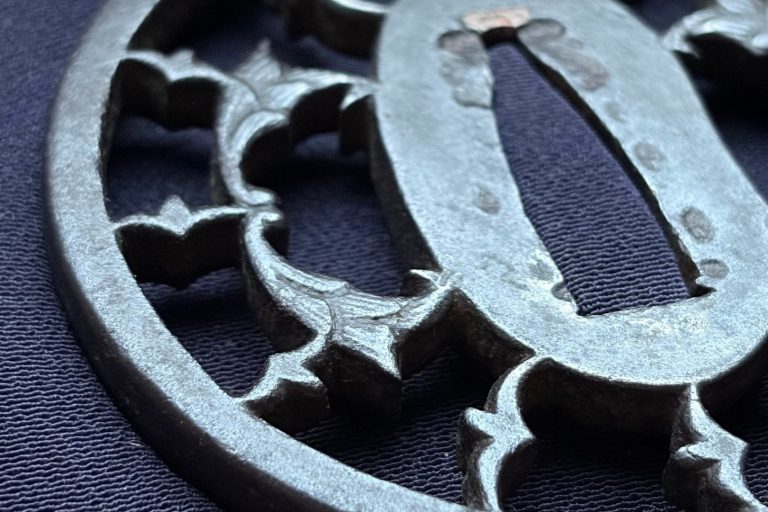
The third guard is the pierced plate of the second part of this series, with ginger buds and wild geese cut through the iron. It is iron like the other two, and it carries no inlay at all. Its paper, Hozon, gives it to the Shoami and names no branch.
Koop had a guard with flying geese, karigane, as well, and he placed it among the unclassified Shoami. Almost a century apart, a catalogue in Oxford and a shinsa in Japan stop at the same point with the same bird.
What a paper says
Read together, the three papers say three different things.
A paper with a branch says that the work shows the habits of one provincial workshop clearly enough to place it. It does not name a maker.
A paper without a branch says that the work shows the habits of the school, and that its place cannot be read from it. That is a smaller claim, and an exact one. It is the claim the appraisers could stand behind.
Neither kind of paper settles what the name Shoami meant to the men who used it. The first part of this series showed silversmiths of the shogun in the sixteenth century. The guards in this collection were made later, in the Edo period, two of them in castle towns in the north. Between the two the documents are silent.
The remainder
The series on the five traditions of the sword ended with the blades that fit none of the five, the remainder that shows how a map was made. The Shoami have their own remainder: the guards that the papers give to the school and to no place. In Koop’s catalogue it was about half of all his Shoami. In this collection it is one guard in three.
It is also the guard that sent this series on its way. It was taken off its mounting because its iron raised a question. The answer came back as a name.
The Shoami: all parts
The three guards and their papers, side by side: The Shoami: Three Papers, One Name
Sources
- A. J. Koop, The A. H. Church Collection of Japanese Sword-Guards (Tsuba), chapter “Shōami school”, Ashmolean Museum, Eastern Art Online: EAX.10239 (aoi floating on water, Kyoto), EAX.10291 and EAX.10292 (aoi, unclassified), EAX.10282 (karigane, unclassified), EAX.10263–10270 (Aizu).
- Collection pages: Akita Shoami tsuba with aoi and rafts; Aizu Shoami tsuba with pine and cranes.
- Part 2 of this series for the third guard; “What the Map Leaves Out” in the series The Five Traditions.