Every list of the five traditions has a remainder. The blades that fit none of the five are called wakimono, things from the side. They come from smiths in provinces far from the five centres, or from schools that mixed what they found. Overviews give them about a fifth of the old blades. It is tempting to treat them as a footnote. They are better read as the place where the map shows how it was made.
A remainder that moves
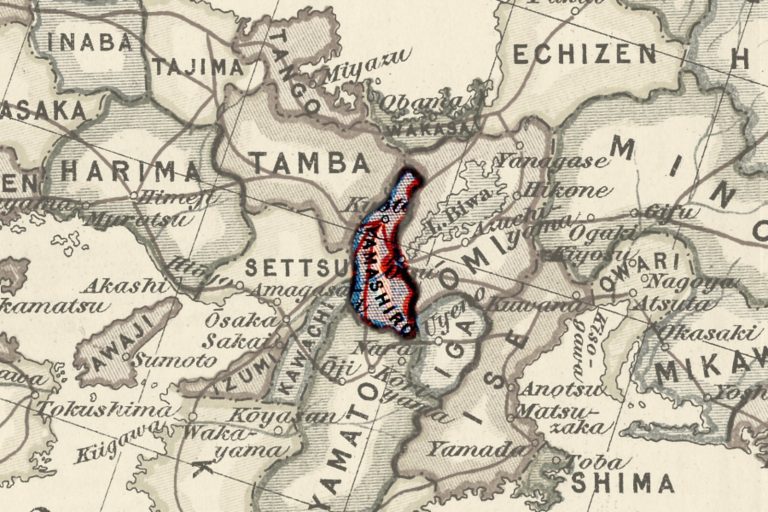
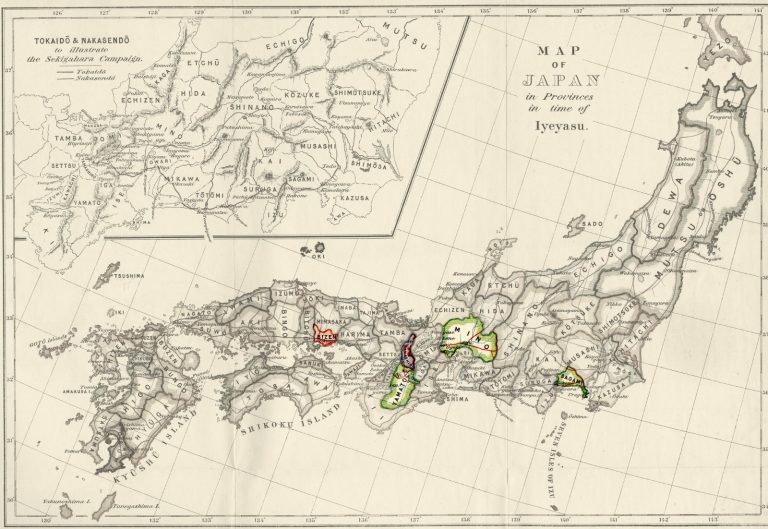
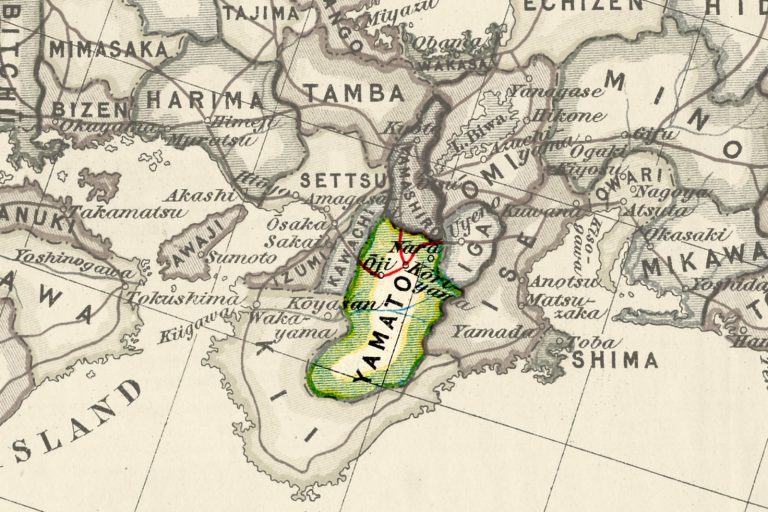
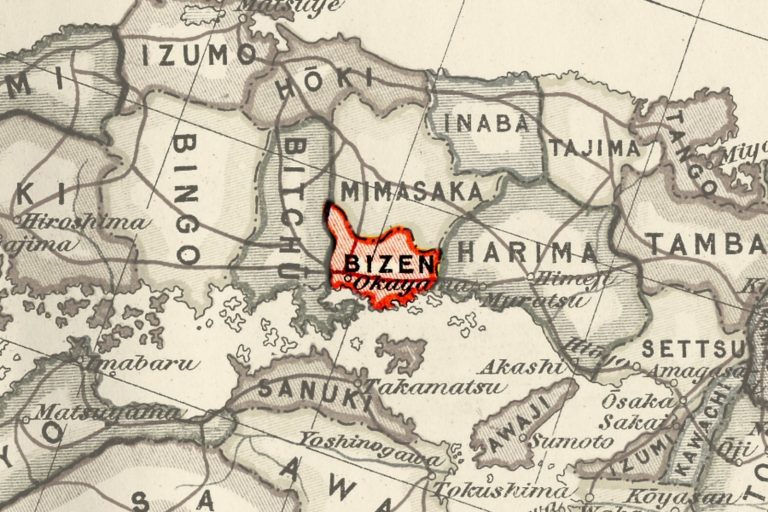
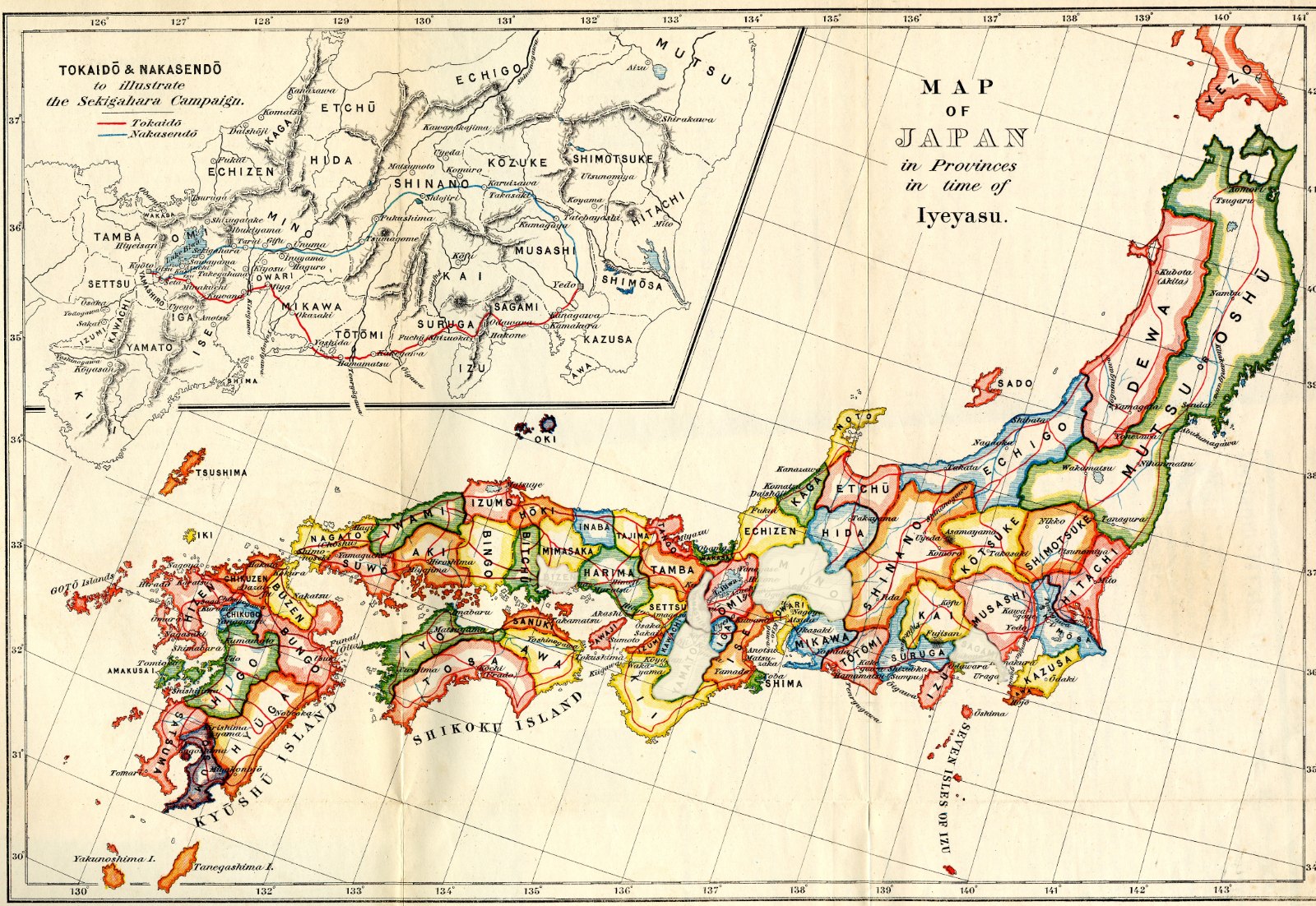
What counts as a side school depends on who draws the map. Tanobe Michihiro, in his volumes on Yamashiro and Yamato, moves a whole group of schools from the margin into the centre. The Enju of Higo, in Kyushu, he counts with Kyoto, because their founder was a grandson of Rai Kuniyuki and their blades follow Rai. The Naminohira of Satsuma, the Uda of Etchu, the Fujishima and Asako of the Hokuriku, the Mihara of Bingo and the Nio of Suo he counts with Yamato, as offshoots carried out by the estates and temples of Nara. In many other books these are wakimono.
Neither view is wrong. One sorts by place, the other by descent. The second needs evidence of descent, and Tanobe gives it in the blades: a high ridge line, straight grain, a straight temper with frayed lines and streaks, a tang finished with crossed file marks. Where the evidence points elsewhere, he says so. The Mihara smiths of Bingo share the high ridge line of Yamato but not its wide ridge surface. In a blind appraisal, he writes, most would guess a Mihara blade to be from the Aoe school of neighbouring Bitchu.
A story from the margin
The Naminohira smiths of Satsuma claimed a founder who came from Yamato in the tenth century; no blade by him exists. One of their blades, called Sasanuki, comes with a legend that a later smith of the line, counted as its sixty-fourth generation, wrote down in 1886. The smith Yukiyasu forbade his wife to enter the forge while he worked on a blade meant to be handed down through all later generations of his line. Worried, she looked in. He believed the blade spoiled, struck it on the anvil and threw it into the bamboo behind the forge. At night a light shone there. When the village elders searched, they found the sword standing upright, point to the sky, with the bamboo leaves that had fallen on it speared on its point. Sasa, bamboo leaves; nuku, to pierce. The blade went to a family related to the Shimazu, who believed it brought good fortune if taken out on one sunny day each year. A well called Sasanuki still gives water, and a tram stop nearby carries the name.
The story tells nothing about Yamato. It tells how a provincial school kept its own memory, apart from the map that would later file it.
The Fujishima blade
A hira-zukuri wakizashi in this collection is attributed to the Fujishima of Kaga. It has no paper. Its temper is a broad undulation with rounded waves, in strong crystals, and its grain shows burl near the collar.
The Fujishima are a good test of the map. Tradition places the school in Echizen and makes its first master, Tomoshige, a pupil of Rai Kunitoshi in Kyoto. A dated blade of 1409 shows the school in Kaga by then. Tanobe finds that a Rai teacher is possible in time but not in style, and that the other candidate, Kashu Sanekage, fits the style but came too late. He places the school’s origin in Yamato, with the Shikkake smiths, on the evidence of the tang, the rounded joined waves of the temper and a tanto form common in Yamato, kanmuri-otoshi. He notes that the Fujishima temper is often described as a cross between Mino and Bizen, and that some Fujishima blades show a reflection in the steel in the Bizen manner. One school, and four traditions named in its account.
Higo: blades and fittings
Higo, in central Kyushu, lies off the map of the five for blades, and it is rich in fittings. It had the Enju smiths in the fourteenth century. In the Edo period, under the Hosokawa, it had metalworkers whose iron guards and fittings became a tradition of their own, the Higo-kinko. An unsigned wakizashi in this collection is given by its paper to the Enju school. Its mounting is not from Higo. A tanto signed Kanetaka of Mino sits in a mounting in the Higo manner. In this collection the Higo blade and the Higo taste sit on different swords.
The Higo fittings were one of the first Japanese subjects that a European collector studied from the Japanese texts. In 1905 Gustav Jacoby in Berlin brought the Higo Kinkoroku, a record of the Higo metalworkers, into German. The map of fittings was learned in Europe the same way as the map of blades: from books, and often before the objects.
What the series leaves
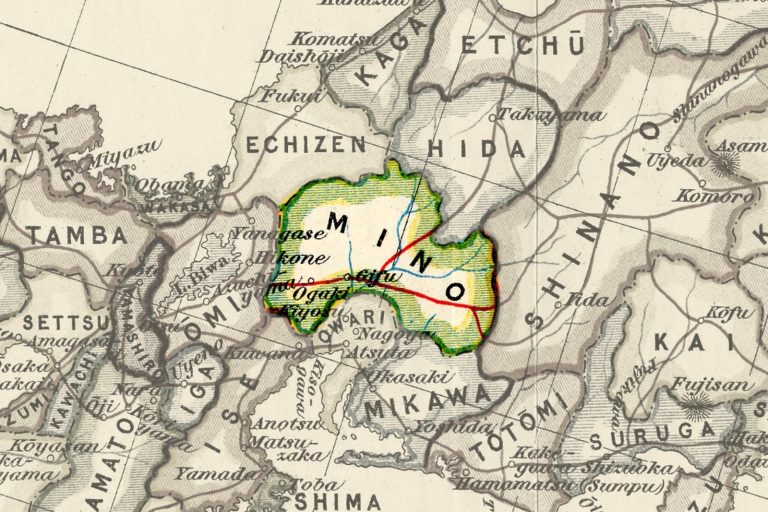
Five traditions and a remainder. Read through the collection, the remainder is not small. An Enju blade that is Kyoto by descent and Kyushu by place. A Fujishima blade that may be Yamato by origin and Kaga by address. A Mishina blade from a Mino family that worked in Kyoto and Osaka in the shinto period. A Tsunahiro blade that carries a Soshu name into the sixteenth century and beyond. On each of them the map shows its folds.
For the collector this is a method as much as a problem. Learn the five, then learn where each one leaks. A blade that sits between two traditions often tells more than one that sits at the centre about how the traditions were made.
What to look for
- Signs of one tradition in a blade from another province: a Yamato ridge line in Satsuma, a Rai temper in Higo.
- In Ko-Mihara, Nio and Ko-Naminohira blades: a high ridge line with a narrow ridge surface.
- In the point, a round return that falls back steeply, like a waterfall, in Ko-Mihara; round but brief in Enju.
- A subdued, slightly blurred line of the temper, urumi, in Nio and Ko-Naminohira work.
- Above all, the tang: its shape, file marks and the finish of its end often say more about descent than the signature.
Sources
- Tanobe Michihiro, The Japanese Sword: … The Yamato Tradition: ch. 1 (spread of Yamato), p. 12; Naminohira and Sasanuki, pp. 105–112; Fujishima and Asako-Taima, pp. 122–125; Mihara, pp. 130–137; Nio, pp. 143–145.
- Tanobe Michihiro, … The Yamashiro Tradition: Enju, p. 202.
- Gustav Jacoby, German edition of the Higo Kinkoroku (1905), after the essay on Jacoby on tosogu.eu.
- Wikipedia (de), “Gokaden” (share of the five traditions among old blades).
- Collection pages: Fujishima wakizashi, Enju wakizashi, Kanetaka tanto, Kanemichi wakizashi, Tsunahiro wakizashi, the Mishina study.
The Five Traditions: all parts
Overview of the series, with the blades of the collection: The Gokaden