Was die Politur genommen hat
A Tanto by Osafune Morimitsu

A tanto in a red lacquered saya, its hilt wrapped in dark blue silk. The blade inside is flat on both faces, without a ridge, and grooves run down both faces toward the point. The tang is signed by a smith of Osafune in Bizen and dated to the year 1411. What the blade no longer shows is as much a part of it as what it does.
Das Objekt
The blade is hira-zukuri. A broad groove runs along the omote, two narrow ones along the ura. They end just above the tang. The hamon is suguha, straight and narrow and even. The polish is tired now, and the grain and the point are hard to read.
Was die Politur genommen hat
Bizen blades of the Oei era are known for utsuri, a pale shadow of the hamon that stands in the steel above it. This blade shows none. Utsuri forms in the outer skin of the steel, and every polish takes a little of that skin away. A blade polished again and again over six centuries can lose it.
Read that way, the missing utsuri says nothing against the blade. It records how long it was kept in condition, and how often someone decided it was worth the work.
Die signierte Seite
The tang has one peg hole. Below it the omote reads 備州長船盛光, Bishu Osafune Morimitsu. Bishu is the short form of Bizen province, Osafune the village of its largest workshops.
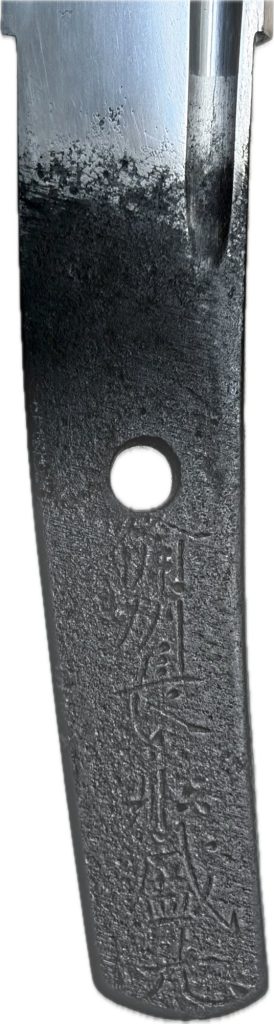
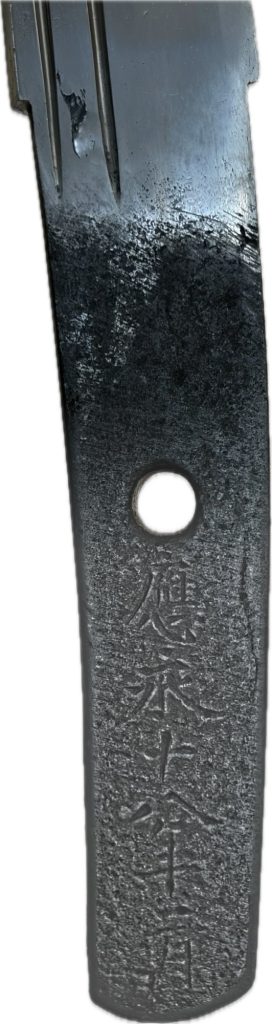
The ura carries the date, 應永十八年, the eighteenth year of Oei, which is 1411. The character for the month follows at the end of the tang; the number before it is worn away. Both photographs of the tang are shown with raised contrast, so that the cuts read against the rust. The blade has not been to shinsa, and the attribution rests on the signature.
Oei-Bizen
The Oei era ran from 1394 to 1428. After the unrest of the late fourteenth century, the Osafune workshops found a settled manner again. Morimitsu is one of their smiths in these years. The Oei-Bizen smiths often dated their blades, which lets a signature be tested against other dated work by the same hand.
Die Montierung
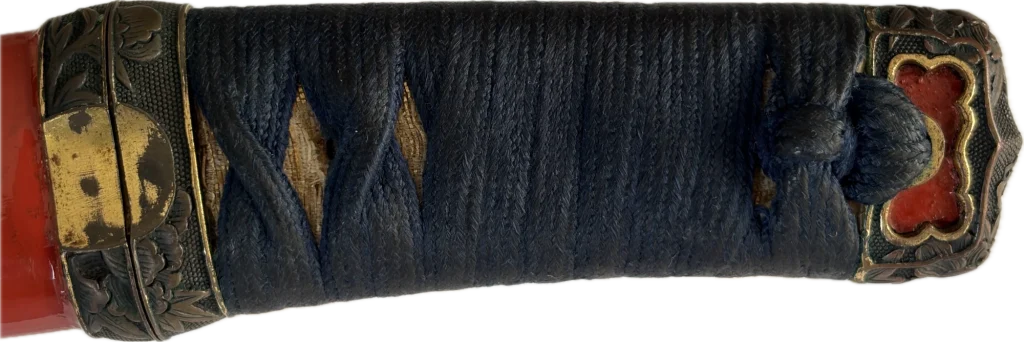
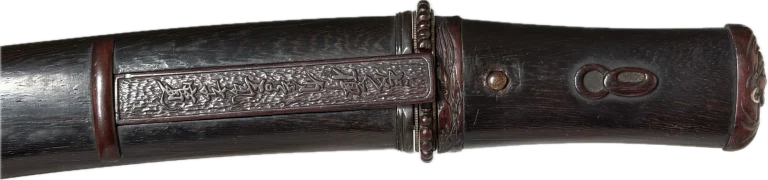
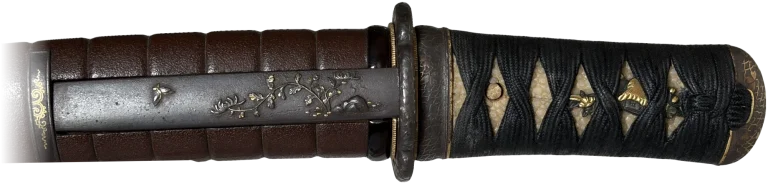
The mounting is an aikuchi, without a tsuba: hilt and saya meet directly. The saya is lacquered red. The hilt is wrapped in dark blue silk, and where rayskin would usually lie beneath it, a gilded woven fabric takes its place. There are no menuki. Fuchi and kashira are of dark metal, most likely shakudo.
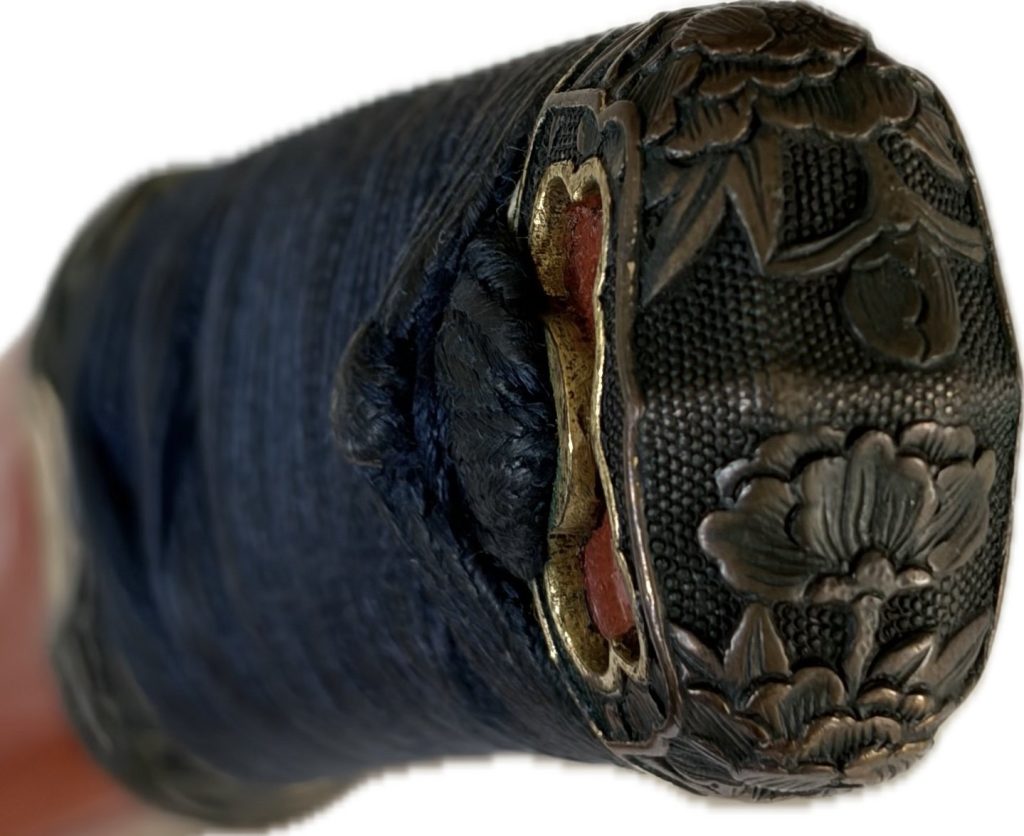
The kashira is carved with peonies and their leaves in relief, the flowers open, the ground between them finely punched.
The Morimitsu Tanto
Tanto. Signiert Bishu Osafune Morimitsu (備州長船盛光), datiert Ōei 18 (1411). Hira-zukuri, Bo-hi auf der Omote, Futasuji-hi auf der Ura. Suguha, Utsuri durch Polituren nicht mehr sichtbar. Koto. Aikuchi-Koshirae ohne Tsuba und Menuki, rote Lack-Saya, blaue Tsuka-Ito über vergoldetem Gewebe, Fuchi-Kashira wohl Shakudo mit Päonien. Privatsammlung, erworben in Europa, zuvor in einer europäischen Sammlung.
In the collection
- Type
- Nihonto › Tanto
- School
- Bizen Osafune
- Period
- Muromachi
- Blade period
- Koto
- Tradition
- Bizen