Eine Montierung aus Holz
A Tanto Attributed to Iga no Kami Kinmichi
A tanto in a mounting carved from one dark, hard wood. Saya, hilt, guard and fittings are all of it. Where other mountings use metal, a carver has done the work, and everything he made points to one figure: Daruma, the monk who brought Zen to China. His face looks out from the end of the hilt.
Die Klinge
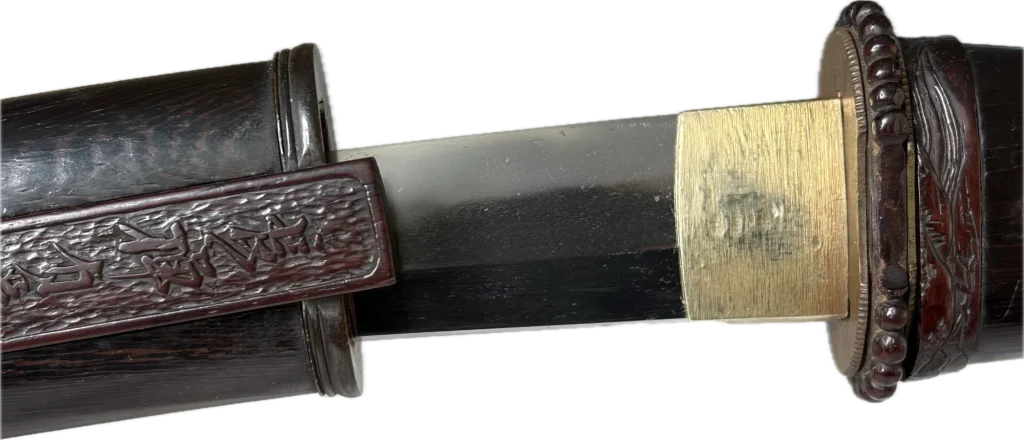
The blade is a short tanto in nagamaki-zukuri, a naginata in small. From the habaki the back slopes away toward the point, and the edge rises into a broad curve. The tang is ubu, in its original length.

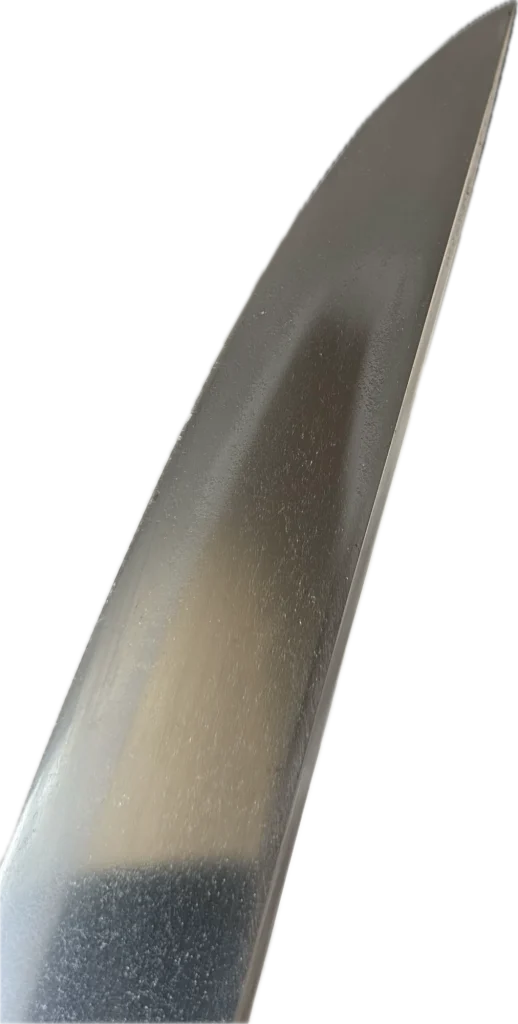
The jigane is a dense itame with ji-nie. The hamon is suguha for most of its length, straight and calm, and opens into one large wave in the lower part of the blade. It is worked in nie.
Daruma
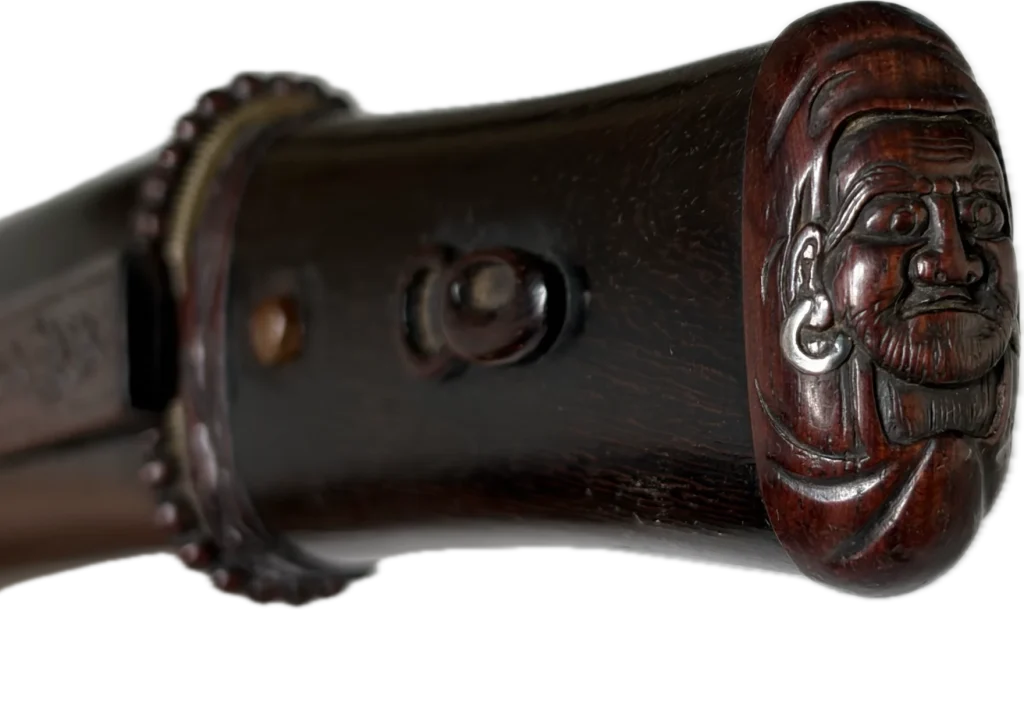
The kashira is carved as the head of Daruma: the robe drawn over his head like a hood, heavy brows, wide open eyes. Two small inlays of silver mark his earrings. JAANUS, the dictionary of Japanese art terms, describes the usual image of Bodhidharma in the same way, with large earrings and staring eyes. Legend explains the eyes by the lids he cut away to stay awake in meditation.
Daruma is the theme of the whole mounting, not of the hilt alone. The fuchi shows a quiet landscape with a river. Read with the rest, it recalls the best known episode of his journey, the crossing of the Yangtze on a reed, which JAANUS lists as Royo Daruma. The menuki differ from side to side.
Holz statt Metall
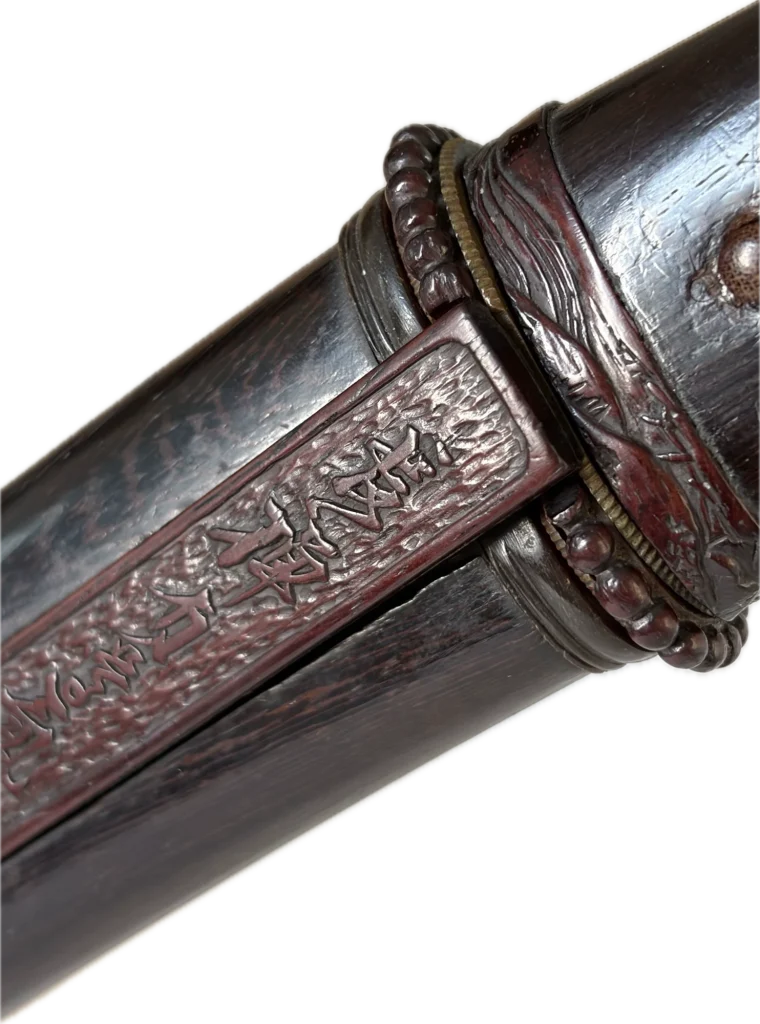
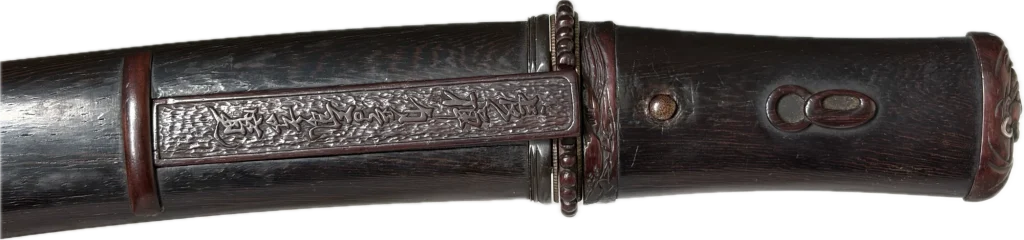
The tsuba is carved from the same wood as a ring of beads, held by two seppa of copper. With the monk’s face on the hilt and the whisk at the end of the saya, the beads recall a juzu, the string of prayer beads used in Buddhist devotion. Beside it a kozuka sits in the saya, its handle of the same wood and carved with a line of characters. It may be a poem or a religious verse. So far no one has been able to read it. The small knife itself is iron, as it should be, and signed, though the signature is hard to make out.
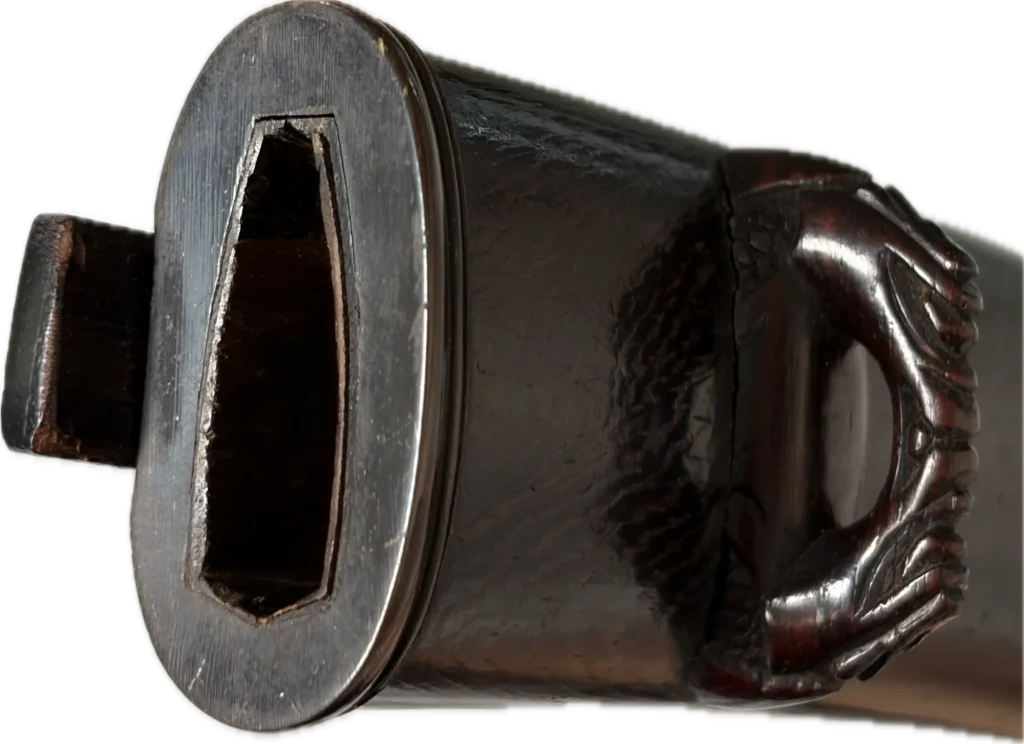
The mouth of the saya is reinforced with horn. The kurikata, the knob that holds the cord, is carved as a tree stump. None of the Daruma legends traced so far accounts for it.
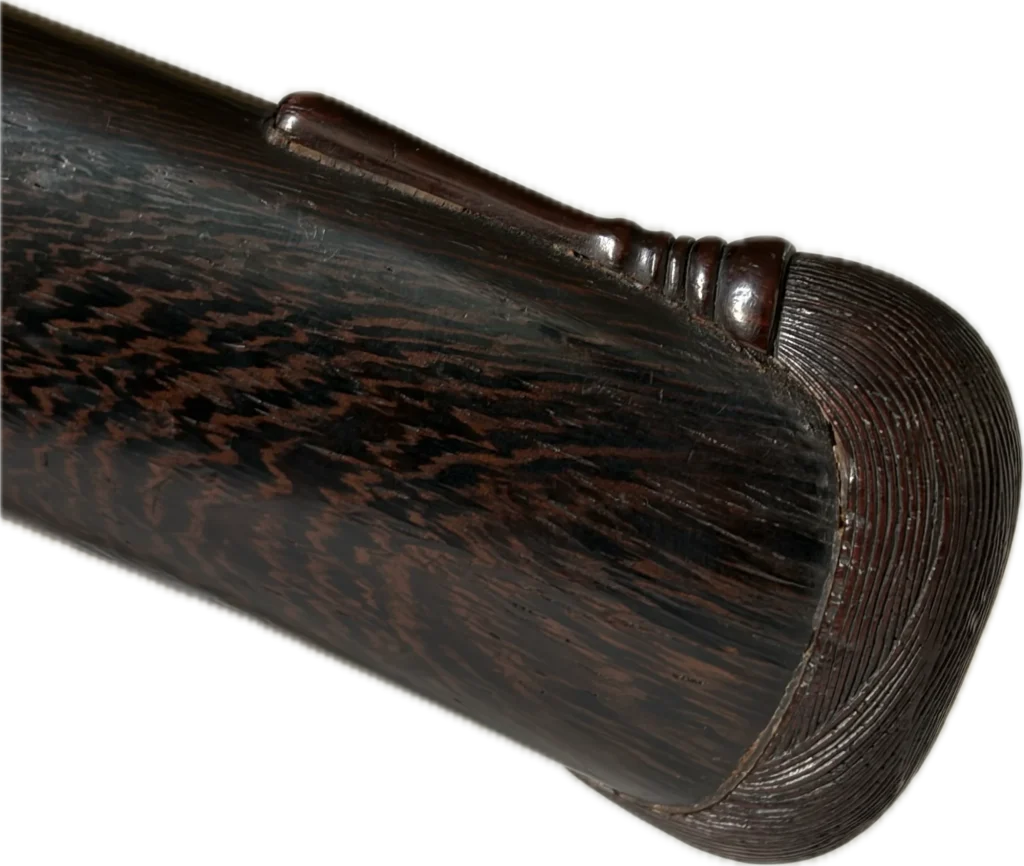
At the end of the saya the kojiri is carved as a whisk, its strands cut one by one. It reads as a hossu, the whisk that Zen priests carried as a sign of spiritual leadership. JAANUS adds that in Zen it stood for the subjugation of desire. Daruma often holds one, as in netsuke at the Toledo Museum of Art and at LACMA.
The wood is very hard and dark, with a fine banded grain. A Japanese koshirae maker who held the tanto in Utrecht named it ironwood, Senna siamea. Inside, the saya is lined with honoki, the soft magnolia wood used for scabbards. No other mounting in this collection is made this way.
Die Zuschreibung
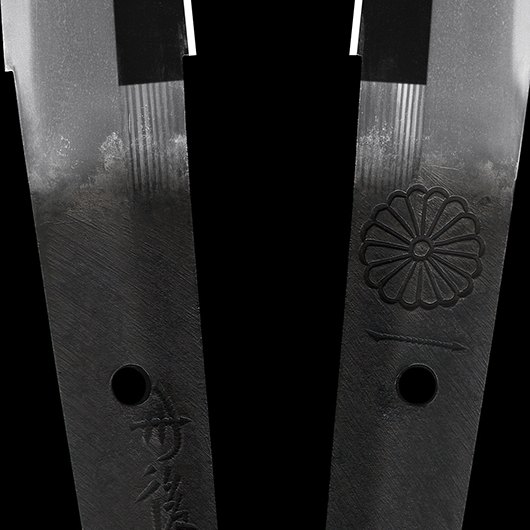
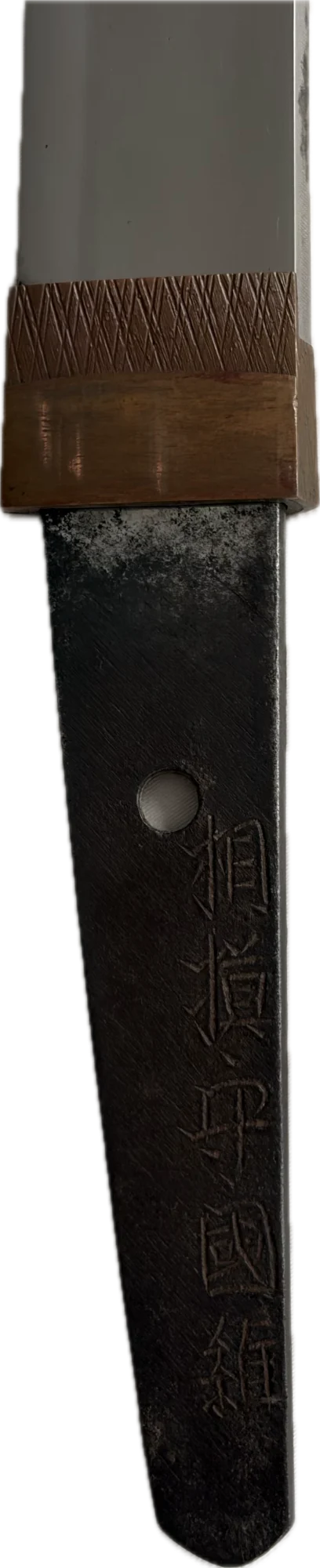
The tang is signed, but the signature has corroded too far to be read. The attribution to Iga no Kami Kinmichi comes from a Japanese expert who examined the blade. It points to the first generation of the name, which places the blade before 1629. It has not been to shinsa.
Kinmichi belongs to the Mishina of Kyoto, the family that came from Mino at the end of the sixteenth century. Markus Sesko writes that the first Iga no Kami Kinmichi, who died in 1629, forged a thousand tachi for Tokugawa Ieyasu before Sekigahara. Ieyasu then had the court grant him the title Nihon kaji sosho, which carried the right to cut the imperial chrysanthemum on his tangs. Through that office the family became the link at court through which swordsmiths across Japan applied for their honorary titles.
Another branch of the same family made the wakizashi by Tango no Kami Kanemichi in this collection.
The Kinmichi Tanto
Tanto. Signiert, Signatur korrodiert und unlesbar; zugeschrieben Iga no Kami Kinmichi, erste Generation, Mishina. Nagamaki-zukuri, ubu. Dichtes Itame mit Ji-nie, Suguha mit großer Welle im unteren Teil, Nie-deki. Shinto. Koshirae ganz aus Eisenholz (Senna siamea) zum Thema Daruma: Kashira mit Silberohrringen, Tsuba als Perlenkranz, Kozuka aus Holz mit Inschrift und Kogatana aus Eisen, Koiguchi aus Horn, Kurikata als Baumstumpf, Kojiri als Wedel. Privatsammlung, erworben in Europa, zuvor in einer europäischen Sammlung.
In the collection
- Type
- Nihonto › Tanto
- School
- Mishina
- Period
- Edo-ZeitEdo-Zeit › Frühe Edo-Zeit
- Blade period
- Shinto