Der zugesprochene Name
An Unsigned Wakizashi, Enju

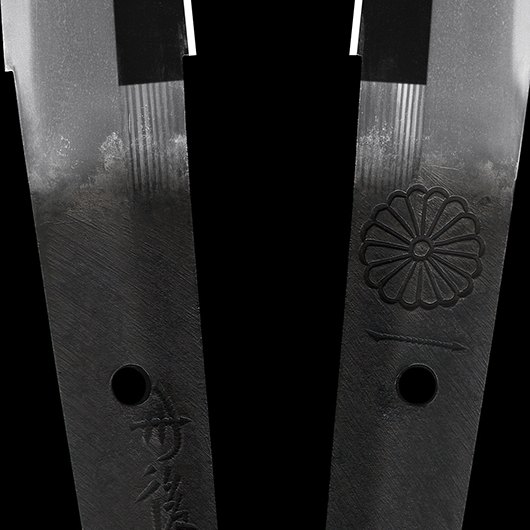
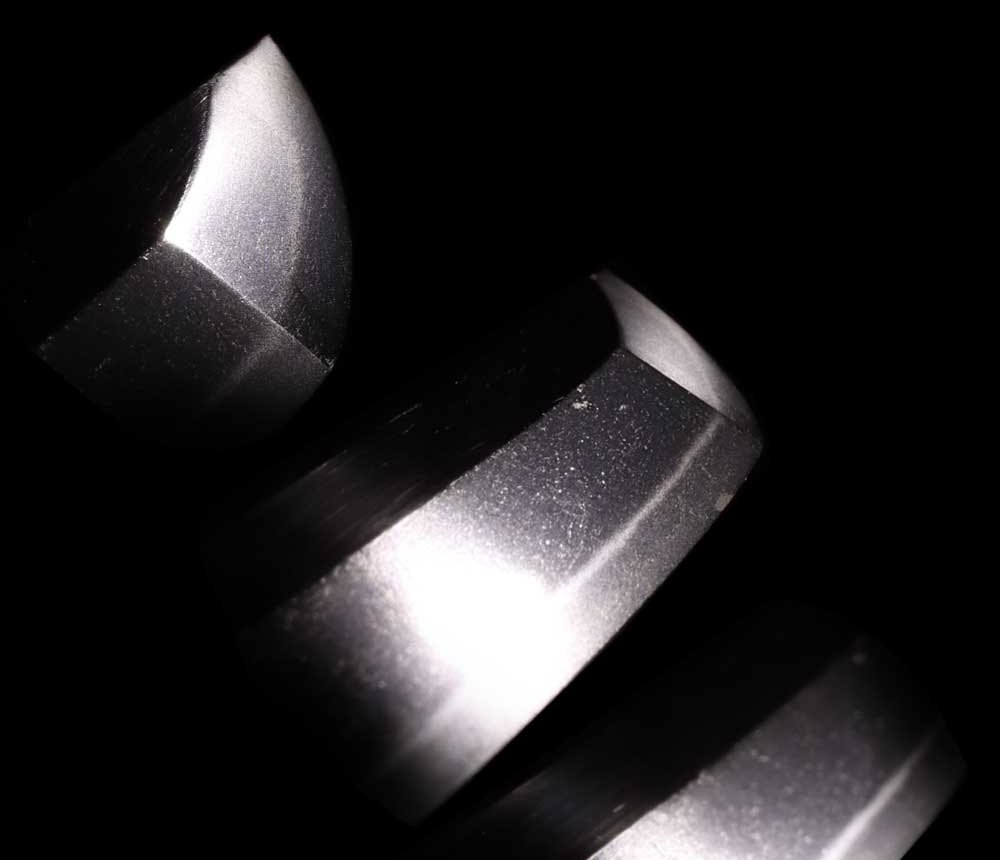
An unsigned wakizashi, shown from both sides with the points meeting at the left. The hamon is a narrow, straight line that runs the length of the blade without a break. The tang has been shortened, and a signature, if there was one, went with it. The NBTHK gives the blade to the Enju school of Higo province in Kyushu.
Das Objekt
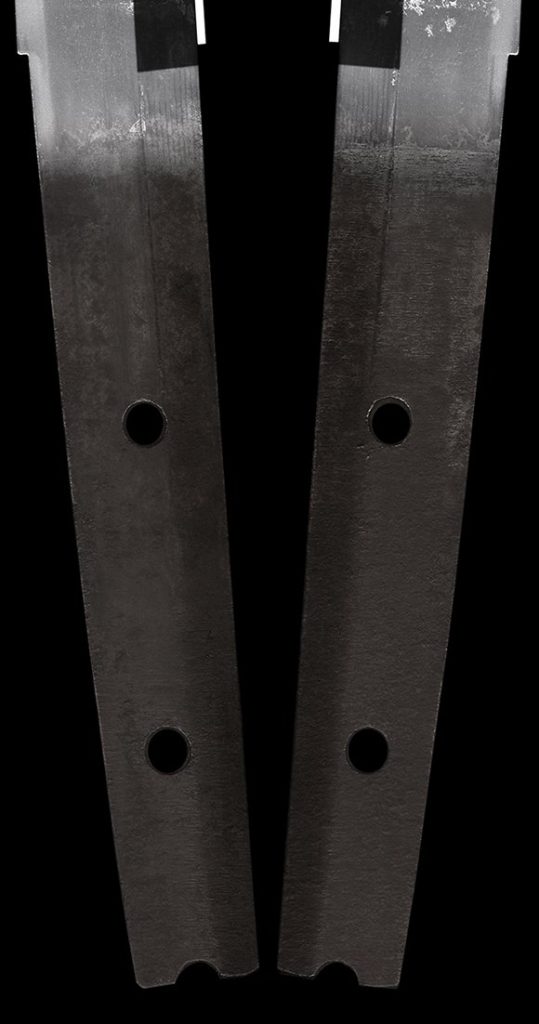
The blade is shinogi-zukuri, with a ridge line along each side and a compact point. It has a gentle curve. The tang is o-suriage, cut down from a longer blade, and has two holes for the peg. The paper names the school and gives no period. The collection dates the blade to the late Kamakura period and reads it as a tachi shortened to its present length.
Hamon und Hada
The hamon is suguha, straight, in ko-nie, with small ashi running toward the edge. The jigane is ko-itame mixed with mokume. The steel is dark, and above the hamon a pale utsuri stands in the ji.
Die Spitze
In the point the hamon follows the curve of the edge into a komaru, a small round, and turns back.
Enju
Markus Sesko’s genealogy of the Rai school of Kyoto includes Kunimura and marks him as the ancestor of the Enju school. The school worked in Higo province. The Kumamoto Prefectural Museum of Art lists an unsigned katana of the Enju school among the swords of the Hosokawa, the later lords of Higo, and dates it to the Nanbokucho period.
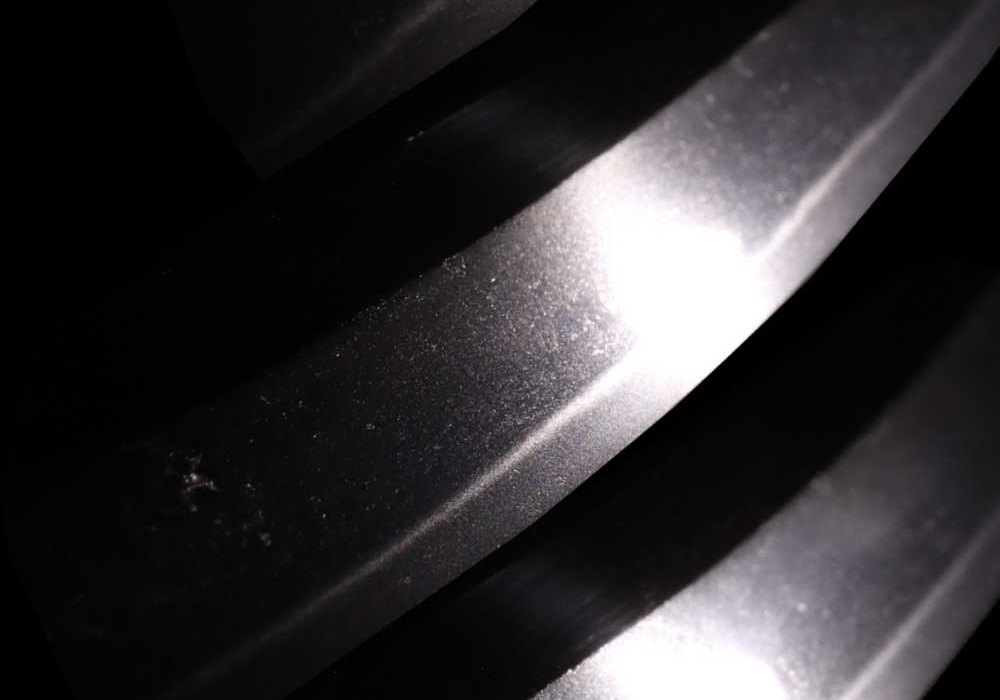
At a meeting of the Nihonto Club Deutschland this blade lay beside a katana also attributed to the Enju school. The two were alike in some respects and different in others. The utsuri was one of the things they shared, and next to the other blade it stood out more clearly than ever.
An unsigned blade can be given a school, not a name. That is what the paper does here, and the page stops there too.
Die Montierung
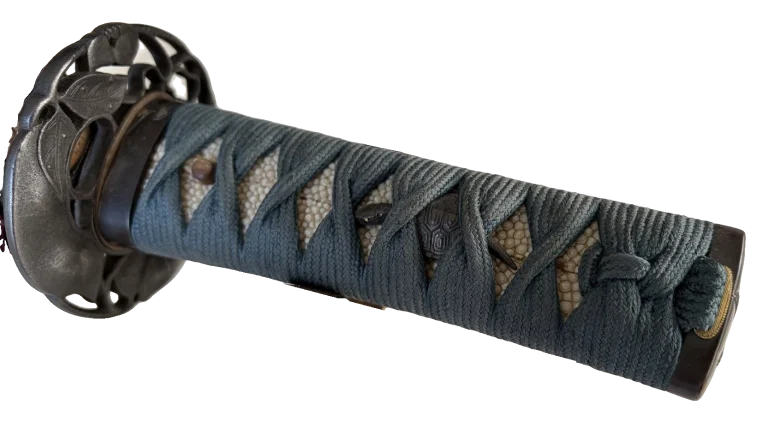
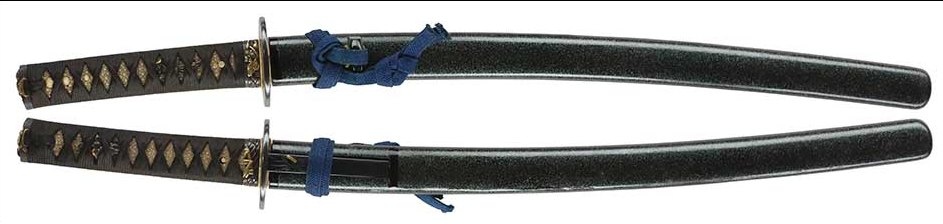
The blade rests in a koshirae with a black saya and a hilt wrapped in dark silk over white rayskin, with a blue cord tied at the mouth of the saya. The kashira carries an armored rider in gold relief. The tsuba is a dark, round plate with a figure, pines and water cut in fine lines, and the kozuka has a figure engraved on its handle. The fittings were made en suite, and all of them are of high quality. The collection gives them to the Mito school, in keeping with the signature on the tsuba.
The Enju Wakizashi
Wakizashi. Mumei, Enju. Shinogi-zukuri, o-suriage. Ko-itame mit Mokume, Utsuri, Suguha in Ko-nie-deki mit Ko-ashi. Späte Kamakura-Zeit (eigene Datierung). NBTHK Tokubetsu Hozon. In Koshirae, Beschläge en suite, Mito (Zuschreibung der Sammlung). Privatsammlung, erworben in Japan.
In the collection
- Type
- Nihonto › Wakizashi
- School
- Enju
- Period
- Kamakura
- Blade period
- Koto
- Tradition
- Yamashiro