Die Chrysantheme unter dem Griff
A Wakizashi by Tango no Kami Kanemichi

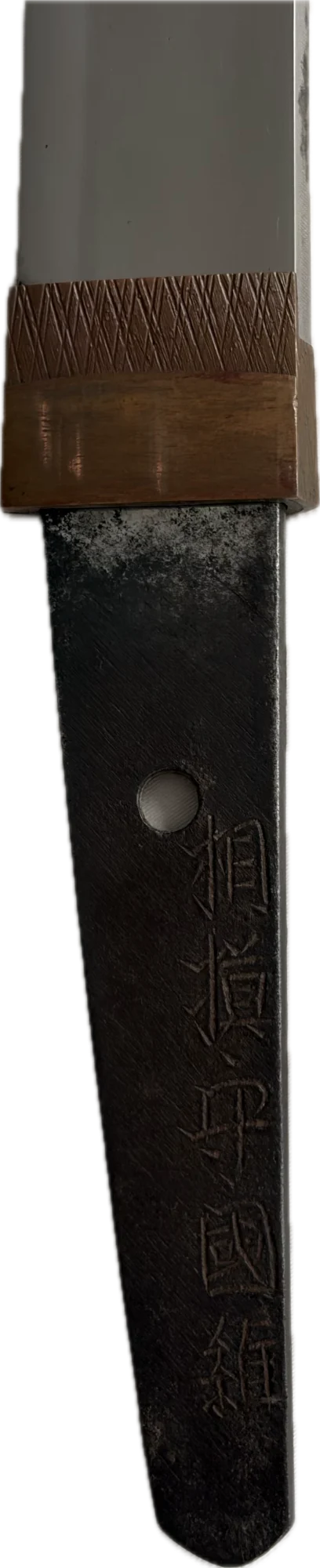
A wakizashi by Tango no Kami Kanemichi of the Mishina, shown from both sides with the points meeting at the left. The hamon is wide and bright and moves in slow waves along the whole blade. On one side of the tang the smith cut his title and name. On the other he cut a chrysanthemum crest and a single stroke, the character ichi. With the hilt in place, none of this can be seen.
Das Objekt
The blade is shinogi-zukuri, with a ridge line along each side and a defined point. It has a gentle curve. The tang is ubu, in its original length and shape, with a single hole for the peg. The jigane is a fine ko-itame with ji-nie, small bright particles standing in the steel.
Hamon und Hada
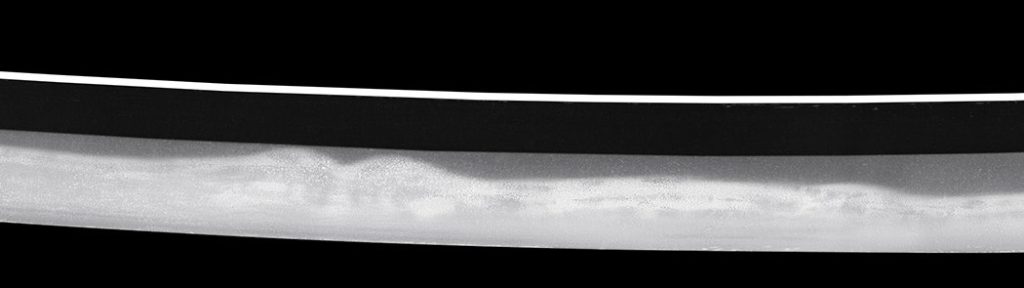
Close to the hamachi the hamon begins as a short, straight line. Then it opens into a broad notare that rises and falls all the way to the point. Inside the hamon, lines of nie run along the blade in close rows, like the slats of a bamboo blind. This is sudareba, and here it is a textbook example. The smith’s father, Tanba no Kami Yoshimichi of Kyoto, is remembered as the founder of the school that made this pattern its own.
Die Spitze
The point is of medium size. In the boshi the hamon runs into a small round, komaru, and turns back in a short kaeri. It is the classic Mishina boshi.
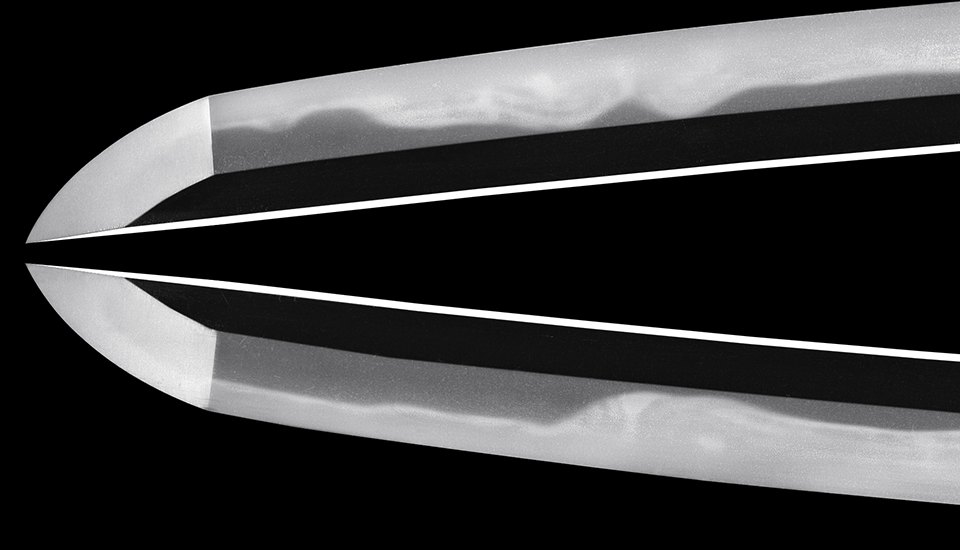
Die signierte Seite
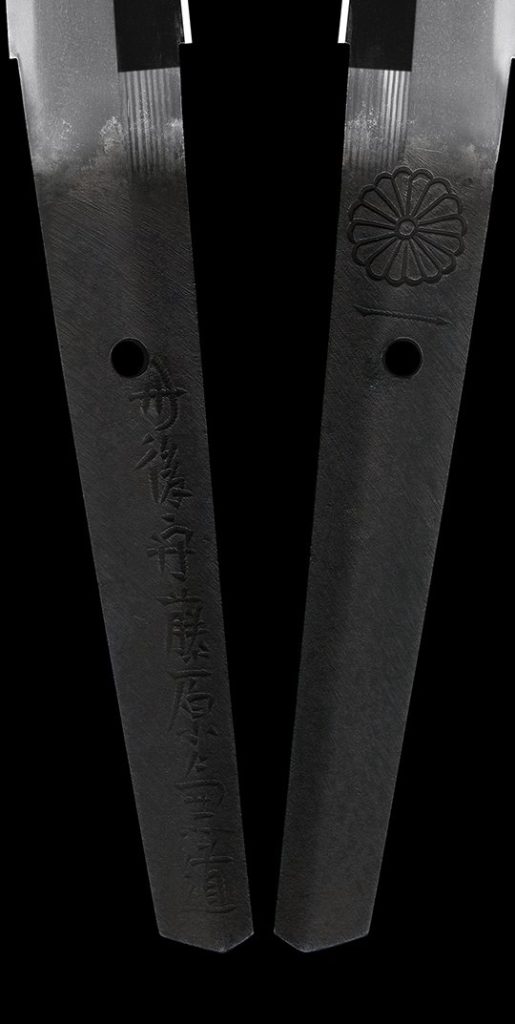
The omote of the tang carries the signature Tango no Kami Fujiwara Kanemichi, 丹後守藤原兼道. Tango no Kami, governor of Tango, is a court title. It was granted to the smith and does not say where he worked. On the ura stand a chrysanthemum crest and the character ichi, 一. The NBTHK paper records the signature together with both.
Markus Sesko writes that Iga no Kami Kinmichi of the Mishina in Kyoto received, with his title, the permission to engrave the imperial chrysanthemum on his tangs. The crest on this tang reads as a mark of that family privilege.
Tango no Kami Kanemichi
Sesko records two smiths of this name. The first lived from 1603 to 1672. He was the second son of Tanba no Kami Yoshimichi of Kyoto and moved to Osaka in the Kan’ei era. His son and heir signed in the same way. The paper names the smith and not the generation, and this page leaves the question open.
Die Montierung
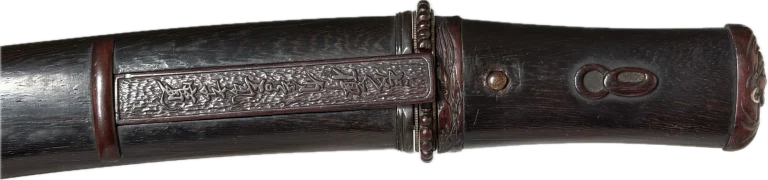
The blade rests in a koshirae with a black lacquered saya and a hilt wrapped in light brown silk over white rayskin. The tsuba is iron and pierced, with figures under a pine picked out in gold and color. The kashira is black, with small motifs in gold.
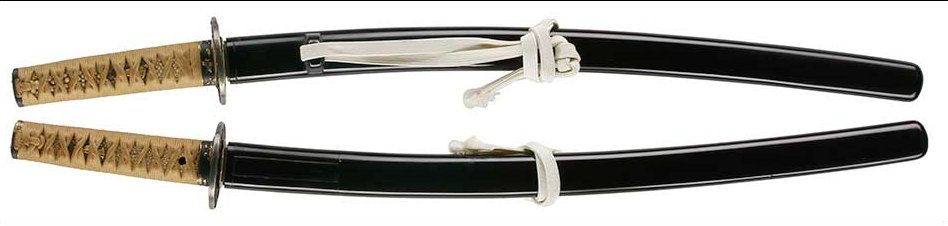
The Kanemichi Wakizashi
Wakizashi. Signiert Tango no Kami Fujiwara Kanemichi (丹後守藤原兼道), auf der Rückseite Kiku-mon und Ichi. Mishina. Shinogi-zukuri, ubu. Ko-itame mit Ji-nie, Notare mit Sudareba, Mishina-Boshi. Shinto. NBTHK Tokubetsu Hozon. In Koshirae. Privatsammlung, erworben in Japan.
In the collection
- Type
- Nihonto › Wakizashi
- School
- Mishina
- Period
- Edo-Zeit
- Blade period
- Shinto