Ein Drache von fern
A Dragon between Sun and Moon, Nanban
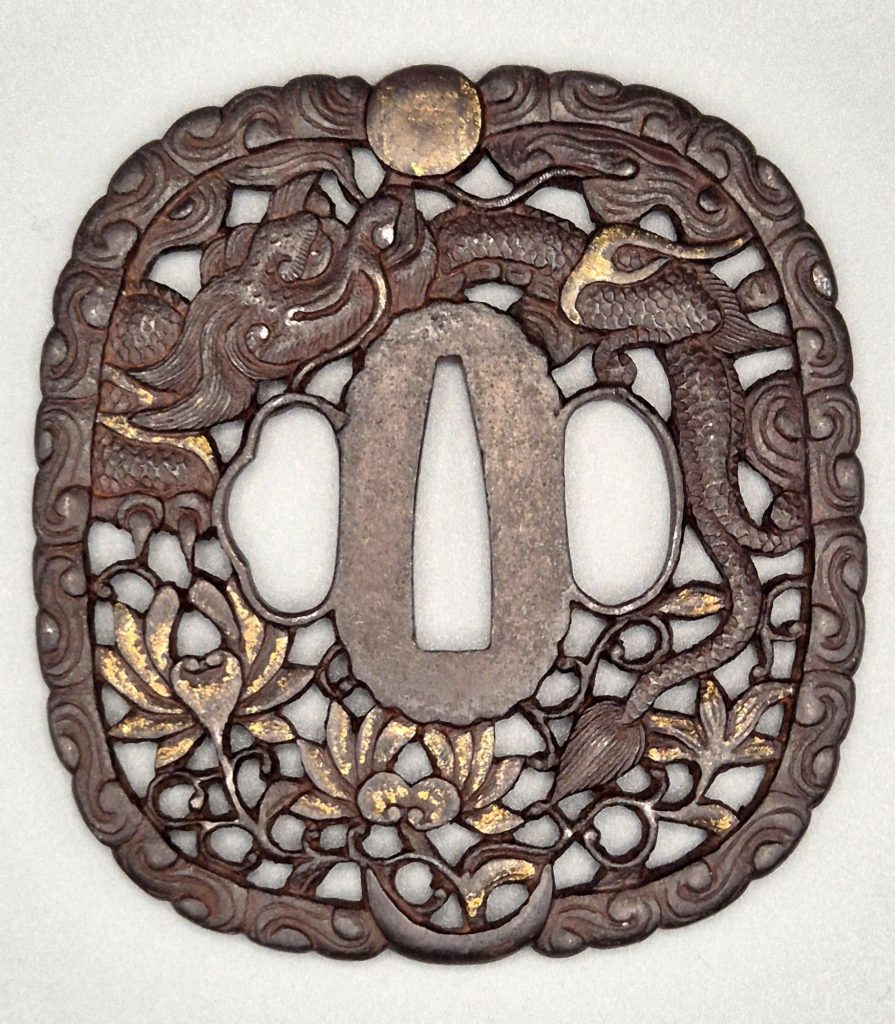
An iron Nanban tsuba, a little taller than wide, framed by a rim of carved cloud scrolls. Inside the rim almost everything is cut away. A dragon fills the upper half. Its maned head lies at the upper left, jaws open and turned upward, and its scaled body arches over the center and runs down the right side. Below, lotus flowers and leaves grow from scrolling stems, and a closed bud hangs at the right. Gold lies along the dragon’s back and in the petals and leaves.
The rim holds two more forms. At the top sits a round disc of gilded iron, the sun. At the bottom, directly opposite, lies a crescent moon, left in plain iron. The dragon turns its open jaws toward the sun. Day stands above it and night below.
The paper names the technique: relief carving with openwork, gold laid in by nunome, and a rim worked in relief. In nunome the iron is first scored with fine cross-hatching, and the gold is hammered into it, so that it lies on the surface like a thread in cloth.
Nanban was the Japanese word for the foreigners who arrived from the south. The Walters Art Museum explains that the style carries the name because it grew from foreign influence. The NBTHK attributes the guard to the Nanban school and gives no maker. A guard that Japan named for what came from far away is now kept far away from Japan. That is not a conclusion, only a small symmetry.
Tsuba. Mumei, Nanban. Tetsu, nikubori-sukashi, kin-nunome-zogan. Kawari-gata, mit reliefiertem Rand aus Wolkenranken. Ryu-sukashi, Drache zwischen Sonne und Mond über Lotos und Ranken. Edo-Zeit. NBTHK Hozon. Privatsammlung, erworben in Europa, zuvor in einer europäischen Sammlung.
In the collection
- Type
- Tosogu › Tsuba
- School
- Nanban
- Period
- Edo-Zeit
- Material
- Tetsu
- Motif
- Drachen und FabelwesenPflanzen und Jahreszeiten