Der Baum hinter der Figur
Eight Guards Signed Tsuneshige
Eight tsuba in this collection are signed Tsuneshige, 常重. Four have their own pages. Three are at present in Japan, on their way from the United States, and the eighth, the most recent to join, is on its way from Japan. Each guard, taken alone, raises the same question: whose hand is this? Set side by side, they begin to answer it, and they open a second question in turn.
Der Name
The Haynes Index knows one Tsuneshige of the Nara school. He was born into the Sekiguchi family, was adopted by the Kawamura and studied under Nara Shigetsugu. He used several art names, among them Masayoshi, Chikusha, Torin and Ryoka, but they rarely appear on his work. In Haynes’ words, he “normally uses only Tsuneshige which is employed almost as a monogram and was used by his students, as well.”
The Metropolitan Museum of Art dates its guard by Kawamura Tsuneshige to the late eighteenth century and counts it among his masterpieces. A second guard there, Daruma facing the wall, records that he lived in the Kanda district of Edo and studied with the Nara master Shigetsugu. The Nara school was among the leading kinko lines of Edo. Its three great masters, Toshinaga, Yasuchika and Joi, are counted among the finest carvers in soft metal of the eighteenth century. The Museum of Fine Arts, Boston, files works under a Tsuneshige sub-school of the Nara line. A name that, by Haynes’ account, pupils may have used as well, and a sub-school in a museum catalogue: the signature alone does not yet say whose hand is at work. That question is still to be studied.
Zwei Seiten, ein Raum
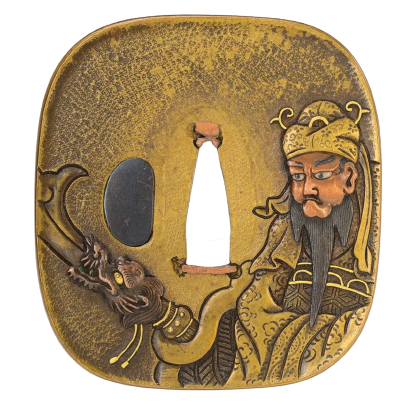
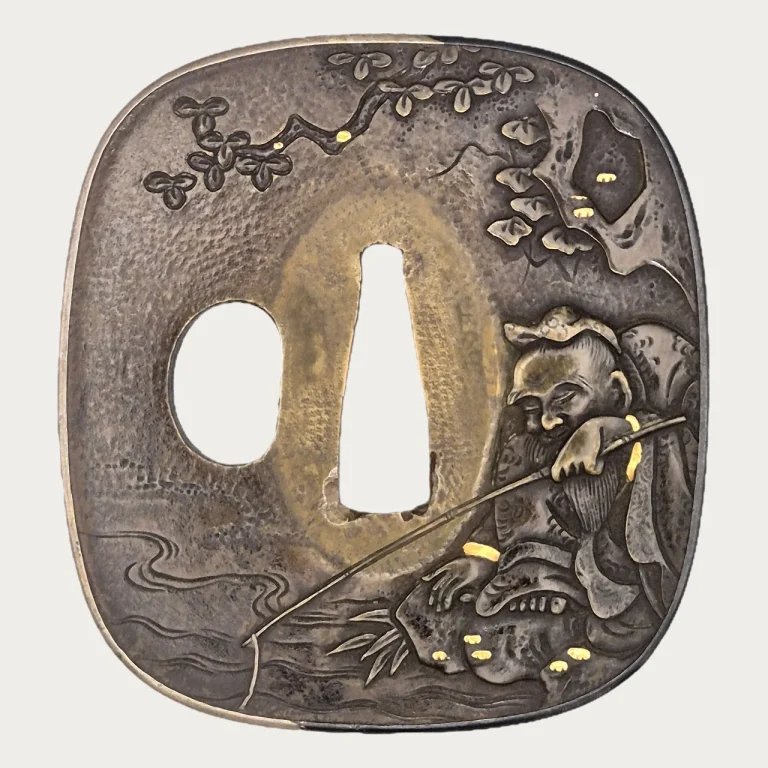
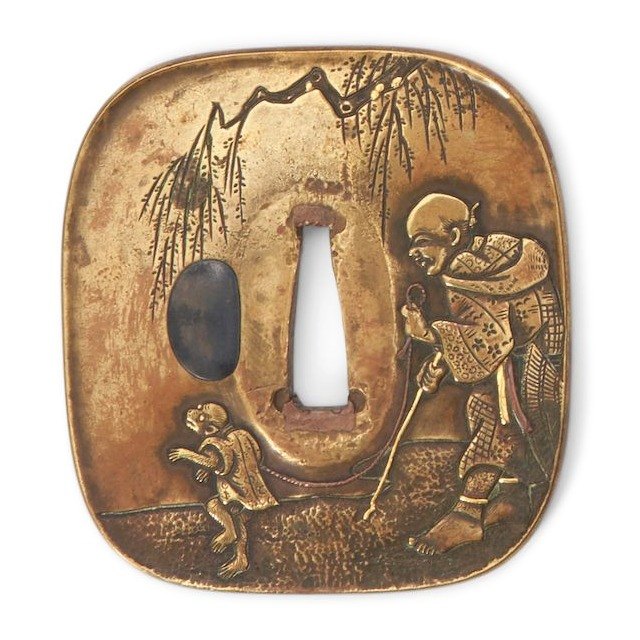
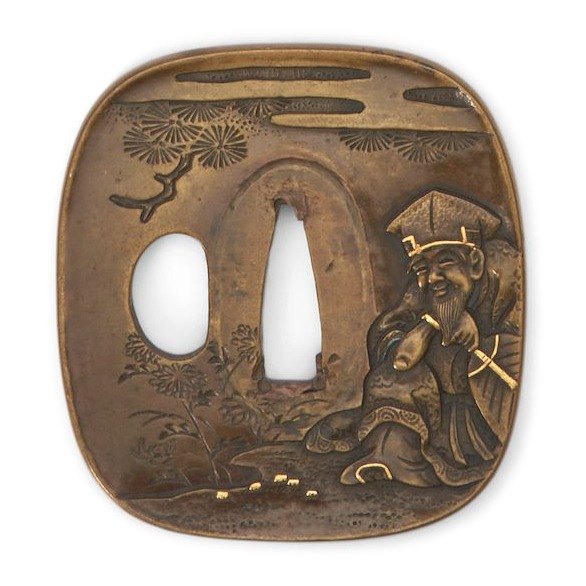
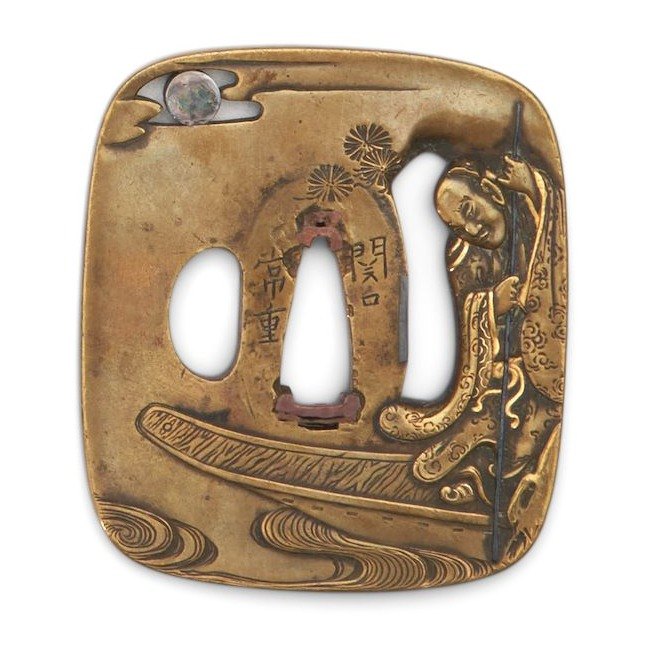
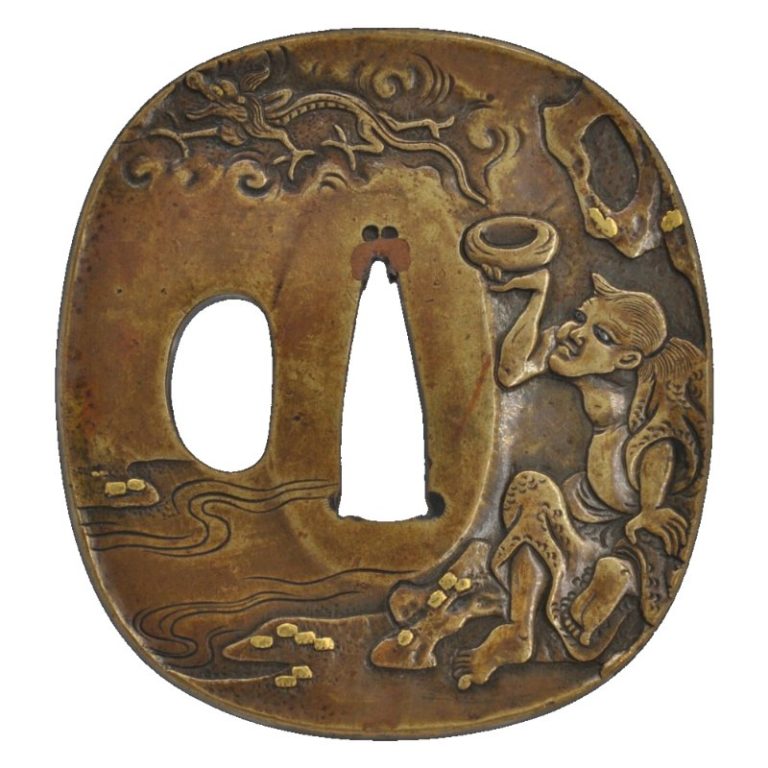
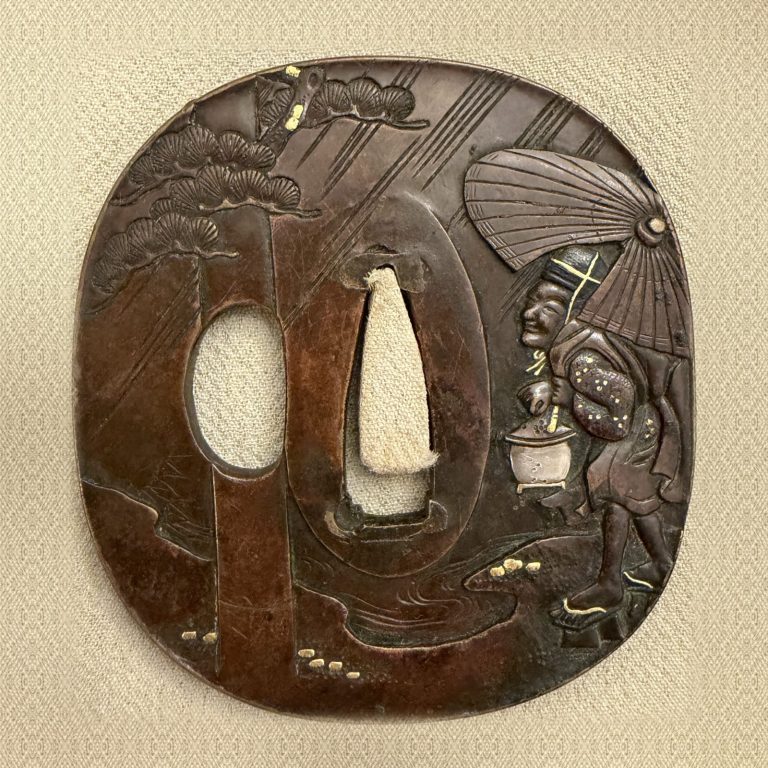
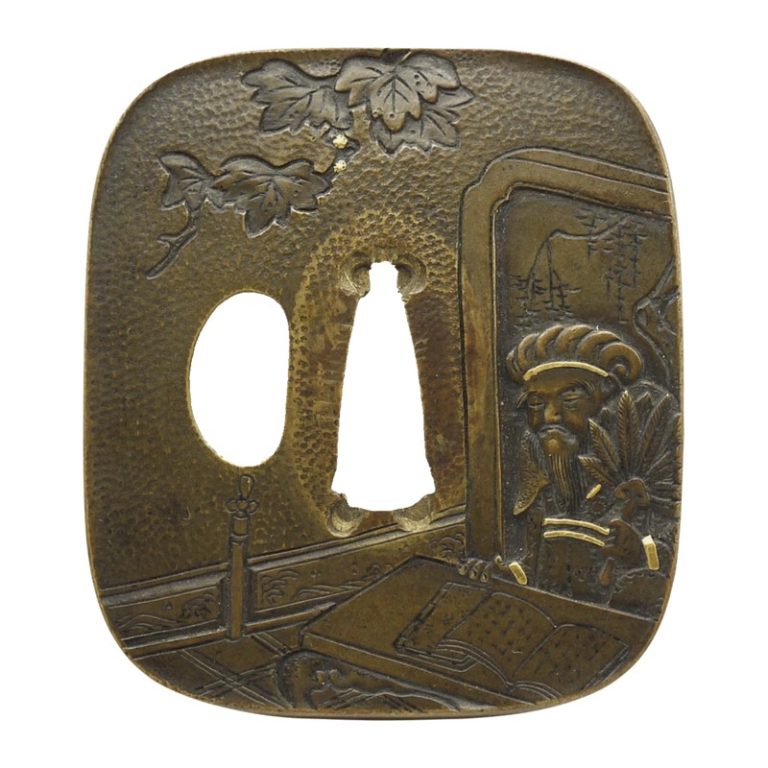
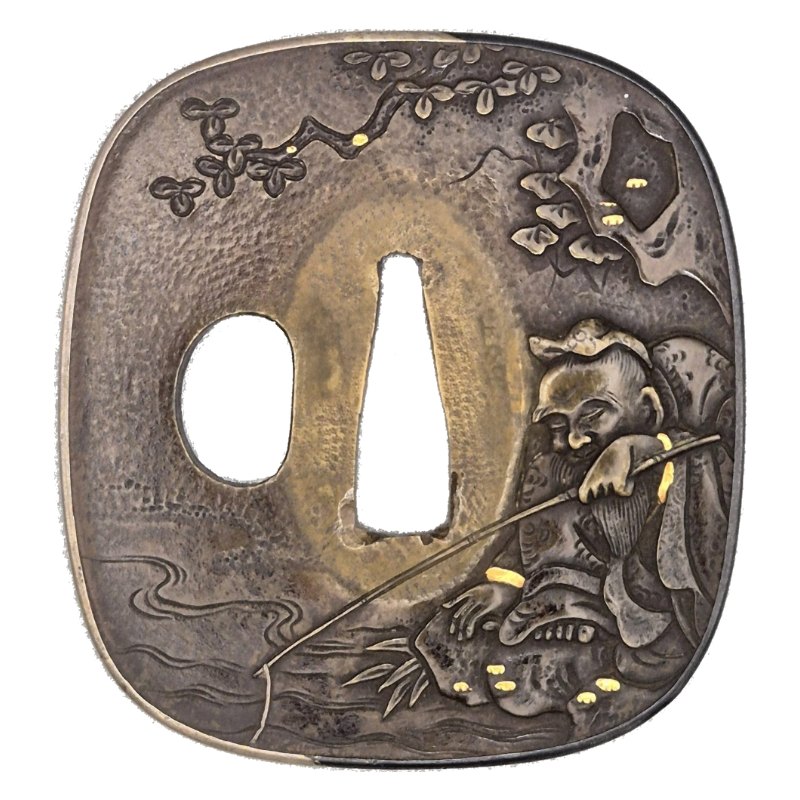
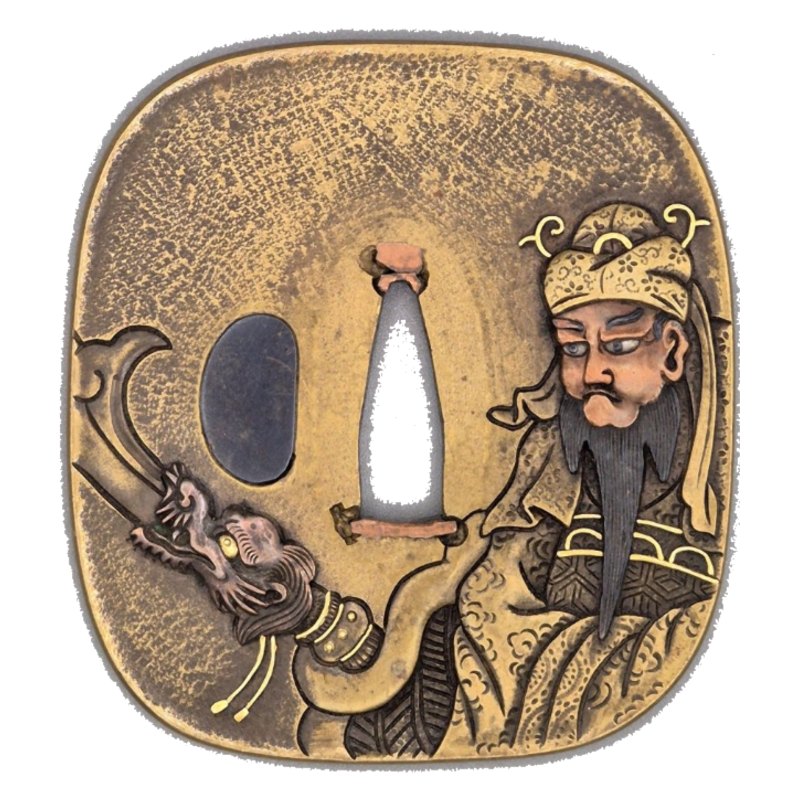
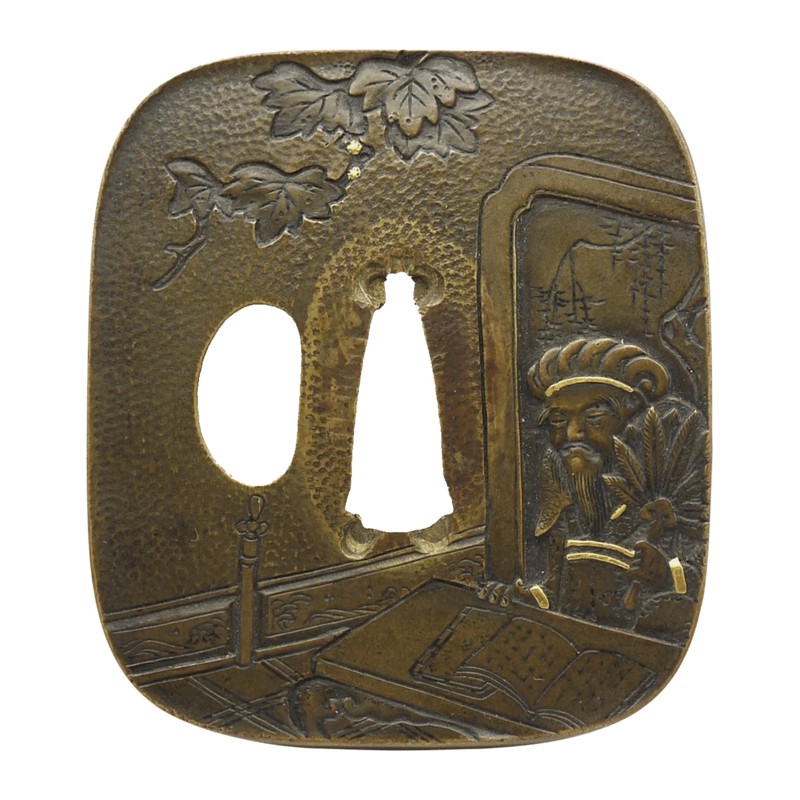
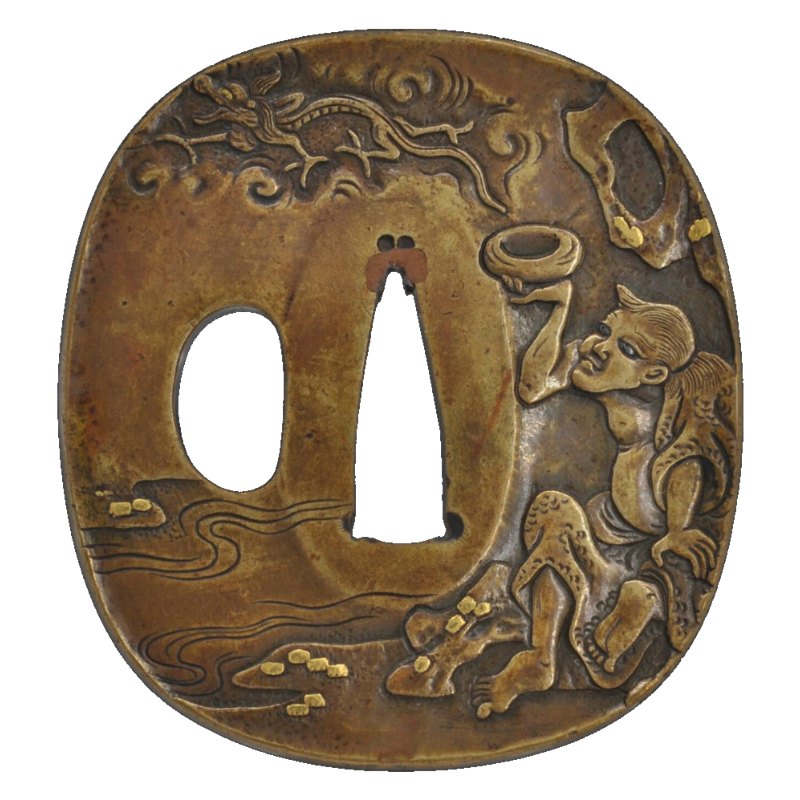
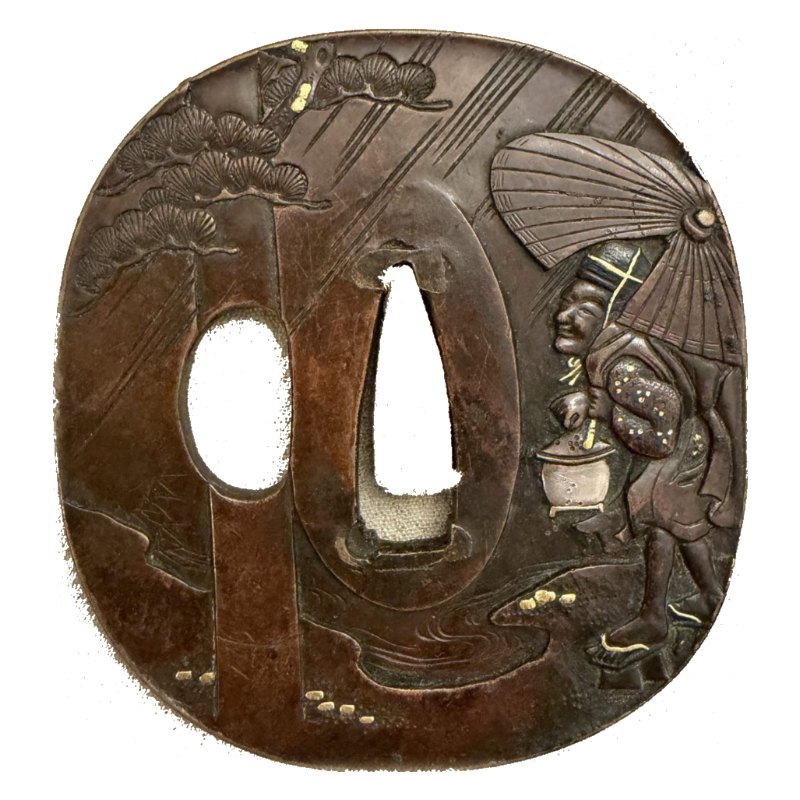
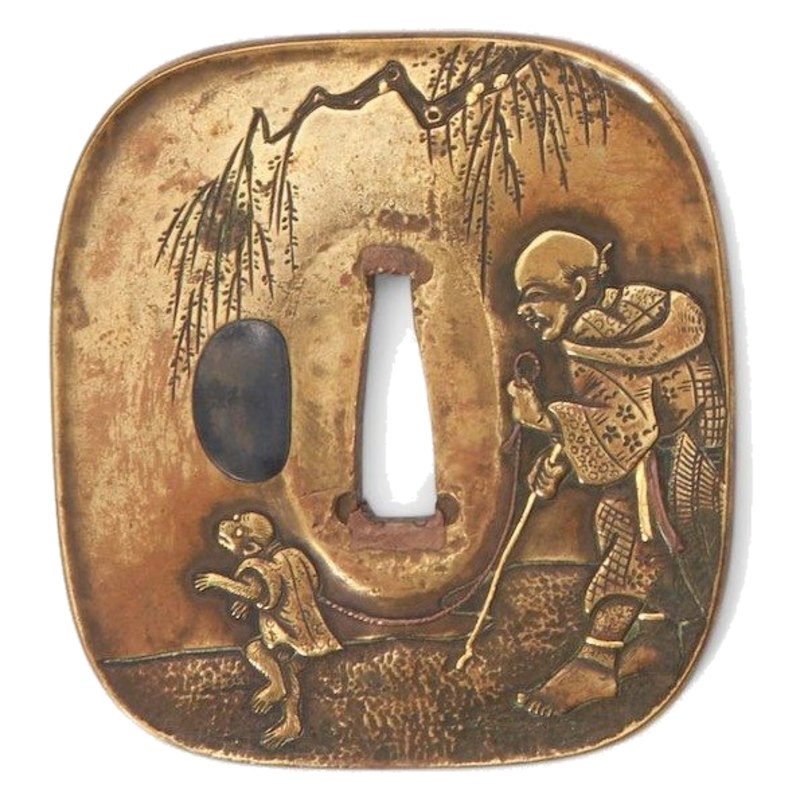
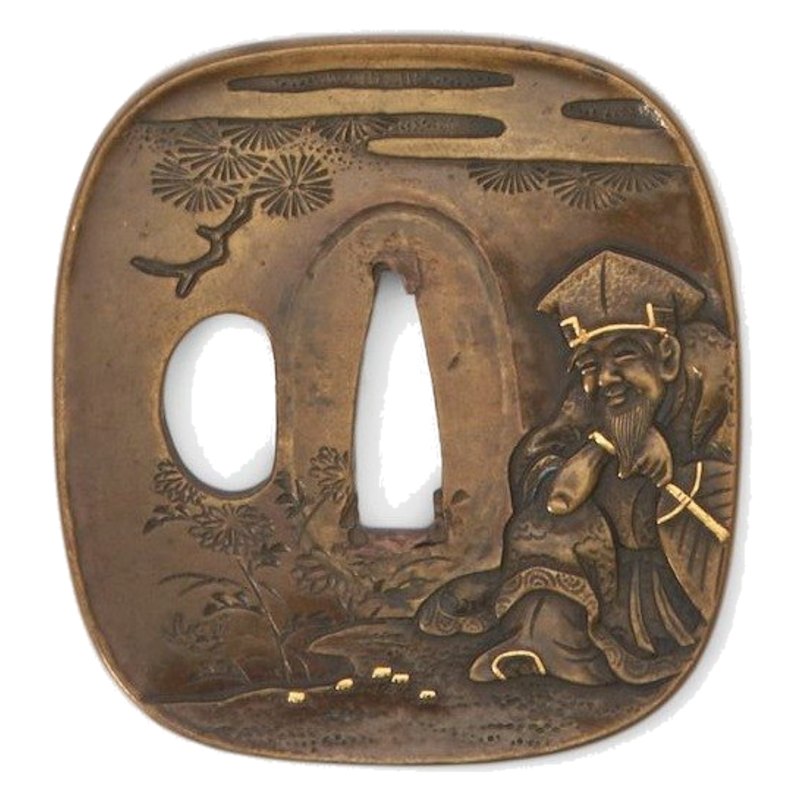
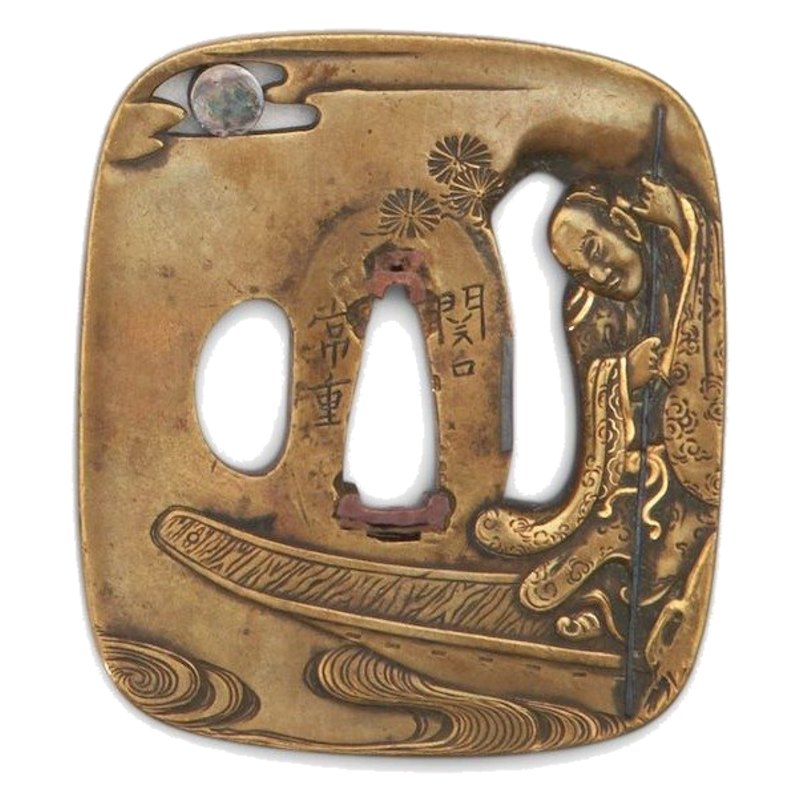
Seven of the eight follow one plan. On one face a figure stands or sits at the right edge, so close that the rim cuts into it: Taikobo with his rod, Guan Yu with his halberd, Zhuge Liang at his desk with a feather fan, a monkey trainer, Tao Yuanming among his chrysanthemums, a figure lifting an empty bowl, a god walking through the rain.
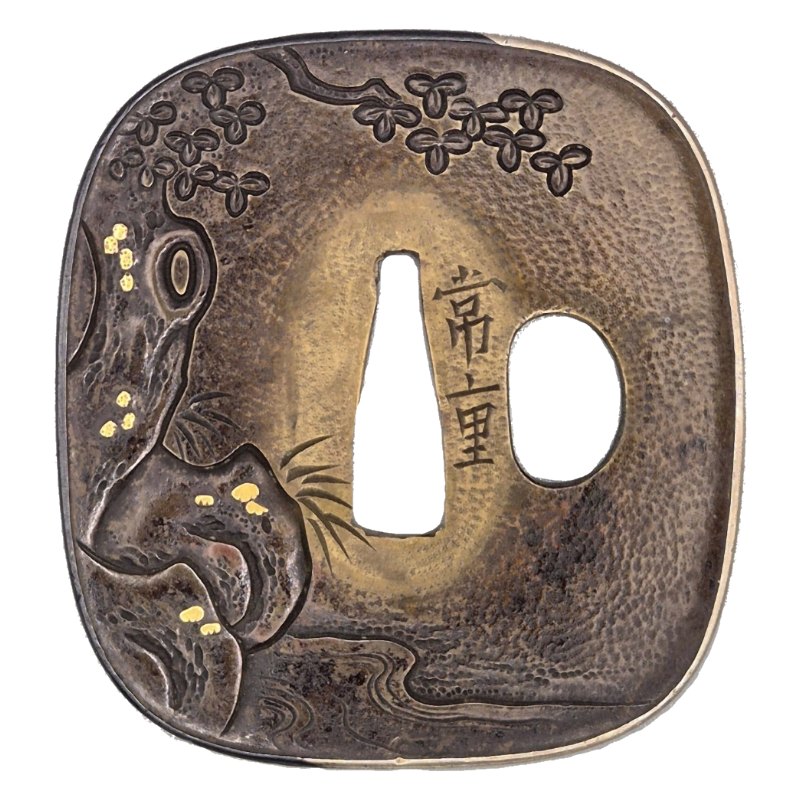
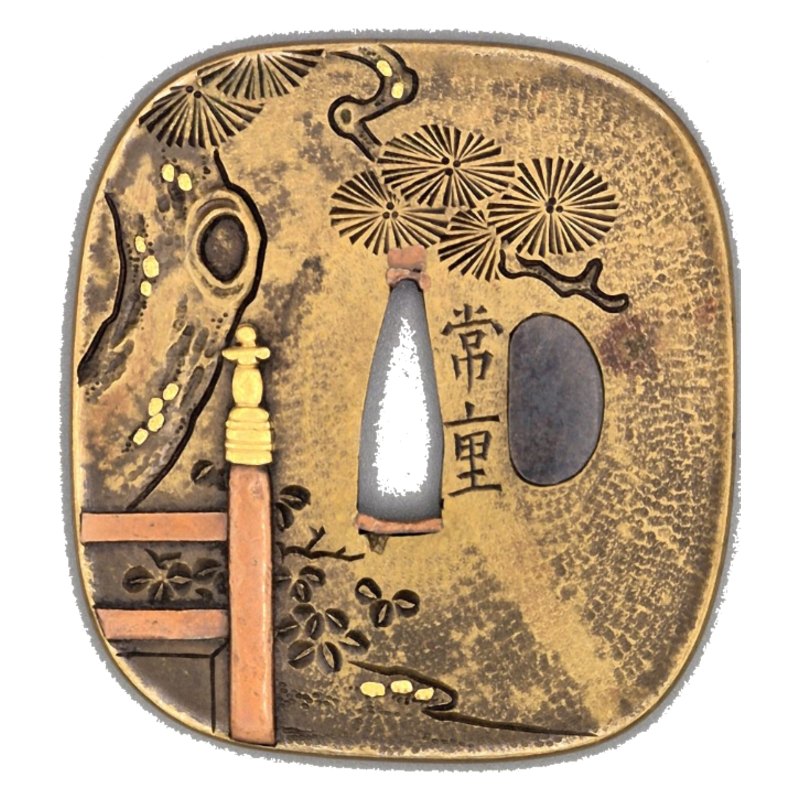
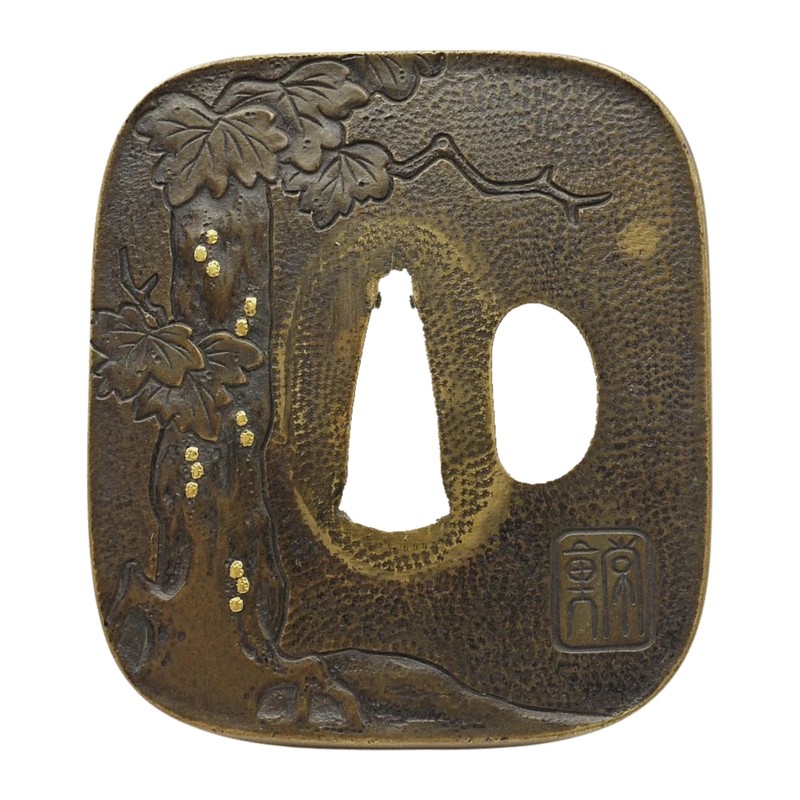
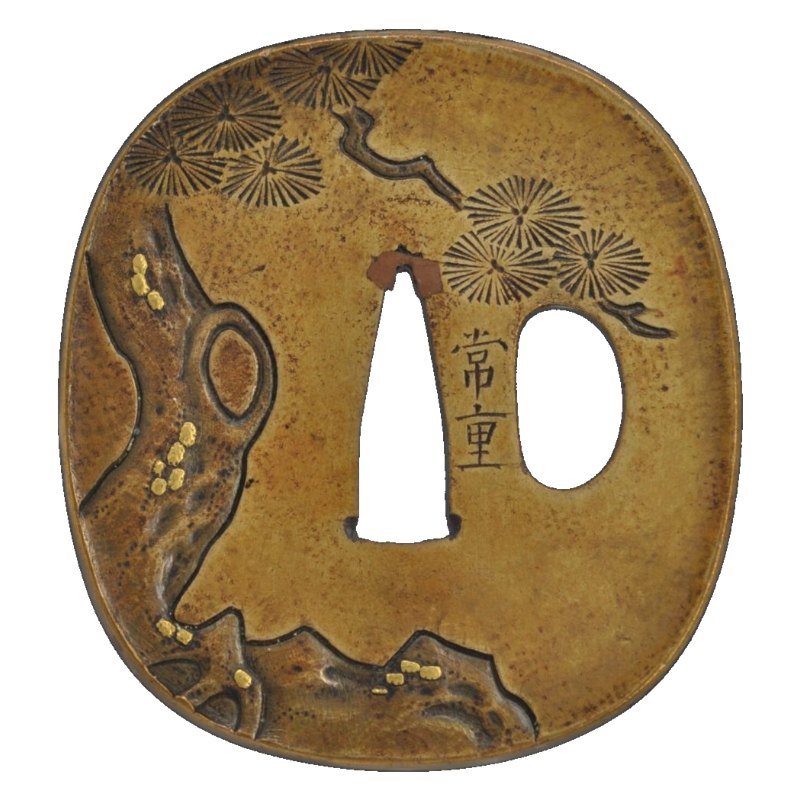
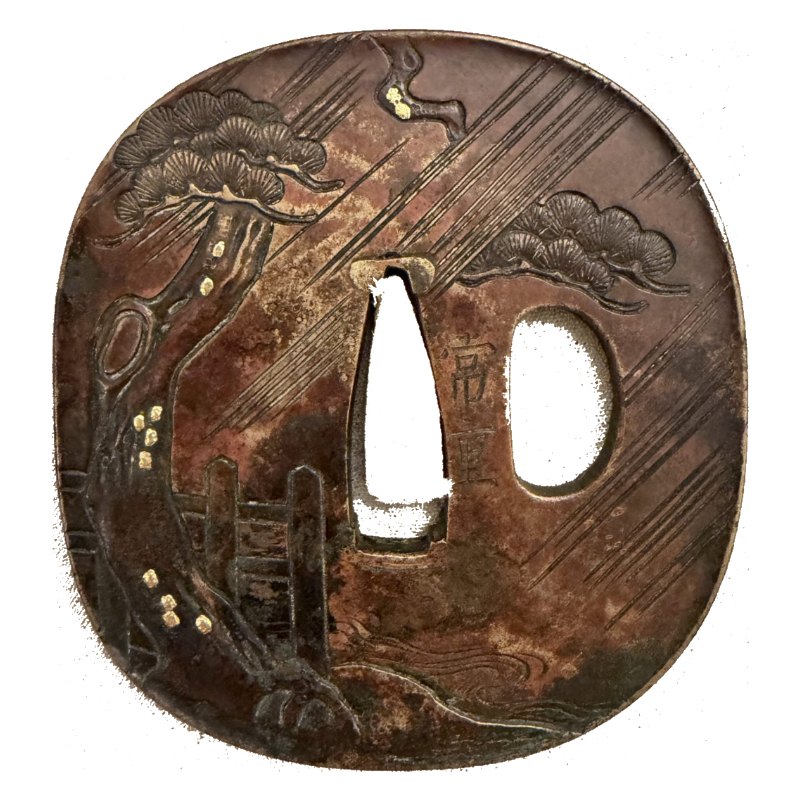
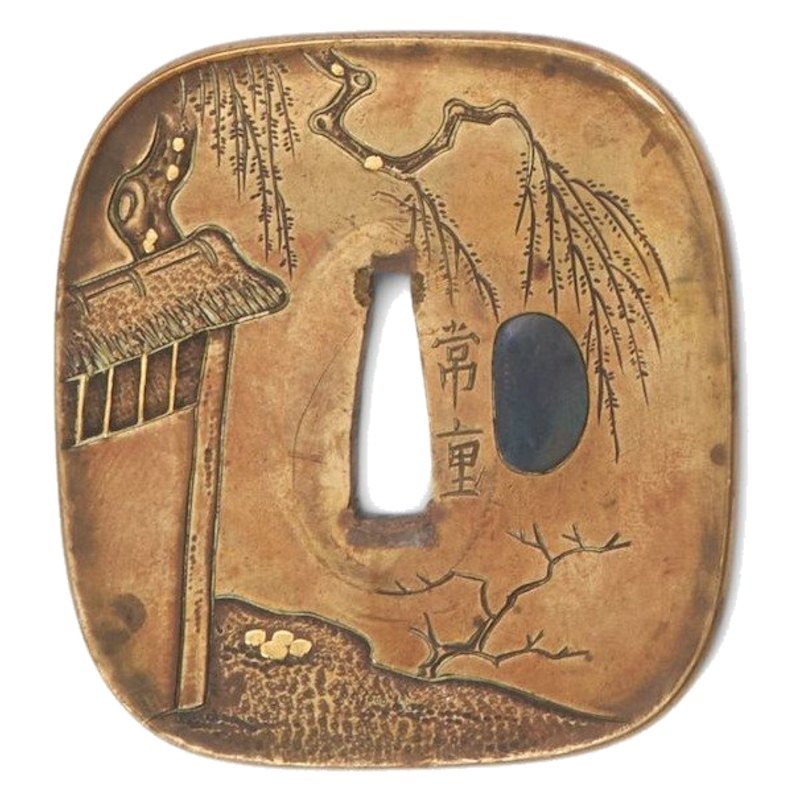
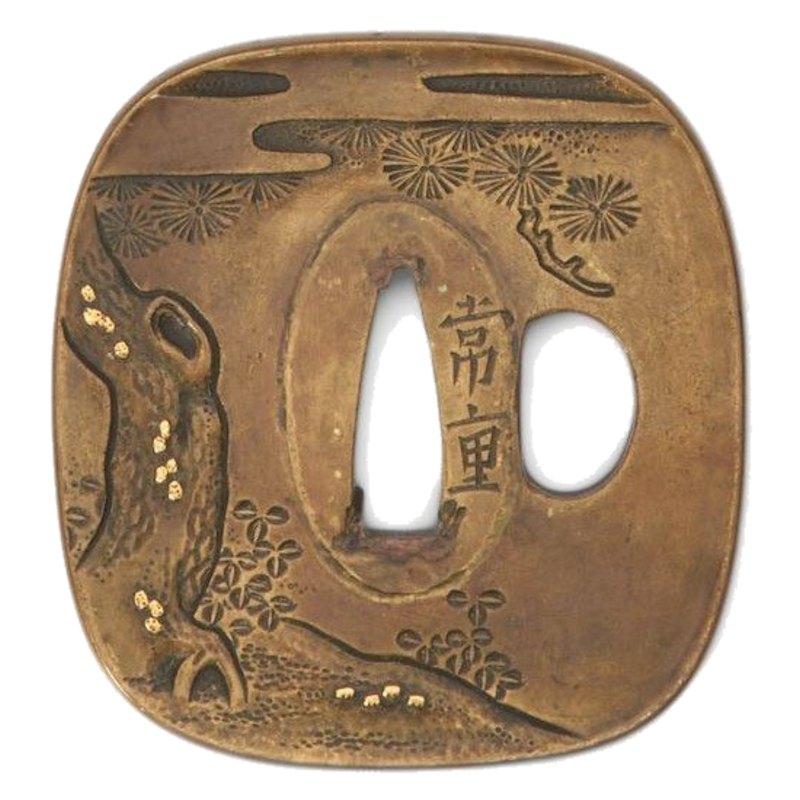
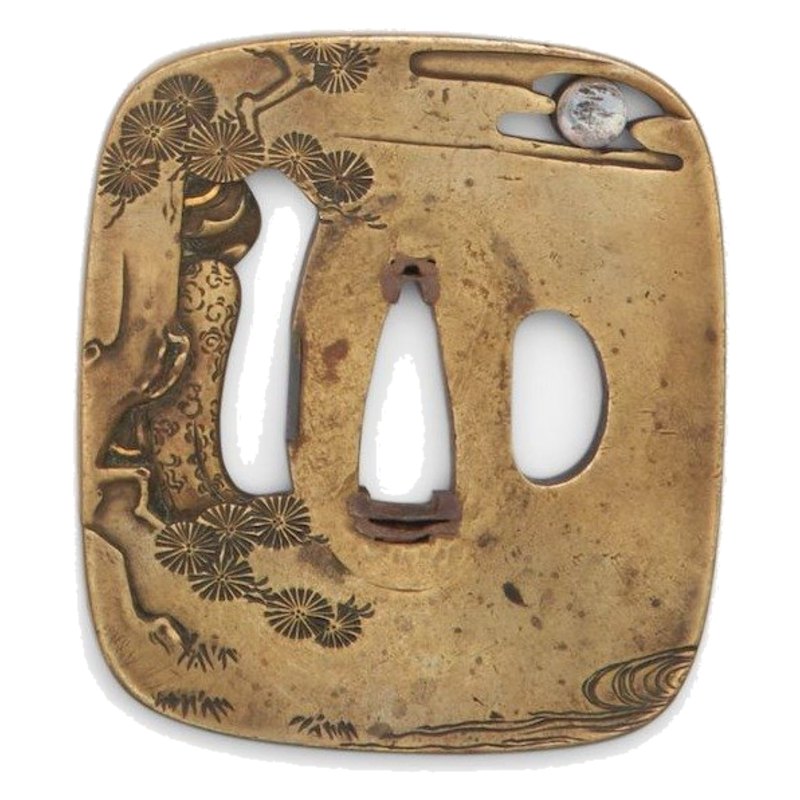
The other face is quieter. An old trunk rises along the left edge, often opened by a knot hole. Pine needles spread above it in small bursts. A post, a fence or a gate often stands nearby. Water runs along the foot of the plate, and small dots of gold sit on the stones like moss. Beside the central opening, on this quiet side, stands the signature, short and plain: 常重.
Turn one of these guards over, and the left edge of the back lies behind the right edge of the front. The trunk stands where the figure stands, seen from the other side. The two faces read as two views of one place. The guard in New York shows the same thinking in another way: its dragon leaves the front over the right edge and returns on the back at the left.
Die Ausnahme
One guard, a figure poling a boat beneath the moon, keeps the plan but moves the signature. Here it stands on the picture side, and it has two columns. To the left of the central opening is 常重. To the right it reads 関口, Sekiguchi, the family into which Tsuneshige was born. Its back carries the pine and the moon, and nothing else.
The guard in New York also carries its signature on the picture side, in a longer form that reads 常重製, made by Tsuneshige. Five others bear only the two characters, cut on the quiet face. The guard with Zhuge Liang carries them there too, but as a square seal in the lower corner, which its paper calls in-mei.
Haynes notes that the plain name was used by pupils as well. How far that holds, and for which guards, is still to be studied. A guard that adds the family name of his birth stands apart from the plain name in any case, and so, in another way, does the seal. Whether it points toward the master’s own hand is one of the open questions of this page.
Was erzählt wird
Five subjects come from China: the sage Taikobo, who fished without bait; Guan Yu, the general who became a god of war; Zhuge Liang, called Komei, the strategist whom Liu Bei found reading in a reed hut; the figure with the dragon from the bowl, read as the immortal Chinnan or the arhat Handaka; and the poet Tao Yuanming, Tō Enmei in Japan, who left office and went home to his pines and chrysanthemums. Guan Yu and Zhuge Liang belong to the same story, the Record of the Three Kingdoms. Two come from Japan: the god of the Aridoshi shrine in the rain and the monkey trainer under the willow. One is still without a name: the figure who poles a boat under the moon.
Water joins almost all of them. A stream winds below the fisherman and below the man with the bowl. The dragon he has released brings rain, and on the Aridoshi guard the rain has arrived. The frame stays the same, the stories change.
Material und Form
Six of the guards are sentoku, a brass alloy that ages to a warm, uneven gold. Two are brass by their papers, the Taikobo guard and the guard with Zhuge Liang. The Taikobo guard alone has a rim set in two metals, shakudo and silver. All eight are rounded squares, a little taller than wide. Two have one hitsu-ana closed with dark metal, as the guard in New York does.
Was offen ist
Two guards have been to shinsa so far, the Taikobo guard and the guard with Zhuge Liang. The four still on their way will have their own pages when they arrive. What remains after that is the comparison of the hands: the cut of the two characters, their depth, the way the lower part of 重 is closed. That needs the guards on one table, not on a screen. This page will follow it.
The essay Tsuneshige and the Nara School reads the group against the school he worked in: what he shares with it, and where he goes his own way.