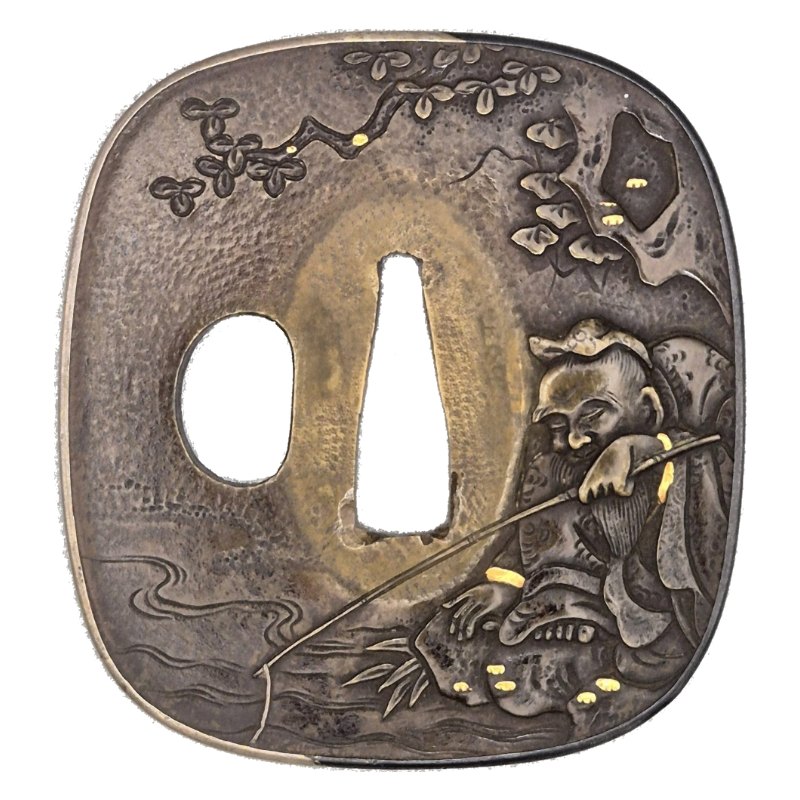
The Nara school is one of the great families of Edo metalwork. Its three masters of the early eighteenth century, Nara Toshinaga, Tsuchiya Yasuchika and Sugiura Joi, are counted among the finest carvers of their age. The Ringling Museum, following B. W. Robinson, names Joi as one of the Three Great Nara Masters.
Tsuneshige belongs to a later generation. He worked in Edo in the late eighteenth century, in the Kanda district, and studied with the Nara master Shigetsugu (The Met; Haynes). Eight guards signed with his name are in this collection. What do they share with the school, and where does he go his own way?
The school
Nara begins with iron. The first master, Toshiteru, is said to have learned from the Goto and to have brought their soft-metal techniques to the iron plate. The old Nara guards are iron, often hammered, with figures and plants inlaid in gold, silver, shakudo and copper. Their subjects come from Chinese and Japanese legend and from nature. All this is cited here after the Japanese Sword Index, which draws on Torigoye and Haynes, Robinson and others.
The school grew in Edo and spread through its pupils. Nara artisans founded the Hamano line, and Joi is credited with shishiai-bori, a relief cut down into the plate so that it never rises above the surface. The work of the great masters was much copied, which is one reason why Nara signatures are read with care.
What is Nara in his guards
First the subjects. Taikobo fishing without bait, Guan Yu with his halberd, an immortal with a dragon rising from a bowl, the god of the Aridoshi shrine in the rain, a monkey trainer under a willow, the poet Tao Yuanming among his chrysanthemums. The Walters Art Museum notes that Tsuneshige’s guards often depict figures from narratives; its own shows Nitta no Shiro killing a boar. These are subjects from the repertoire of the school.
Then the carving. The figures stand in high relief, the faces small and exact, the robes picked out in gold, silver and shakudo.
Where he goes his own way
Three things set these guards apart. The first is the ground. Old Nara is iron. Six of the eight guards here are sentoku, a brass alloy that ages to a warm, uneven gold, and so are both guards by him at the Met and the Walters guard with Nitta no Shiro. A body of work on sentoku gives the guards a colour of their own.
The second is the space. On one face a figure stands at the right edge, so close that the rim cuts into it. The other face carries an old trunk at the left edge, pine needles above, water at the foot. Turned over, the trunk stands behind the figure. The Met’s Daruma guard shows the same plan: a large pine on the reverse continues onto the front. On the Walters guard with the bell of Dojoji, a pine and a stream fill the reverse. The two faces read as two views of one place. Whether this is his alone, or something he learned from Shigetsugu, these eight guards cannot settle.
The third is the signature. Two characters, 常重, short and plain, set on the quiet face beside the opening. Haynes records the art names Masayoshi, Chikusha, Torin and Ryoka, and notes that they are rare on his work. One guard in this collection adds a second column, 関口, Sekiguchi, the family he was born into. Another, the most recent to join, carries the name as a square seal in the corner, which its paper calls in-mei.
The Met adds that he may have begun as a lacquer artist before he turned to sword fittings. A painter’s way of building a scene across two surfaces would sit well with that. It remains a reading.
What the comparison cannot yet say
There is nothing by Shigetsugu in this collection. A comparison with the teacher needs his work in hand, not only in photographs. Four of the eight guards are still on their way to Europe. Only the guard with the seal has a paper so far, and it accepts the seal as his. How the NBTHK reads the name on the others is still open.
The eight guards are set side by side, with both faces of each, on the study page: Eight Guards Signed Tsuneshige.
Sources
- The Metropolitan Museum of Art, Sword Guard (Tsuba), Kawamura Tsuneshige, late 18th century. metmuseum.org/art/collection/search/35645
- The Metropolitan Museum of Art, Sword guard (Tsuba) depicting Bodhidharma facing a wall. metmuseum.org/art/collection/search/25721
- The Walters Art Museum, Tsuba with Nitta no Shiro killing a boar, Kawamura Tsuneshige, 51.120. art.thewalters.org/object/51.120
- The Walters Art Museum, Tsuba with the Bell of Dojoji, 51.341. art.thewalters.org/object/51.341
- The Ringling Museum of Art, Sugiura Joi, biography after B. W. Robinson (1980). emuseum.ringling.org
- The Haynes Index of Japanese Sword Fittings and Associated Artists, entry H10905, Tsuneshige.
- Japanese Sword Index, Ko-Nara tsuba, citing Torigoye and Haynes, Robinson, Gunsaulus and Murtha. japaneseswordindex.com