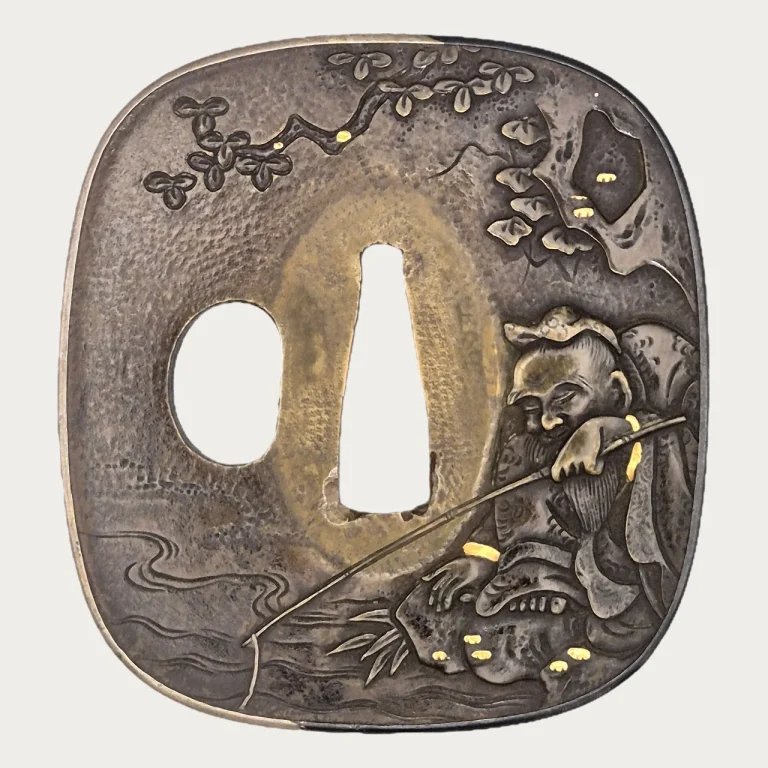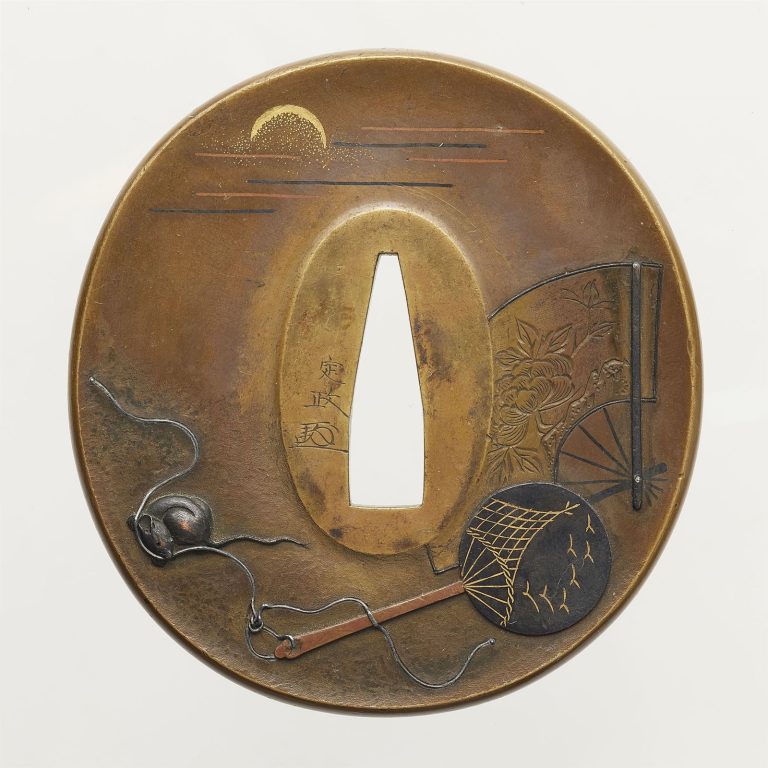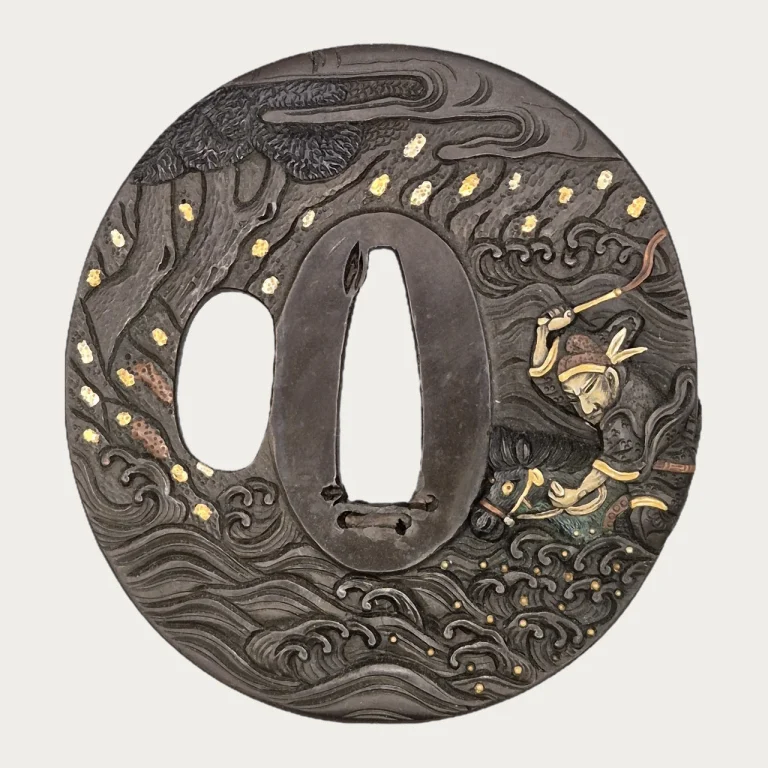
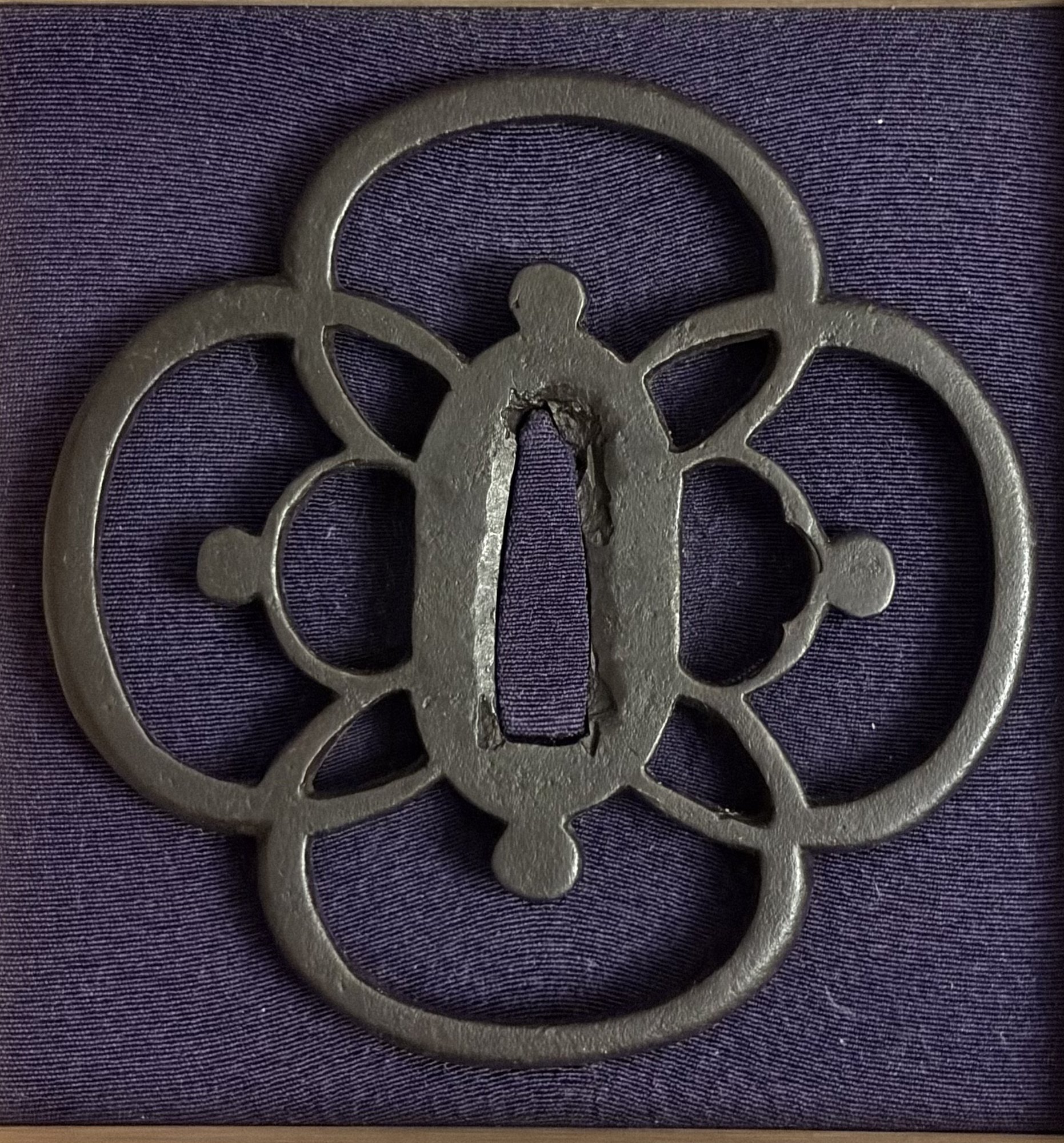
A guard made by a named master two hundred years ago can still pass from one private hand to another in Europe without a museum taking notice. A painting of the same age and rank rarely can. The first three parts of this series asked how Europeans came to tosogu, how they learned without a tradition, and how the objects change their meaning outside Japan. This part asks a plainer question. Why are tosogu still within reach, and what does that ask of the person who reaches for them?
There is no single answer. There are several, and they reinforce each other.
So many
The first is number. Every sword worn in Japan had its fittings, and a sword kept its blade for centuries while its mounting changed. A blade of the sixteenth century in a mounting of the nineteenth is no exception. It is the normal life of a sword: the blade is the lasting part, the mounting the part that changes. Each change set a guard, a pair of menuki, a fuchi and kashira free. In the long peace of the Edo period, fittings became a matter of taste and season as much as of use. The workshops of Edo, Kyoto, Mito and the provinces made them in numbers no painting studio could match.
Taken off the sword
The second is history. In 1876 the Meiji government forbade the wearing of swords in public, except by the military, the police and a few others. Swords did not vanish, but the fittings lost their place in daily life. Many came onto the market just as Europe began to look east. Siegfried Bing in Paris made noticing Japanese art a business. Henri Vever wrote to Hayashi Tadamasa, the dealer in Paris and Tokyo, for more than a decade, asking to see new arrivals first. Georg Oeder, Justus Brinckmann, Pietro Krohn and Hugo Halberstadt built their collections in these years, by the hundred and the thousand.
Back on the market
The third is what happened to those collections. Many did not stay together. Oeder’s guards, catalogued in 1916, were sold at auction in Vienna in October 1943, in the middle of a war. Alexander Moslé‘s collection was dispersed in New York after the next war. Krohn’s tsuba spent most of a century in storage. Each dispersal sent pieces back into private hands, and many of them never left Europe again. A European collector today does not need to reach to Japan for every piece. Part of what Japan sent a century ago is still here, moving slowly from one cabinet to the next.
The law plays a quiet part as well. In Japan, a sword blade kept as a work of art needs a certificate of registration under the Firearms and Swords Control Law of 1958. A guard needs none. In most of Europe, too, a blade can fall under weapons law, and a tsuba does not. A guard can be sent, shown and handed on like a small bronze.
Hard to read
The fourth reason is the one that matters most, and it is the reason that asks the most in return. Tosogu are hard to read. Part 3 described how much of their meaning depends on a shared world of stories, seasons and signs. Signatures are short, schools are many, and names were used by pupils and by later hands. Copies exist, and not every signature is what it claims to be. The papers of the Japanese sword societies help, and they are judgements of experts, not guarantees.
Much of the art market prefers objects it can read at a glance. Tosogu seem to sit between its departments: too small for the sculpture sale, too fine for the arms and armour sale, too Japanese for the European applied arts. What cannot be read quickly is often valued less than what it is. That is the gap through which a patient collector can still enter.
What accessibility asks
So accessibility is real, but it does not mean the objects are slight, and it is not free. It is paid in another currency. The price of a good guard is attention: years of looking before buying, books bought before objects, museum cases studied with a notebook, people who sell you nothing and tell you what they see. The early European collectors paid it too. Oeder wrote his catalogue, Brinckmann argued over classification, Halberstadt wrote each guard into his own register by hand. Their collections did not begin with a budget. They began with a method.
This is why the field stays open, and why it rewards the newcomer who comes for the right reason. A collector who wants a trophy will find the field confusing and the objects mute. A collector who wants to understand will find that a piece of iron or brass the size of a palm can hold a story, a school, a family of craftsmen and two centuries of owners. The last part of the ode follows them as silent witnesses.
A European perspective therefore brings both an opportunity and a responsibility: the chance to meet works of rare quality, and the duty to treat them with care, attention and curiosity. Collectors here do not only acquire. They carry on a line that runs from Edo Japan through the first European collectors into the present.
Nothing here is a promise about markets. Fields change when more people care about them, and this one may too. If it does, it will be because more people learned to look. That would be a good reason for prices to rise, and a good reason for this series to have been written.
For those who want to begin, the Collector’s Guide describes four ways in.
Sources: tosogu.eu, the European Perspective series, parts 1 to 3, and the essays on Siegfried Bing, Henri Vever, Georg Oeder, Justus Brinckmann, Pietro Krohn, Hugo Halberstadt and Alexander G. Moslé; Kōkan Nagayama, The Connoisseur’s Book of Japanese Swords (1997), on the edict of 1876; Firearms and Swords Control Law (Jūhō Tōken-rui Shoji Tō Torishimari Hō), 1958.