
Tosogu in Europe
Tosogu were created within a highly specific cultural and historical context in Japan. Today, they are encountered far beyond it:
In collections, exhibitions, and private hands across the world. A European perspective does not attempt to replace their original meaning. It reflects how these objects are seen, understood, and appreciated at a distance. As individual objects; studied, handled, and appreciated mostly in isolation.
The European Perspective
This series of Essays explores how Japanese sword fittings have been collected, studied and understood in Europe since the 19th century. From early collectors to contemporary engagement, this section shifts the focus away from the objects themselves. Instead, it considers how distance, context, and access shape their perception in Europe today: Across private collections, Japanese art societies, and museum institutions.
-
1. Early European Collectors
The systematic engagement with Japanese sword fittings (Tosogu) in Europe transcends mere exoticism. Between the 1880s and the 1930s, a distinct European perspective emerged, characterized by metallurgical analysis, philological rigor, and an appreciation for the Tsuba as a masterpiece of applied art.
-
2. What it means to study Tosogu in Europe
The early European collectors described in the first essay did not simply accumulate objects. They built a methodology. Oeder’s connoisseurial rigour in Tokyo, Brinckmann’s insistence on classification, Fahrenhorst’s correspondence with Japanese scholars: What these men left behind was not only a body of objects, but a way of approaching them.
-
3. Meaning & perception outside Japan
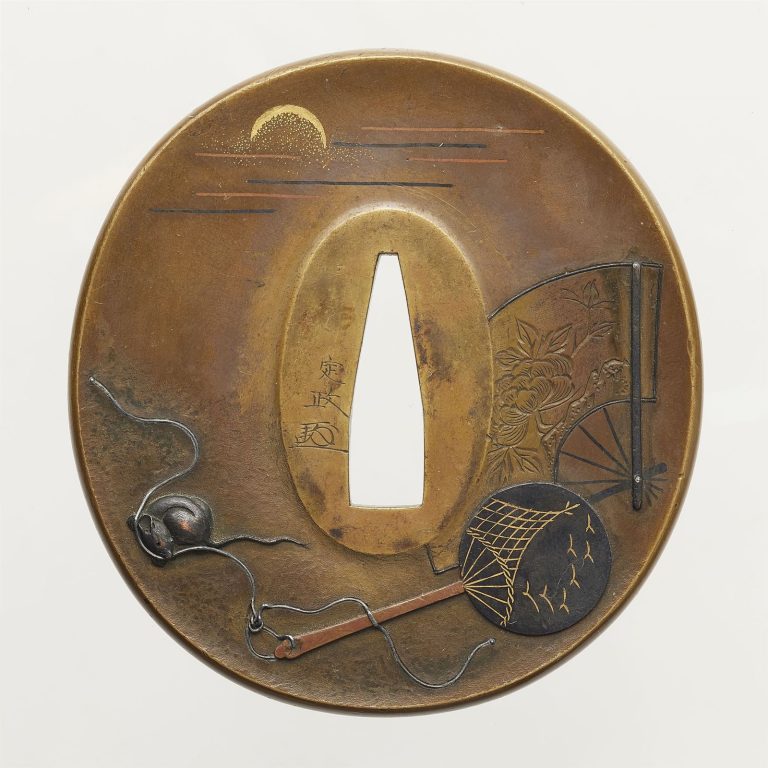
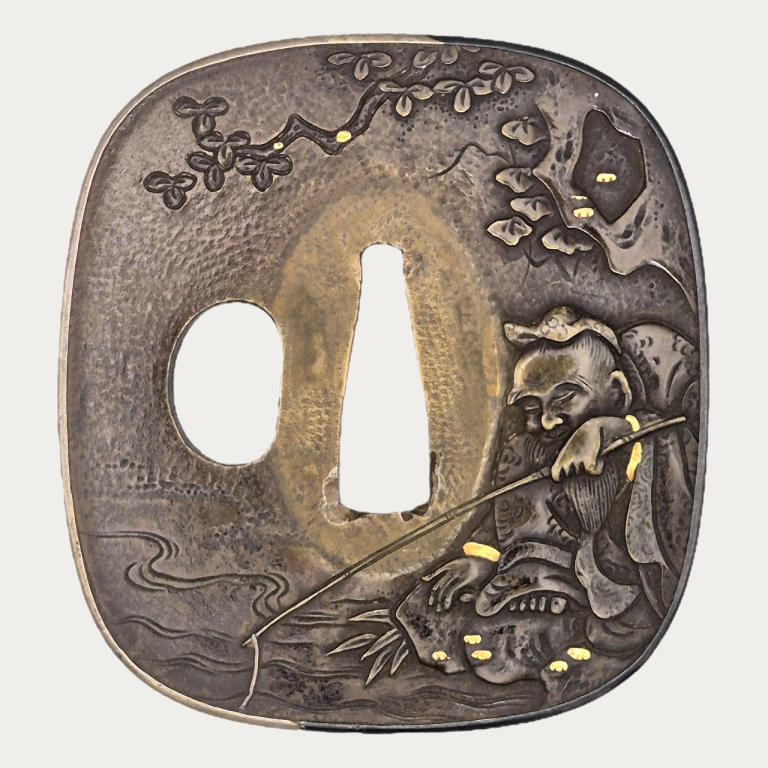
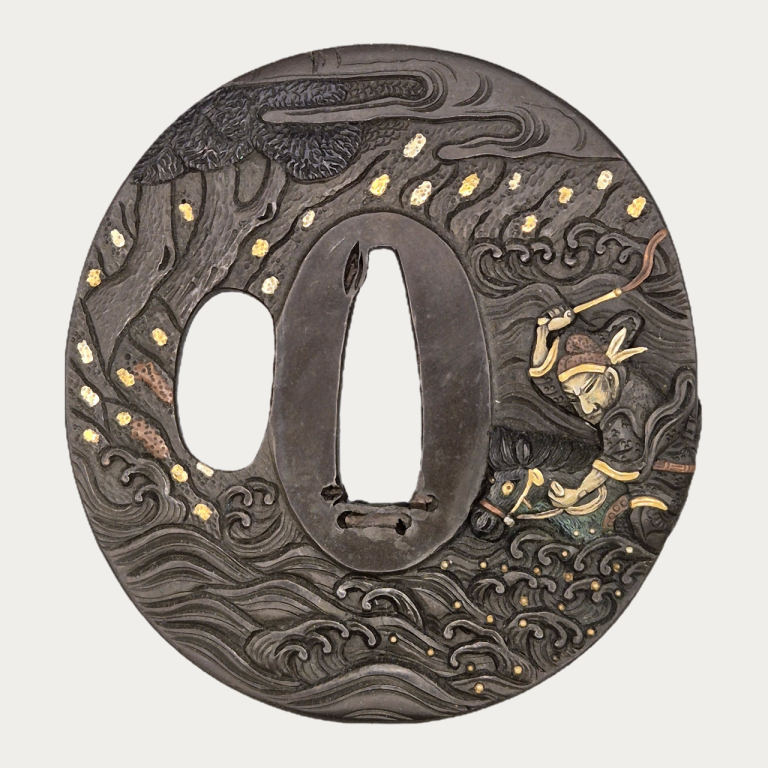
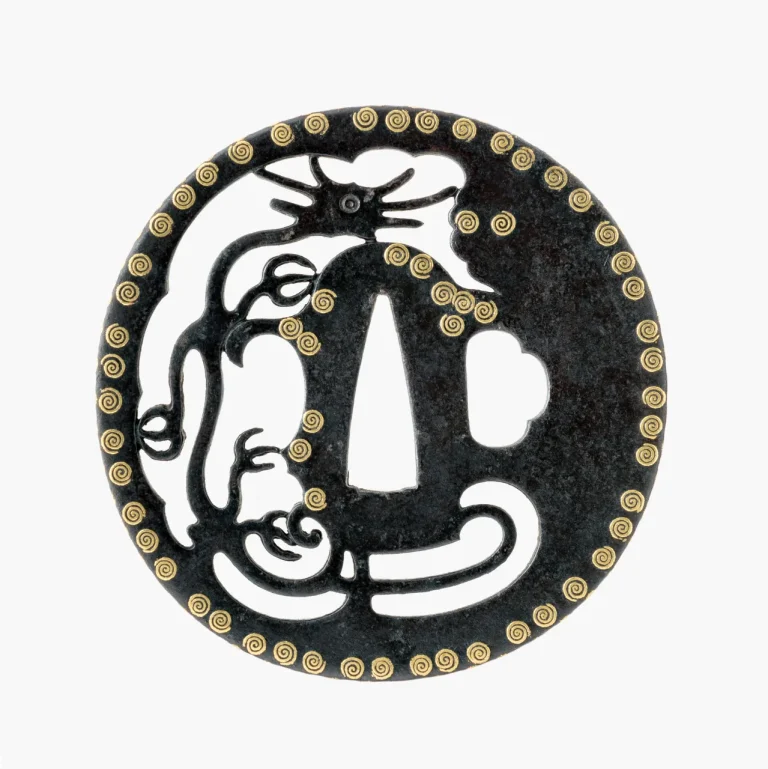
Tosogu were already appreciated as works of art in Edo-period Japan. Collectors, craftsmen, and connoisseurs engaged with them through a shared cultural framework. Within that context, meaning was largely immediate. A dragon, a pine, a seasonal motif required no explanation. It belonged to a visual language widely understood by those who encountered it.
The First Collectors in Europe
Lets dive deeper. These Essays trace the genesis of European interest in Japanese swords and their fittings, examining the pivotal ‘ignition points’ of the 19th-century World Expositions. From the grand halls of Vienna in 1873 and in Paris, 1878 to the first major acquisitions by Western connoisseurs. This section explores the initial encounter between Japanese craftsmanship and European aesthetic sensibilities. It documents the transition of tosogu from exotic curiosities to highly prized objects of art within the first great European collections.
-
Henri Vever: The French Jeweler
Forty-nine letters from Vever to Hayashi Tadamasa and his brother Hagiwara, written between 1893 and 1906, reveal the nature of their relationship: Vever, who held an account with Hayashi, asked to be the first to see his discoveries. This was not merely a commercial arrangement. It was an epistemic one — access to the best objects, before the market had seen them, was what separated the serious collection from the merely good one. Then came the war. Around 1916, Matsukata Kojirō acquired from Vever some 8,000 Japanese woodblock prints, sight-unseen, based entirely on the collection’s reputation. The objects went home. The collector remained in Paris.
-
Pietro Krohn: The Danish Designer
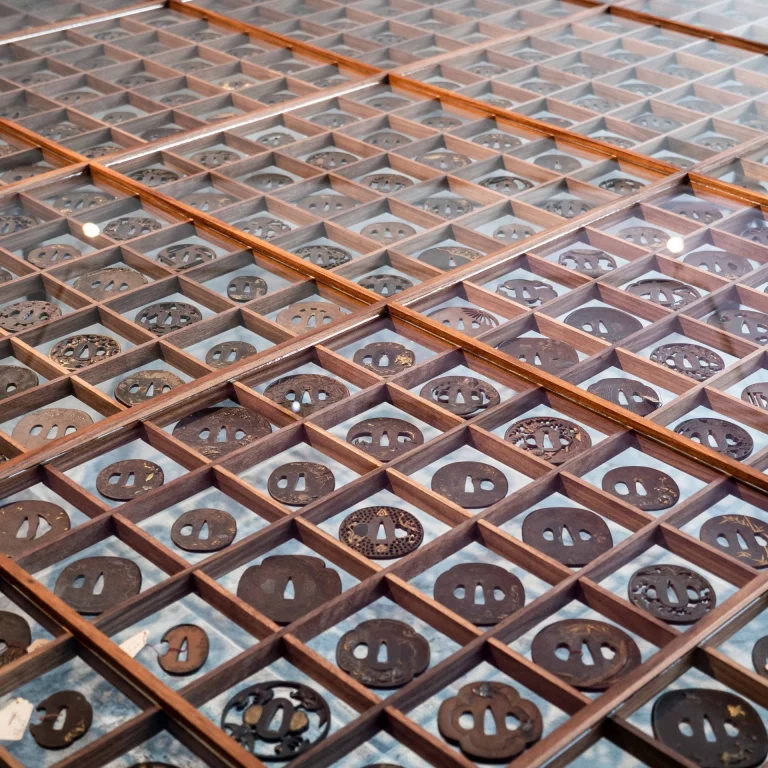
The museum’s first director collected tsuba until his death in 1905. In time, this collection ended up in storage. The sentence is almost comically understated. A museum director collects objects that belong to his field of expertise, connecting directly to the Japanese influence that had shaped the institution from its founding. And they end up in a drawer. Then, in 2022, when the museum reopened after renovation, a highlight was a room dedicated to tsuba. Krohn’s collection was brought out of storage at last, shown alongside Halberstadt’s for the first time.
-
Georg Oeder: The German Painter
The catalogue came in 1916. It documented nearly 1,798 objects, with information on material, period, motif, and maker. The original is now one of the hardest to find in the field — a rarity that reflects not only its age, but the destruction that followed. The collection itself was auctioned in Vienna on 17 October 1943, in the middle of a war that was consuming the city around it. Whether scattered, destroyed, or simply lost, the physical objects have never been coherently traced. What Oeder’s story offers the contemporary European collector is not just historical interest, but a mirror.
-
Felix Tikotin and the Collection that was saved twice
He arranged for his collection to travel to an exhibition in Copenhagen. On the night he crossed into Denmark, the Reichstag burned. A Danish friend intervened, rerouting the collection to Holland rather than back to Germany. The few remaining pieces in Berlin were smuggled out afterward, declared as samples of no commercial value. In Holland, the collection survived the occupation hidden by neighbours. Then it was stolen. Five years after the war, Dutch police pursuing art smugglers called Tikotin in as an expert. To his amazement, he recognised the pieces as his own. A collection that had survived so much, he concluded, deserved to survive further — and to be seen.
-
Justus Brinckmann: The Question of Classification
Brinckmann saw a Darwinian-evolutionary tendency at work, a progression from simple to complex forms. Hara found this nonsensical and argued for a classification according to schools and lines of tradition. The disagreement is more than a methodological footnote. It is a condensed version of the central problem of the European encounter with Tosogu. Brinckmann was applying a framework that made sense of Gothic cathedrals and centuries of Western decorative arts. Hara knew it was wrong — not because the objects were simpler or more complex at different periods, but because the logic of their development was entirely different. Hara prevailed. But the episode reveals something that remains unresolved for the European collector today: the frameworks we bring to these objects are never neutral.
-
Walter Fahrenhorst: The Collection that came Home
What Fahrenhorst saw in Japan was what the Meiji Restoration was in the process of discarding. He returned to Germany, but Japan did not leave him. In 1934, he did something no other European collector of Tosogu appears to have done: he built a dedicated building for his collection. He died four years later, surrounded by his artworks. And then, in 1968, some of what had survived came back to Japan. Dr. Sato Kanzan examined the pieces one by one. He recognised what was there.
-
Gustav Jacoby: The Collector as Scholar
Jacoby did something different: he treated the collection as an occasion for scholarship, and the scholarship as inseparable from the collecting. In 1905 he translated and adapted the Higo Kinkoroku — a Japanese-language reference on the sword mountings of Higo province — producing a German text with illustrations and an appendix of signatures. To do this in 1905, when almost no European collector had the tools to approach it, was a contribution of genuine scholarly value. The image of his notebooks, in their grey cloth case by the Berlin binder Angermann — a collector working through a Japanese text, page by page — is a precise emblem of what distinguished Jacoby from the majority of his contemporaries.
-
Hugo Halberstadt: The Collection he could not keep
Every time he purchased a tsuba, he recorded it in his own hand — occasionally with Japanese characters he had taught himself to reproduce, occasionally with a small sketch. The museum has kept these notebooks with the collection. They are, in their way, as interesting as the objects they describe: evidence of a man working without a teacher, building his own vocabulary for things that had arrived in Europe without their interpretive framework intact. In 1943, he deposited all 1,719 pieces with the museum and made his way to Sweden. He collected what he could not keep, and kept it by giving it away.
-
Edward Gilbertson: The Collection that set the Standard
His first name is almost certainly Edmund. Beyond that, E. Gilbertson remains one of the more elusive figures in the early history of European Tosogu collecting — known almost entirely through the weight of what he assembled, and through a single quantitative detail: that his private collection contained over 500 different artist signatures. Five hundred signatures. In a field where attribution was still largely guesswork, this figure was not merely impressive. It was a statement about depth and seriousness that most of his contemporaries could not have matched.
-
W. L. Behrens: The Taste for the Archaic
Behrens’s aim, Joly records, became “thwarted some years ago by a proclivity to reject the elaborate work of the XVIIIth Century, and to interest himself only in the archaic, the so-called primitive tsuba.” This is, dressed in Joly’s diplomatically compressed prose, an account of a collector who changed direction mid-career — and whose change of direction was both an aesthetic statement and an implicit critique. Being wrong in an interesting direction is often more productive than being conventionally right. Behrens asked a question the field was not yet ready to fully answer: what does it mean to prefer the simple?
-
Sir Arthur Herbert Church: The Chemist’s Eye
In the matter of the subjects depicted, Church’s predilection was for the botanical or the purely conventional and geometric, as against the animal or human figure. Botanical and geometric: the preference of a man who looked at structure, at pattern, at the underlying logic of a design rather than its narrative content. A chemist who spent years studying the molecular composition of plant pigments would naturally be drawn to tsuba that rewarded sustained formal attention. He understood, as a chemist, that iron is not simply iron — that the quality of the metal, its treatment, its patina, the way it responds to light, are all data that bear on attribution and period.
-
Henri L. Joly: The Man behind the Catalogues
Between the private catalogues came the work for which Joly is most broadly known: Legend in Japanese Art, published in 1908. A detailed iconography — one of the first ever compiled on Japan, and still considered the best reference work — devoted to the iconographic vocabulary of Japanese decorative art, from netsuke to tsuba to illustrated books. He did not simply translate or summarise Japanese sources. He synthesised them, cross-referenced them, tested them against the objects he had spent years examining, and produced a tool that collectors could actually use while looking at a guard in their hands. He died in 1920, at 44. No comparable figure emerged to replace him.
-
Alfred Baur: The Collection that became a Museum
They went to Japan armed with an introduction from Blow to Tomita Kumasaku, a dealer in Kyoto. Before Baur returned to Europe he had purchased some 700 objects from Tomita at a cost of £12,350, over 400 of which were sword fittings. Tomita wrote afterward that in the Japanese art dealers’ circle, the consensus was that Baur had made a selection of exceptional quality. By 1927, Tomita was describing the collection not as a “collection” but as a “selection” — a distinction that says something about what he saw Baur doing. A collection is what accumulates; a selection is what remains after the accumulation has been tested and kept only at its best. Baur spent forty years making that distinction real.
-
Siegfried Bing: Before the Collectors Arrived
He was not the first European to notice Japanese art. He was the first to make noticing it a systematic operation. What Bing found when he arrived in Japan in 1880 was precisely what Moslé, arriving four years later, would also find: the Meiji dispersal at full flood. The sword prohibition of 1876 had been in effect for four years. The samurai class was being dissolved into a new social order that had no institutional use for the objects that had defined it. Into this situation walked a Hamburg-born merchant with commercial instincts, an eye trained on the ceramics trade, a brother already embedded in the Yokohama market, and a consul brother-in-law with access to the Tokyo collecting world that most foreigners could not reach. He bought everything he considered worth carrying.
-
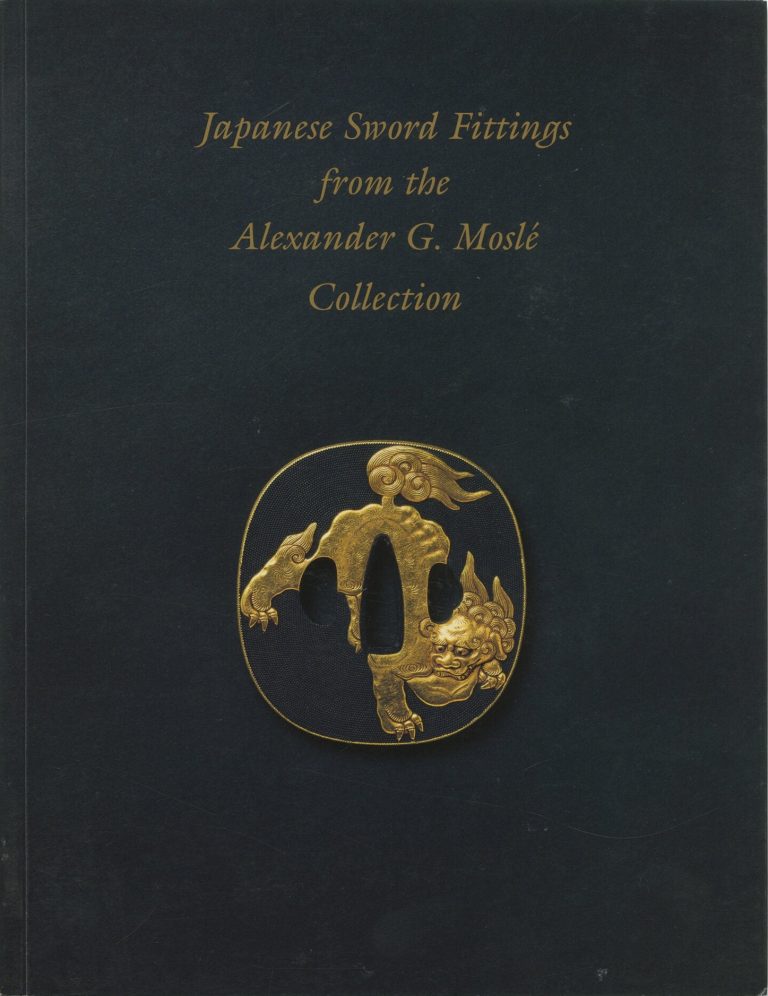
Alexander G. Moslé: The Collection he could not Give Away
He was in America when Europe closed. He could not go back. The period that followed was one of decline: a man in his late seventies and then his eighties, far from home, with a collection he could not move and affairs he could no longer manage. He died in Washington D.C. in 1949, following a period of decline during which he was not in control of his affairs. The collection had already been consigned to Parke-Bernet by a trustee. The two-day sale dispersed what remained while he was still alive, incapacitated, somewhere in Washington. He did not direct it. He did not see it. That is not the story of a collector who failed. It is the story of a collector who succeeded entirely; and whom history simply outlasted.
-
Michael Tomkinson: The Catalogue before the Catalogues
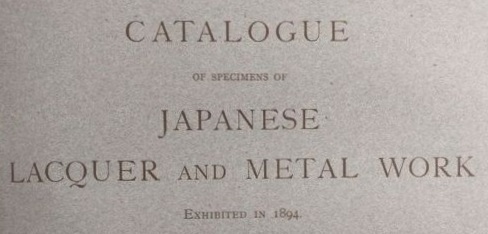
There is a detail that separates Tomkinson from most of his British contemporaries. Behrens had a large collection. Church had a systematic one. Gilbertson had an extraordinary breadth of signatures. But Tomkinson built a building. In Kidderminster, in the grounds of a house that his carpet business had made possible, he created what is now described simply as “a Japanese museum.” The gesture is significant: not the gesture of a man who collects for private pleasure, but of one who has concluded that what he has assembled requires its own architecture. The 1898 catalogue was the natural extension of this conviction — not one intelligence systematically imposed, in the manner of Joly, but a symposium in book form: seven different specialists, each authoritative in their domain, brought together by a man in Worcestershire who had decided his collection deserved serious documentation and had the resources to make it happen.

How to start your own Collection
A beginner’s guide to exploring the world of Tosogu and Nihonto at first hand. Drawing on my personal experience and the network I have built over time, this platform is intended as a point of orientation. Offering guidance where it is useful, and context where it is needed. I hope you find something here that informs, and perhaps also inspires further exploration.