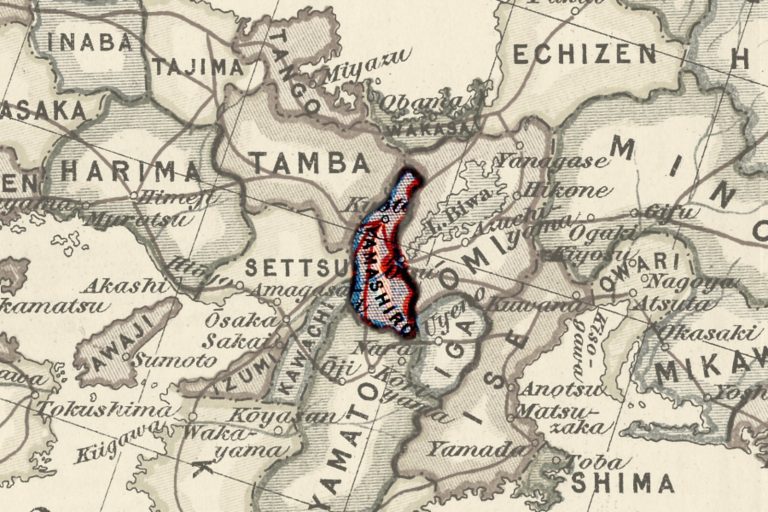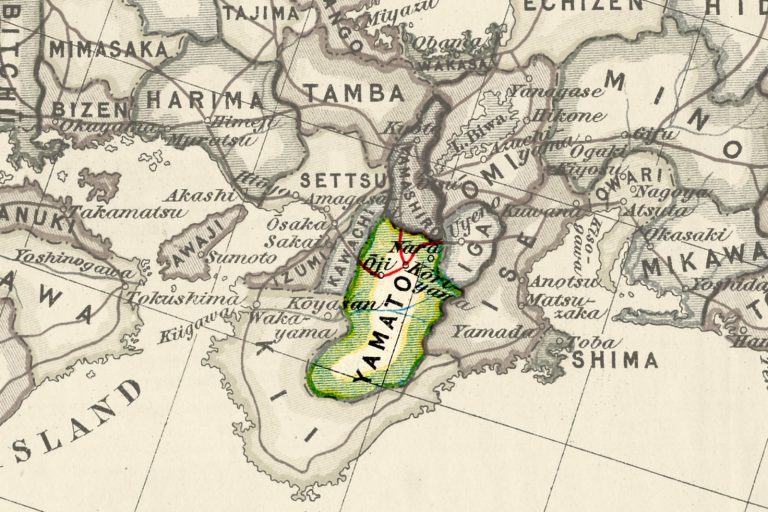
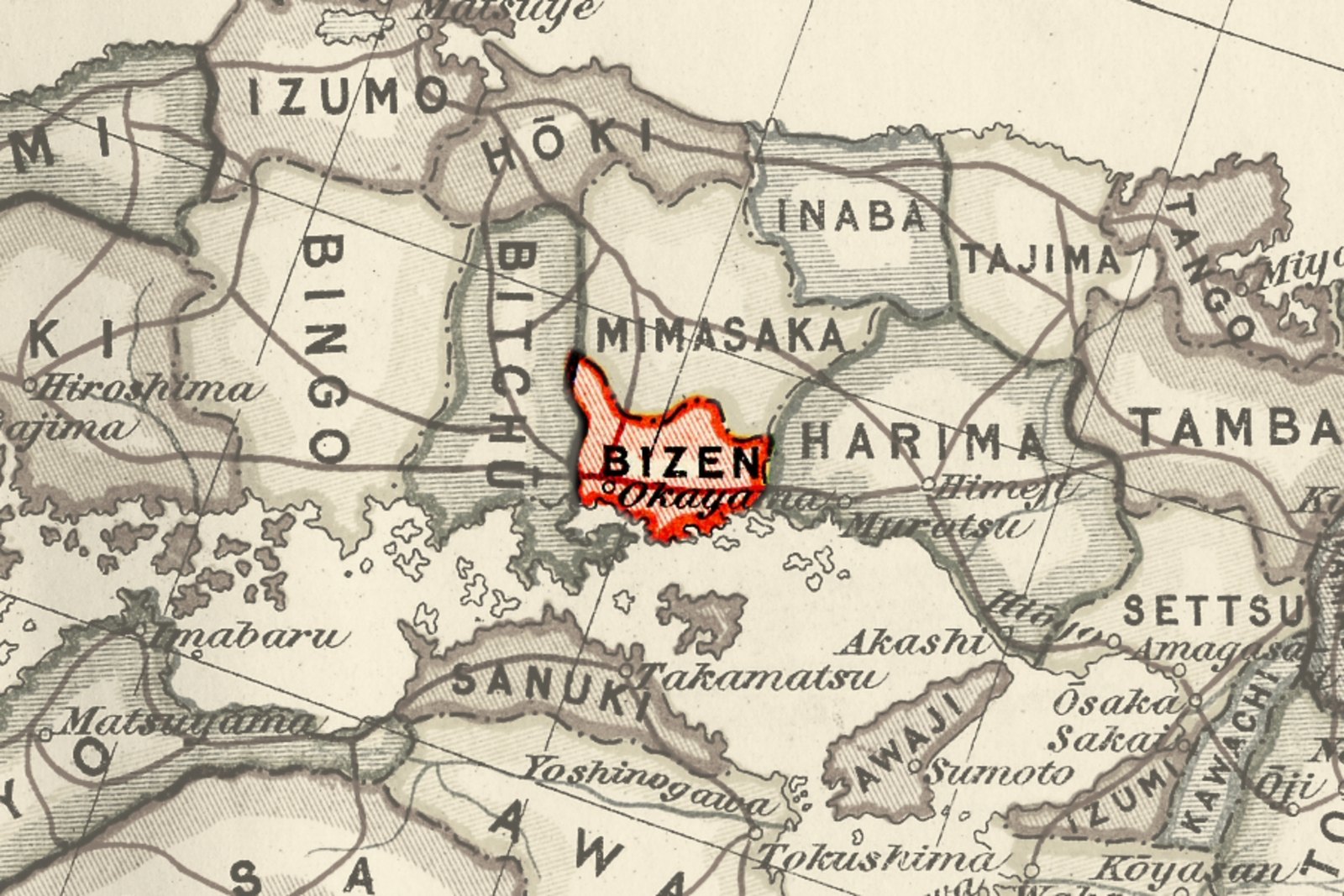
Ask where the old Japanese swords were made, and one valley is named more often than any other place. Along the Yoshii river in Bizen province, in today’s Okayama, smiths worked from the Heian period to the end of the sixteenth century, at Osafune and in the villages around it. They had iron sand, charcoal, water, and the roads and harbours of the Inland Sea. No other province has as many recorded smiths.
A tradition with a market
Bizen-den is the tradition of the market. Yamato smiths worked for temples and often left their blades unsigned. Bizen smiths sold to anyone who could pay, and they signed, often with the province and the village: Bishu Osafune, of Osafune in Bizen. Tanobe Michihiro, writing on Yamato, uses Bizen as the contrast: Bizen work is flamboyant where Yamato is plain, and Bizen blades were made in number and traded.
Generations of a valley
The names come in layers.
The earliest, Ko-Bizen, belong to the Heian period. Their blades are slender, with the curve set low near the hilt, and their temper is a line of small cloves on a straight base, still built from crystals, nie.
In the Kamakura period the Ichimonji smiths of Fukuoka made the clove-shaped temper, choji, into a flowering line that covers much of the blade, in a soft mist, nioi, with a waving reflection in the steel above it. When the retired emperor Go-Toba called twelve smiths to forge in his palace, one for each month, seven of them came from the Ichimonji. At Osafune itself a line began with Mitsutada and Nagamitsu, and continued with Kagemitsu and Kanemitsu into the fourteenth century. Toward the end of the thirteenth century two new elements appear: a temper of rounded waves, gunome, and a reflection that runs straight, bo-utsuri.
In the Nanbokucho period the Soshu manner reached the valley. Blades grew long and wide, and smiths around Kanemitsu mixed the cloves of Bizen with the strong crystals and the grain of Soshu. The books call this Soden-Bizen.
The fifteenth century brought the Oei-Bizen, named after the era that began in 1394, with smiths such as Morimitsu and Yasumitsu. The sixteenth brought Sue-Bizen, late Bizen. The wars wanted blades in great number, and many were made quickly, in bundles. The same workshops also made careful blades to order, and late Bizen smiths hardened in nearly every style, including the hitatsura of Soshu. Then the valley stopped. A flood of the Yoshii river in 1591 is said to have destroyed Osafune, and the old tradition did not recover.
The reflection in the steel
The mark that every Bizen guide names is utsuri. It is a pale shadow in the steel above the temper line, as if the temper had been reflected a second time, softly, higher up. In the Kamakura blades it waves with the temper below it. From the late thirteenth century it can also run as a straight band.
Utsuri lives near the surface. Every polish takes a little steel away, and over centuries the reflection can fade or vanish. A tanto in this collection is signed Bishu Osafune Morimitsu and dated in the eighteenth year of Oei, 1411. Its polish is tired, and grain and point are hard to read. What remains of the reflection is a question as much as a feature. A Bizen blade teaches this too: the tradition is visible only as far as the steel has survived.
Bizen outside Bizen
The Bizen look travelled. Part 1 of this series met Ryumon Nobuyoshi, a Yamato smith of the late thirteenth century whose cloves and reflection belong to Bizen, and one of whose blades was for a time given to a Bizen smith of the same name. Tanobe finds a Bizen-style reflection in blades of the Fujishima school of Kaga as well. Blades in the Bizen manner were still made in the Edo period, in Osaka and elsewhere, long after the flood.
In the collection
The Morimitsu tanto is the collection’s dated Bizen blade. A second tanto carries the signature Kagemitsu. It has no paper, and the signature is not confirmed. It stands here as a question. A katana of the koto period under the name Kiyomitsu is at present with the polisher.
No fitting in this collection can be tied to Bizen, and this part has no bridge to offer.
What to look for
- In early tachi, a curve set low near the hilt.
- A clove-shaped temper, choji, in soft, misty crystals, nioi, rather than strong nie.
- A pale reflection in the steel above the temper line, utsuri, waving or straight.
- Long signatures with the province and the village, Bishu Osafune.
- In late blades, a temper of waves that open at the base, and often signs of quick work.
Sources
- Tanobe Michihiro, The Japanese Sword: … The Yamato Tradition: character of Yamato against Bizen, p. 15; Ryumon Nobuyoshi, pp. 22–24; Fujishima, pp. 123–125.
- NBTHK, Tōken Bijutsu, English edition, no. 755 (December 2019), on the Ichimonji among Go-Toba’s smiths; Markus Sesko, “About the goban-kaji” (2013).
- Nagayama Kōkan, The Connoisseur’s Book of Japanese Swords (1997).
- Wikipedia (en), “Japanese sword” (recorded smiths by tradition).
- Collection page: Morimitsu tanto.
The Five Traditions: all parts
Overview of the series, with the blades of the collection: The Gokaden