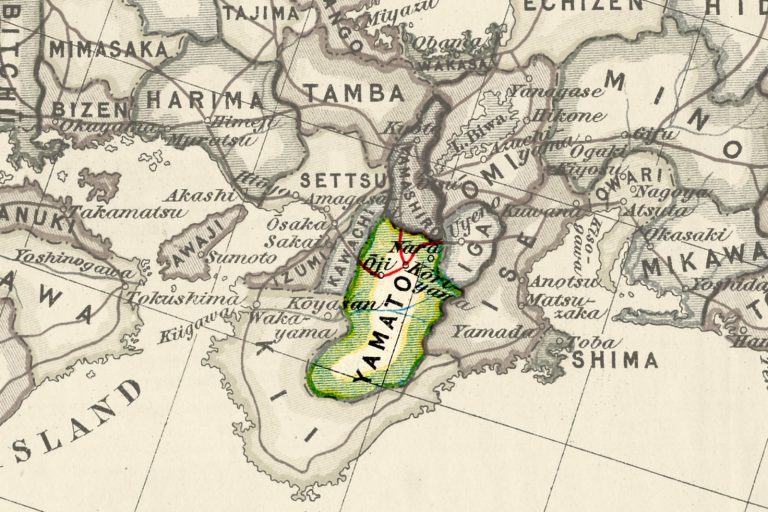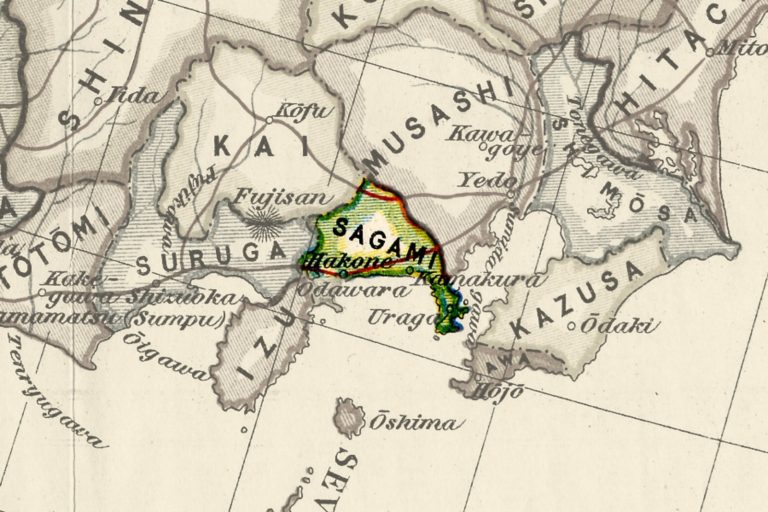
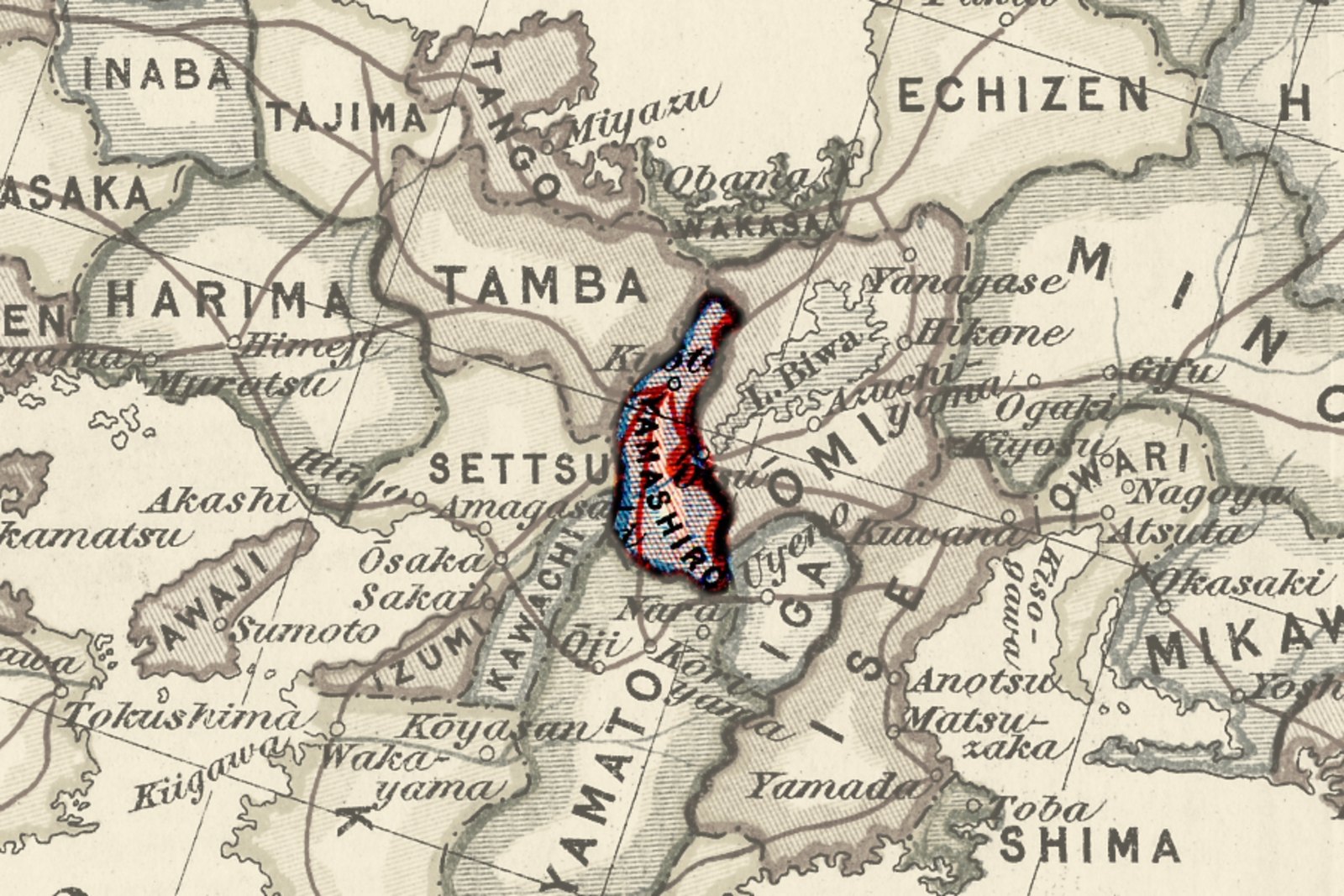
For more than a thousand years Kyoto was the seat of the court. Between 794 and 1869 the court left the city only once, for a few months in 1180, when Taira no Kiyomori moved it to Fukuhara. Tanobe Michihiro begins his volume on the Yamashiro tradition, Yamashiro-den, with this fact, and draws the rest from it. A city of courtiers, poets and temples wanted swords that looked like it: finely forged steel and a quiet, straight temper.
Kyo-mono
Blades from the capital are called Kyo-mono, things from Kyoto. The earliest name among them is Sanjo Munechika, said to have worked around 987. He and the smiths around him lived along Sanjo, the third avenue. Others lived along Gojo, the fifth. Their blades are grouped as old Kyo-mono, Ko-Kyo-mono, and set apart from what came after.
After them the capital had a sequence of schools, each with its time. The Awataguchi led from the early to the middle Kamakura period, the Rai from then until the Nanbokucho period, and at the end came the Hasebe and the Nobukuni. The order matters, because the reader meets these names on papers and in catalogues, and each stands for a generation as much as for a style.
The Awataguchi and the emperor’s forge
Awataguchi lay on the road from Kyoto east to Omi. A collection of tales from the early Kamakura period already mentions the many smiths there. The school’s reputed founder left no blade, but his six sons did, and they became known as the six Awataguchi brothers.
The emperor Go-Toba, who abdicated in 1198 and ruled from retirement, called smiths from across the country to forge in his palace, one for each month, and is said to have hardened blades himself. Tanobe names three of the brothers among them: Kunitomo, Hisakuni and Kuniyasu. The name Awataguchi became a word for a fine sword.
Their steel is the mark. It is forged so finely that the grain is hard to see, a surface the Japanese compare to the skin of a pear, nashiji. A treatise of 1606 adds that it is slightly bluer than Rai steel, clear and moist.
The Rai and a question of origin
The Rai school takes its name from a character that means to come. Early sword books say that its founder, Kuniyoshi, came to Japan from Korea. The idea was dropped in the Edo period and taken up again in the late eighteenth century. Watanabe Taeko, who prepared a major exhibition on the Rai in 1999, concluded that there is hardly anything to support the story, and nothing that rules it out. No blade by the founder is known. A tachi signed with his name came to light in the late 1980s and was found to carry a false signature.
What the Rai left is plain enough: a long line of blades from the later thirteenth century into the fourteenth, beginning with Kuniyuki, with a refined straight temper and an even grain, and a reflection of fine crystals in the steel above the temper line, nie-utsuri.
A Kyoto school in Kyushu
The Enju school worked in the Kikuchi district of Higo, in central Kyushu. After Tanobe, its founder Kunimura was the son of a smith from the Senju’in of Yamato who studied with Rai Kuniyuki and married his daughter. Kunimura was Kuniyuki’s grandson. All Enju smiths share the character Kuni, as the Rai did, and their blades follow Rai in shape, steel, temper and point. Tanobe therefore counts the Enju with the Yamashiro tradition, though they never worked in Yamashiro province. He thinks the school was founded in Kyoto and moved south as a group, invited by the Kikuchi, a local clan that fought for the Southern Court. Two Enju smiths, Kunitoki and Kunitsuna, dated their blades by the era names of that court.
The school that Tanobe counts with Kyoto thus has a Yamato smith at its root and a Kyushu address. The last part of this series comes back to that.
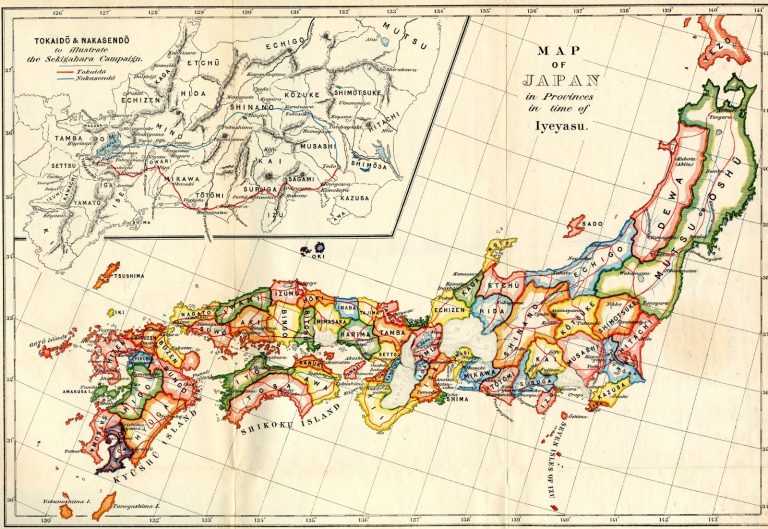
An unsigned wakizashi in this collection is given by its paper to the Enju school. Its temper is straight, in small crystals, and above it a pale, whitish reflection, shirake-utsuri, stands in the dark steel. Seen with Tanobe’s map, it is a Kyoto blade made at the other end of the country.
The capital in a louder key
The capital did not always stay quiet. In the Nanbokucho period the Hasebe school hardened its blades in hitatsura, islands of hard steel spread across the whole surface, at the same time as the Soshu smiths Hiromitsu and Akihiro. The Nobukuni smiths, by tradition pupils of the Soshu master Sadamune, brought the Soshu manner into Kyoto in their own way. Part 4 of this series sets the Hasebe and the Soshu hitatsura side by side, with a wakizashi in this collection signed Tsunahiro.
Fittings from the capital
Kyoto made fittings as it made blades, for the court and for the families around it. The paper on a pair of solid gold menuki in this collection gives them to the Kyo-kinko, the metalworkers of the capital. The name fixes a place and not a person, as Kyo-mono does for blades. A kozuka by Goto Injo, born in 1621 into the Goto family, shows a lady at the koto between gold lattice screens. It is the capital’s taste in another metal: a room crowded with pattern, and beside it an open field of dark ground.
What to look for
- A slender blade with a deep curve and a small point, especially before 1300.
- Very fine grain, often hard to see, the steel clear and moist.
- A narrower ridge surface than in Yamato.
- A straight temper line with activity that rises across it rather than running along it.
- In Rai work, a reflection in the steel above the temper line.
Sources
- Tanobe Michihiro, The Japanese Sword: A Journey Through the Five Traditions of Japanese Sword Making. The Yamashiro Tradition: overview, p. 16; Awataguchi, p. 36; Rai, p. 103; Enju, p. 202; Hasebe, p. 222; Nobukuni, p. 237. Preface by Watanabe Taeko.
- Watanabe Taeko (ed.), exhibition catalogue on the Rai school, Sano Art Museum, 1999, cited after Tanobe.
- Markus Sesko, “About the goban-kaji” (2013), for the differing lists.
- Collection pages: Enju wakizashi; Tsunahiro wakizashi; Kyo-kinko menuki with two shishi; Goto Injo kozuka.
The Five Traditions: all parts
Overview of the series, with the blades of the collection: The Gokaden